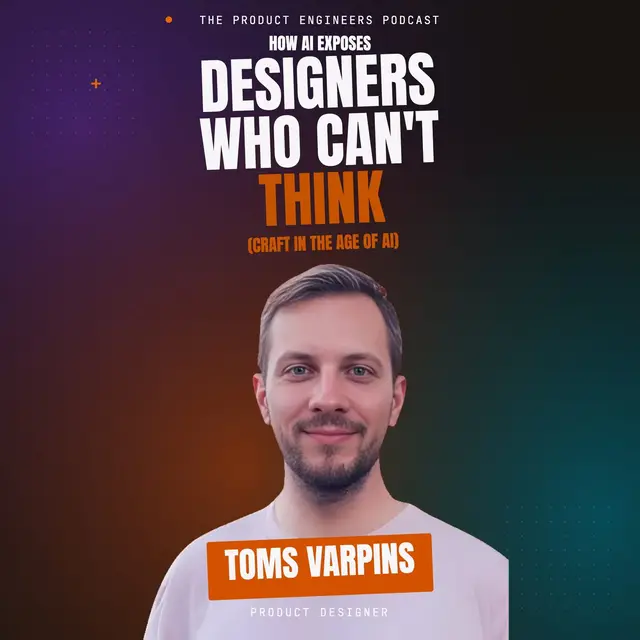
What happens when AI tools promise to turn anyone into a designer—but deliver "generative mediocrity"? Toms Varpins, a product designer with 12 years of experience spanning fintech, healthcare, and e-commerce, doesn't mince words about the current state of AI in design. While tools like V0, Lovable, and Figma can spit out a landing page in seconds, Toms argues the real work hasn't changed: you still need vision, iteration, and an understanding of first principles to build something people actually trust and want to use.
What you'll learn
- 1Generative mediocrity is the default
- 2You still need vision and understanding
- 3Roles are blurring, but knowledge isn't expanding
- 4Cost and economics matter more than we think
- 5The uncomfortable question: what's left for us?
Chapters
Resources
- ChatGPT (for thought organization and content generation)
- V0 (AI coding assistant from Vercel)
- Lovable (AI prototyping tool for websites and apps)
- Figma Make
- Supabase (backend database integration)
- Visual Studio with Copilot
- Notebook LM
- DeepSeek and Qwen (Chinese AI models)
- Product Engineers job board (demo: https://productengineers.com)
- Dead internet theory
- Innovation curve and trough of disillusionment
Transcript
8,759 words
live. Welcome Toms.
Thank you. Thank you. Glad to be here.
Nice. Nice. So, this is one of the meetups of the Pro Engineers community. So, we have people live watching and uh I'm going to just check if on YouTube everything is fine because sometimes reverse side does some glitches. Yes, it's all good. It's all good. Nice. Nice. So, the chat is open. If anyone is listening, feel free to leave any message at any point during the our conversation. And uh at the end, we're going to have also a Q Q&A session. So yeah, feel free to ask questions and have fun. That's the most important thing.
Yeah,
sounds good.
Cool. Cool. So let's get to Tomms. Toms is a former colleague of mine. We worked together at Kingston. He was a designer there. And uh so he he's a product designer. Uh he has 12 years of experience and uh he worked from fintech systems to AI powered um health tools and even e-commerce growth and uh he has different interests. He likes to running workshops uh learning everything about uh from design, engineering, economics, philosophy, music. So yeah a lot of interests. And today we're going to talk about uh a bit of like the state of the design industry in the age of AI and how AI is impacting uh designing products.
Uh so we have a lot to talk about and also at a certain point we're going to even have a quick demo on uh I think lovable ball or v zero even both just to see just to have a critique from Toms on what what's the outcome of these tools where where they kind of suck at design let's say if they do I don't know so we're gonna see we're gonna see.
Cool. Yeah. Welcome to Toms.
Thank you. Thank you. Glad to be here. uh the AI is affecting everyone's life nowadays but and uh we have to make sure we embrace it in a friendly way and uh take it with us on our right to building something that people actually enjoy using.
Yeah. Yeah.
There's no way back, right?
There's no way back. Yeah. it and it becomes useful over it will become more useful over time once we uh get through the current throat of um of you know the the the peak after the hype is the throat of the the innovation curve to go. So we're we're currently like at the peak and let's see which direction we we keep going but it feels like we are stagnating on use cases at the moment. So we need a lot of refinement into existing use cases that are being um presented. So there's a lot of work to do here and a lot of what to explore which is very interesting. Yeah. And we haven't met AGI yet. Right. So
uh Mr. AGI has not yet arrived. Uh we have issued a ticket to Mr. AGI and uh we are waiting for it to be accepted basically.
That is nice. So yeah, let's start talking about uh you know what's how the design industry is doing right now with all these new AI tools. So at least for from like the engineering word we have um cursor for example what all these editors are very smart and they help you with producing code um and so what's equivalent in the design world uh what are the tools that are really relevant at the moment and what's the impact they're having
yeah the the design process is very sort of filled with opportunityities is where AI can actually do a lot of assistance and it depends on what is relevant to you in your design process. For me personally, uh it is very useful to use JGPD to start out anything because like
if you're starting a project from zero, there's always some kind of information around available to use and you can put that together with your brain dump into JGPT and it will make some kind of sense of your thoughts will give you some uh more accurate wording in how to express yourself. But that then has to be taken and applied through again thinking you can't just take copy paste answers and move forward through it because again every product is unique every use case is kind of uh different and the way people work is also different. So first main kind of benefit is that you're able to put your thoughts into some coherent story.
Uh next you can also you can use it to kind of help with content creation for example uh when you're building UIs like you're building screens a lot of time you need to put like dummy Laura Mipsum text in there though nobody really does that anymore uh used to people just write their own wording and then when the marketing people see your wording they come they come crashing at your door asking where did you get this from? So now if you put in AI generated content in your UIs, there's only refinements happening at the edges of the text cuz if you've got essence that helps um and summarizing a bunch of information like when you work we live we work in complex environments.
There are geo tickets or whatever linear that you use. There are confluence pages. There's so much information around the work that we do that as a human just spending time reading it is not really an effective way because again the documents have been created by humans and you know people like using extra words similar to LGBT in which image it's been made like in human image. So it's helpful to take this information and summarize it to you in key aspects and then it is very nice to try and test your knowledge as well to ask it questions about information and to kind of give it the space to reason through that information and make it make sense to you.
Uh what I keep doing a lot is when you ask anything it's very good to ask for the contrarian opinions. the ones that are like outside of the boundaries because a most of part most of the time they are not really contrarian opinions. They're just opinions that are true in some cases but not in all cases and it allows you to kind of check how far your uh basic understanding is from the edges. So that's that's very useful. Uh that's only for information management. There's there's so many other uh sort of steps in the design process. Uh I have tried using um v 0ero and there's also like a
another there are so many tools right right now and you can't really follow through but I've tried from zero I downloaded like a visual studio added like the uh check with the copilot that it's installed there and try to generate some websites which is very interesting uh and there it's mostly about um getting the first draft out just to kind of get some you can put put in all the requirements and it gives you like a good starting point to generate something that you can then use as a kind of a basis to actually refine and or rebuild but just to give you to get over the the writer's block the first empty blank page.
I forget how it's called that principle when you even like if you're a product manager and you're writing a PRD or something you write the title and you're like okay where do I start and and and um and the AIS can really help with that. And the working with prototypes is also very useful because instead of you stitching together a bunch of screens uh currently uh sometimes when it works properly, you can use like Figma make or some other lovable or other of these tools to kind of give you some sense of a draft journey to to jump off of which is useful.
And of course you know we have the other there basically in every part of the journey where you require some generation aspects like for workshops or summarization uh aspects for condend condensing a bunch of information into more of a clear output. That's where it's very very useful. But there's a lot of caveats to the usefulness part and a lot of limitations and in different contexts. We can get on to them later.
I I I remember that um one big thing in design is uh are like um low fidelity prototypes. So just you know do them on paper, black and white with sketches. And if I'm not wrong, they used to be like they are like that because you could kind of want to isolate the the the the flow the let's say the um yeah the flow the journey of the of the user from the visual impact. So it's not a distraction, right? So now with with the these tools like Lova Bowl and VZ or whatever, this kind of is not like that anymore, right? because you kind of have all these visual elements can that could be distracting. So, do you think this is like a a problem or are there ways to overcome this to get around this?
Well, paper prototypes are a tool and the main aspect of them was that they allow you to explore ideas quicker. like you're sitting like the the glorified use case was that you're sitting in a cafe uh having lunch and suddenly you have this epiphany of an idea for the feature and you just sketch it out on a napkin and you go back and you start you know do more paper prototypes and maybe you can show someone to try and interact it which is a good way to start off and it helps a lot of people to kind of get their ideas into more concrete way.
But one of the reasons this was an approach was because when this came out, designers were designing in Photoshop and in other non design uh function specific tools for product design. So it was just like a lit literally easier to design a few flows with your hand than go into Photoshop and design several art frames uh with that. But in modern days, I do agree like we I haven't seen much wireframing recently and I haven't also myself done much of wireframing or even paper book types and there is this a lot of focus on design details which can be and is distracting sometimes for stakeholders.
Uh because you as a designer you spend a lot of time figuring out the problem the solution space and you do a lot of alignment with other people and then when you need to get the final approvals stakeholders who have not been involved in the process but they have to put their stamp of approval they see designs and if you come too early like I had some experiences where I come with a thought with an idea laid out but specifically made the UI horrible to look at. So that idea would be on the flow and that now distracts from the problem because now you design high fidelity more or less and it distracts the stakeholder attention.
But if you go with a very crude version, the idea is that you haven't put enough effort into it. So the ideas are not worth talking about. So for a designer it's very hard to not do um detailed designs specifically for stakeholders because you the goal is to get your point across and get the approvals got the insights for your problem and try to avoid conversations around that and the only way you can do that if everything else just disappears in the in the background.
All right. Yeah. Makes sense. Makes sense. And um what's what's your feeling? Do you feel are designer designers excited, anxious about using these new tools? What's the general feeling?
Well, it depends who you ask and what perspective you're looking at, right? So if you think about where what is the source of these tools, it's like five six companies in general that are generate that that build tools. They keep iterating in the tools. Then there are thousands of companies that take these tools and wrap them into a product of some sorts. Useful or not useful, that's a different topic. And you the engineers me like the designers product managers even the sea level are kind of recipients of this software. So it has not been the case where each business individually have decided we should use AI because we see specific opportunities here and here and here and here.
It's been the other way around.
It's like AI appeared and because we live in a very investor driven business environment where most of the companies that are making money are investor-driven and you know and so and then there's a a big push amongst investors because for them it's the new NFD it's the it's the new crypto token it's the new whatever trend you think about don't get pitchforks out I can I can verify is it's a trend in AI is a trend in specific use cases and not in other use cases but we haven't chosen this as a tool and for most of most part we are told to make this tool work for the product environment and I've heard a lot of stories where people are made to use AI instead of their reg regular processes to get through the regular process which creates delays because technology is not necessarily there in all of these ways.
Like it can be useful at each step. But depending on your use case, maybe it's not even useful in your design process. So from a design perspective, it's a very very very shiny tool. Like for me as a designer who uh doesn't really have great programming skills, I can in a few minutes generate an app and that's great. I created a do app. I was able to iterate and put like more detail into it. I was able to put new functionality on top of it and then oh I ran out of credits. So it's it's a useful tool that is very very alpha stage for real world scenarios. So for me I just like it as a conversation sparing partner basically that I have thoughts and it helps me to put them in different words.
It helps me to sum up some bunch of information or to use like notebook LM to try and learn information because a lot of information nowadays is consumed like this like this podcast or uh this meetup that we are doing. People consume content from people talking to them personally because we're technically talking personally to these people. So um yeah there's a mixed reaction. I have not really seen uh designers really celebrate. Those who celebrate I've noticed are very focused on the website creation side. So for example, if you in marketing very useful, you can get a lot of drafts out.
You can get a lot of design directions out because it's all about vibes and information architecture then is put into the vibe because it's a brand. Website is a brand and information is the core of the brand. But that kind of come afterwards the uh the brand is kind of decided. But in product design it's we work with very precise things. We like design each input field each button comes from a whole bunch of services in the background that took a lot of time to develop and you cannot just generate front ends here and there and then connect them easily to the back end.
uh in one of my previous companies we tried uh they were building a bunch of landing pages and the idea was like hey maybe we can try these AI tools and generate landing page and maybe we can use that as a final product. it was great. You could do the first draft, then you make edits and it starts to lose uh context. So, it doesn't make edits in the way that you want to make the edits. And then when you talk to developers about, oh, can we use this tool? Can we use the code that has been generated? and they're like we can but it might be easier and more uh maintainable if we just rewrite it but we can use this as a reference.
So there is excitement but I feel the excitement comes more from the investor space than from the technology aspect where it is meant to do the main disruption.
Right. Yeah. That's interesting. most of the last thing you said um like in my experience I've used it a lot like I've used or vio other tools to generate a lot of code and to be honest it wasn't that bad all the time most of all the way was architecting the old front end application we react uh I think that the main problem was in um architect architecting a good state management solution but Then thinking in retrospective I didn't tell I didn't give any guidelines on that. So I think maybe it comes again maybe better prompting can give better results but you need to understand what you're doing as well right
so I think that could be a a limitation if you're not technical in that sense
there's also the cost aspect because the LLMs are great at generating text the cost per million tokens is not that high but if you think about like generating a UI generating any image that is a lot of tokens and if you want to iterate on that the cost starts to increase and then at the current time there is this this this this uh what is it called the inflection point where
you can continue iterating with AI tool and if it keeps the context and if you give clear enough uh indications maybe you can go through and create something useful without blowing your budget. But if you're doing anything that is a little bit more advanced, there will be a moment where hiring a person will be cheaper than keeping uh paying for the AI credits. And that's currently one of the limiting factors for experimentation if you're not in a company uh because you just run out of tokens to experiment. So you have like a half finishedish project and then okay, so I did this in one day but I ran out of tokens. So I did I so I got to the project graveyard 99% faster than I did before.
Like if you're a developer and you code side projects most of them don't really become businesses right because that's no way it's not always the point. But with AI you can kind of get there a bit quicker. So you can have more exploration like more experimentation before you kind of throw things in the away. So that's kind of a big positive here.
Yeah. And this takes us to to the next topic which is the like the new responsibilities that maybe designers could have in in this in this age. Right? So maybe getting out of just doing the designer part, designing part, but also maybe stepping in other roles lanes. So I can see that as like I don't know uh probably getting a bit more technical learning to to write some front end code which is probably probably a good a good fit. Um have you seen like this this trending somehow like this the the lines blurring between uh the different roles? Oh yeah. Um there's a lot being blurred nowadays. We live in a Gossian blur world.
Um I I think there's a big misunderstanding of the design role in general especially for a product design role because um it is more closer to the PM role than to like a graphic designer role because yeah the UI which is the product that you in the end ship is like 5% UI 95% like 90% code and 5% something else and The biggest investment there is to get people to share and agree on information and that is the most of the part. And then the design iterations again unless you work like in a creative agency where you're working on branding where you're designing websites to make people feel something.
When you're building a product most of it is to align functionality because it has a a cascading effect. any change in design has a downstream effect through engineering and maybe even touches architecture and you have to test all of that make sure it works and it's compatible with uh all the things that it needs to be compatible with. So the first thing to say is that the UI is shouldn't be that big of a focus because that is just the outcome. The same way a code is not the thing that you that the engineers get paid it's the work that they do. the same way PMs don't get paid for Jer tickets, it's for the work orchestration that they do.
And uh sorry, I feel like I went in a tangent and I lost your original question.
Uh no, we were just talking about um like new hybrid roles raising like growing in the industry. So yeah.
Yeah. So I feel like um design is kind of merging with product management or product management always wants to uh move into other spaces like oh look I can I can code a little bit here or look I can design a little bit and like with the idea that there could be one man or one person for the company. So designers role well it depends on company but currently a designer's role is uh more going into experimenting with potential solutions and trying to understand the problem spaces while product manage product managers who have the same responsibilities need to do the same thing.
So everyone's kind of stepping on their toes and when you put in developers who also generate code uh and generate prototypes and then show off to engineers. So everyone is not doing the same kind of a thing if if everyone's brave enough to and the organization allows to do this kind of sharing. And it it does make me think that uh there might not there might be too many uh cooks in the in the kitchen like in the future because if anyone if code becomes a commodity anyone can create a code a code two codes three codes or anyone can create a design or a visual identity anyone can generate a PRD or anyone can organize a meeting and everything becomes a mush.
The question is will this all be squeezed in a single person who have to do all these things. So we are supercharging a single person at the expense of other people or is it that this will actually allow some kind of an expansion to test out more uh product ideas or test out more initiatives. The current trend that we have seen is that AI is used kind of an excuse to downsize company to keep the company as it is and make it more efficient instead of expanding the company outwards which is the original promise of AI. So there's a bit of a uh confusion uh on the messaging part and then the actions following this messaging. So your guess is as good and what do you think?
What do you think about this merging? Because for me it's not clear because everyone in the end is still building the same product as a team.
Yeah. Yeah. That's it's a good that's a good question. Uh I just I wrote a post about this today on LinkedIn actually. So maybe I can I can try to rephrase it. Um but you are in the pro engineers community here. So that's that's a bit biased. My mind is very biased. Uh but yeah, I I I can say that um I I would say uh AI just made it clear that um that everyone wanted to do a bit more than what that what they were doing before because uh let's say product managers uh maybe they wanted to test their ideas but they were kind of blocked by uh maybe designers and and and engineers because it was a bit slower before even to the prototype designers kind of similar.
So I think as you said there is a lot of overlap there. Um but also designers I I know that um a bit like the code monkey for us there is the uh design monkey you know so you kind of strategic
ticket writer
the ticket writer right but now this can kind of change because you can focus a bit more on the the strategic part not much on the on the like hard work part the you know the the figma thing no uh for engineers it's it's it's going to be the same if we get more let's say productive writing code uh then we have more time doing more strategic stuff so in my opinion I I see this this convergence somehow between these roles and um it's um I've always seen this like these three roles um represent the three main activities of product building So it's framing framing a problem understanding the problem which is usually what PM do uh finding good solutions for this problem which is usually what designers do and then the technical parts implementing it.
So these are the three main things and I always seen these things very very very inter interwined between them. So they are very interdependent. Um so unless you understand the problem you everything else doesn't matter. So, and unless you understand the tech, you can't really start designing because maybe you don't understand the technical the technical um limitations of what what's available nowadays, right? Or in your system. So, the way I see it in the future is maybe this is just my my theory, but having teams made of people that can do a bit of everything. So as a base we have everyone that can do can act can u act in this three levels.
So understanding designing solutions and implementing them and this this is this could be the core of a product team. Uh and it's not it's not much about rules anymore but it's about it's about who does what in a specific moment. So maybe one day you can do this one day you can do another thing.
as long as we get to an outcome and then the problem is that this is not probably scalable because you can't have one team doing all these things or one person but the problem becomes coordination between different teams right so that's where I see maybe PMs or tech leads leading different teams like as a coordination effort just to keep the vision and the the direction clear for everyone But at at a team level, as long as they stay small, I don't see why this cannot happen. So I think AI just made this clear in my opinion that we can actually do a bit more.
Before it was a bit more limiting because of time most of all like you can't do lot all these things because of time but now it could be a bit faster and as long as you understand the the the first principles um why not? It's uh it's complex. Yeah. But this is my theory. I don't know.
Well, you have to like it makes sense what you say. And it is again from the lens of uh productivity, right? And efficiency. How can we do more with less which is you know uh current mindset in the tech industry. But then you think about good product teams right now developers should be understanding the strate strategic objects. The same with designers and product managers. We should be understanding the technical aspects of limitations and everyone should be understanding who they're building for. So the knowledge kind of stays the same, right? It doesn't really enable one to think bit more strategically.
But if everyone's thinking strategically what does the sea level do if their main uh main direction is to provide direction based on all the inputs which by the way come from the bottom up uh they don't necessarily come from the top down always and then if everyone's doing doing strategic things then you don't really need that many people but then at the same time you think about companies expanding there's a finite number of people on the world and all the markets have a finite amount of value that's currently there.
Unless you start creating new value that people are willing to pay extra for you are overlapping with other companies and if the market does not expand then AI which enables people to be uh verticals themselves vertically able to build a product right one person can do everything then it is more of the fact that uh monopolies become bit harder to control because if everyone is AI enabled, who is enabling the AI? Which is a few companies right now, right? Which is all being pushed down. So I can be my own entrepreneur, be my be my own person, but I need a market to keep the life that keep me living right to give me enough money so I can continue working on.
And then there would be hundreds of people like me offering very niche solutions and things. Uh I heard um an interesting quote from I think it was a net Netscape the uh the creator of Netscape who said that all business all business value comes from coupling or decoupling. So you couple people together you can create more value. When it becomes too too big it starts to stag stagnates. they need to decouple it back into pieces and let it individually grow again. It's just like the generative approach. Uh yeah. So like my big question is really how does this affect economy in general? Because if the economy is doing well uh job creation accelerates.
If economy is not doing well, job creation is as you see right now. And what would happen if suddenly you have a seven people team let's say current team and everyone can do everyone's job that that sounds more like a conflict situation than freedom for all. And we also see now that many people are generating websites, generating products, generating small niche solutions with the help of AI and they're using that to improve their skills. But in the end, who will pay you for your product? Like are you solving a customer problem? Do your customers even have this problem? Are they willing to pay for this problem? Who are you competing with? Right? It all comes down to fundamentals.
And if the market stays the same, like whenever monopolies grow, market shrink. Whenever uh individual startups grow, the market becomes bigger because there's more money, more value created, and there's more competition happening. So the question is will this AI come as a big enablement force for the individual allowing to compete with those who own the AI code. I mean we have deepse we have the Quen from China. We have a lot of of these models that are standalone but the hardware is not there for us to use them properly. That's why that's why Apple is failing with AI because they started late, didn't have their own models and the hardware wasn't really there nor the use cases really.
So I don't know this is a lot of lot of thoughts that are not really condensed into coherent thought but I just feel like there's a lot of shakiness happening and we don't know which direction the force will go. So for us in tech, it's a great addition to have this assistant to help us go through these things and it's elevates other people's ability to be more expressive, be more thoughtful. Uh but in the in the end, yeah, I'm not sure where this is going. I'm just I just have thoughts. Well, I guess we need to um we need to use our kind of mindset, the engineering mindset, the design mindset to approach it like that.
So, exploring, experimenting and seeing if if he actually helps help helps us somehow. Um, so I think uh this is the perfect time to to show uh to to get on lovable and v zero and we can have some fun creating some some some apps and see what they come out with and then yeah curious to see what you think about it like what's the the just a design critique I don't know
I feel it would be very interesting to uh do two parallel builds. Uh one build is where we write our prompt ourselves just you know just whatever we think and then we ask JGPT to write the same prompt for us with more detail and and to compare the outcomes between just your regular thought generated because if you look at all the commercials and ads about AI it's like one line generates a SAS product for you uh which is not realistic. So, let's kind of put that to the test. So, how important prompt structure is to the outcome of the initial solution?
Let's do it.
Okay,
let's do it.
So, I'm on lovable right now. Um, yeah. So, I think we can start with a generic one and see what happens and then we can go to specific.
Yeah. Have you got any ideas? Um
um
yes uh what is sort of let's make a landing website for this uh podcast so that we can gather emails and send
uh email notifications.
Okay. So a landing page for the product engineers community to gather emails to gather emails. That's it. Try it.
Let's try something simple and I'll go to chat GPT
and I'll also try it on V zero so to see what's the difference.
Yes. Can you copy the prompt to me please? So this could be faster.
Yeah, it's in the chat.
Nice. Thank you. So uh so JGBT design a prompt for lovable that will achieve the following because you need to uh give chip some excuse. Okay, there you go. we have uh I had I wanted to touch also on like um on the generation aspect of the thingies because
um there's the one I put in the chat the longer prompt from CHPD to see if can you do a parallel build while it builds in another tab so I think so for a new browser or I think I was thinking about for design because I would love to be able to put thoughts and and kind of market research into like a chat box and then lo just spits out like a bunch of generate bunch of potential UI ideas. That would be amazing which it might do in a while. But then I realized that they have been trained on limited amount of data. They've been trained on a fixed set of data. And if we think about innovation, how innovation happens, innovation comes from um copying and improving and adding on top while I mean
it's I can read every single thing. It doesn't
I think yeah I think it it generated an image and they used that as an hero but he also that has some add headers here but then also the ates here. So yeah weirdly never happened before. Uh
but this is from your simple word prompt. This is pointing down.
Yeah.
Let's see if we got engineers technical sensor problem mindset ship faster. Yeah makes sense.
Trust. Yeah, it's uh I mean to my eyes it looks clean. Uh just way too simple, you know, very this does not give high confidence that the email will go to uh uh highly reasonable people.
So what do you think is the the the the worst thing here? The first thing that comes at your eyes? It's the gen well I'm not if we ignore the bugs for me it's the generality of how it looks like because it is built on existing designs which are not used as references again this like a big soup right you you train the AI on a bunch of information the AI takes it as a soup to learn from it and then from that morial morial soup it provides something like And it does not have um because we want it to be available to people the detail in the output is very low and it is using what is the average website on the internet.
So it just it generates uh like what was my it was a generative mediocrity what what I call it is that it takes the average of everything but if you look at any any SAS website lovable for example it is fine-tuned there's there's all kinds of small touches that technically practically are not important from a technical aspect but from the human perception aspect those little details that the craft aspect is what creates trust trustworthiness into the product. So here we have the more complicated prompt, right?
This is the vid zero version.
Oh, this is a v 0 version. This is still the same prompt to vzero. Okay.
Yeah. But v zero usually I think the target of v zero is a bit different from lovable. So lovable tries to make things a bit more beautiful let's say appealing. But v zero I think it's more for technic. Yeah. V zero is more like for I don't know. I think the targets are developers here. you it's very usually very this kind of style it's what I see every time if you don't if you don't uh suggest anything so it's very simple just right to the point um nothing fancy is more trustworthy than the lovable output and you have to think that lovable made a product out of generating websites and vzero is a coding assistant
it looks more it looks more professional
yes Yes. Yes.
Let's see the one. This is
Oh, okay. So, this is uh
this this this this gives me a good vibe already.
This is better. This feels that Oh, look at the G being cut off by some kind of a frame. But yeah, this this this feels like Okay, it's still very basic. This is like an email campaign, right?
Mhm.
You feel like, okay, I add I'll subscribe to a newsletter here. It's it feels okay. I mean, I wouldn't put my email here, but if you compare just from a technical aspect, you compare a simple prompt versus a more complicated prompt, um, there are differences. I do feel like there's more creativity in the more open-ended prompt because with the more defined prompt, we have much less
Yeah.
randomness in here. Yeah. And I think that that's where these tools could be useful like if you kind of give them freedom to just going crazy. You can get maybe different versions that you can get kind of inspiration from from your like a mood board, right? You create a mood board out of it. Yeah. And then you can you can keep iterate the thing you like. And you know for the untrained eye like if I was not in the tech industry I would be like and I would just be a regular person doing all the other jobs in the world. This is amazing. I just went from just putting a thought into a box to generating something that previously would require a lot of searching for people.
uh it would be quite expensive to even make this but at the same time this is a presentation. This is not something that you can use. Well, you can publish it.
So, Lavable will host it for you I guess and then you can but it doesn't have a database behind it.
Uh but you can you can use superbase. So you can connect it to super and it's like the same as v zero v zero allows you to do that
and yeah then you can tell v with zero ballable to configure it for you and you can create something a bit more complex let's say um yeah but as you said during the conversation uh the thing here if you don't have like I would call it like a like a vision in your mind like who are you serving And what's what's the the feeling you want to give? What's the the mission like the the goal? Then uh yeah, it can be anything doesn't make sense because if if it doesn't solve the problem, what's what's the point, right?
Yeah. Who you're solving the problem for and how does this help you get to the outcome?
So I'll show you this. I I've coded something today. I did the product engineering jobs. This is the one
I mean
based on the branding that with the with the with which one did you vote? This one
uh this is from Vzero.
This is from Vzero. But when this is like which draft is this? How many drafts did you go through before you filmed?
40 43.
43.
But it was it was different before. Uh and then since now like I branded the community. I gave Vzero all the material. So the brand the branding style guide some visuals that I created the mood board and it kind of nailed it. like I mean for me it's appealing to see but uh the vibe I wanted is there let's say
this is much like you it took you 40 uh iterations but this is much better than was the first iteration spit out by either of course the ch prompt or the first prompt
this so because this feels already a little bit like manicured this feels like massaged feels like someone has put in effort into making this this happen because there's like you you know where you are, you know what's the tagline and there's some description more and you have the two main actions to do and those jobs those actions kind of differ from each other from the header and the main action but you also see that you can scroll down. So it gave you some animation that there's more to this website than was before. Cool.
So
cool. you know this this this useful but at the same at the same time like what would it take to kind of from this does it have the CMS behind can you actually post jobs can you edit the descriptions and everything
there's uh the integration with superbase
mhm
so everything is there
everything's mapped so then
yeah so the developers
no why
it's just and this But and you didn't pay for token. This is like a monthly subscription, right? That you were able to iterate.
Uh
yeah. Yeah. So you I I paid like for a month, but this is like a work of a few hours. Like if I had to do this by myself, it would take way longer.
Yeah.
Um but I I did I don't know how the code looks like to be honest. Like in this case, I don't care much
because it there is a very low risk behind this. Like it's not like I'm handling people's data or anything. So it works fine. It just does its job. It's very simple. So I don't care about the code here. Um but it would be different if it was like a publication with people data. The security is a big one. But in this case, who cares really?
Would you be able to make changes to this code? Like if you want to make a
Yeah, as I said, it's not bad. So the code is not bad is is is understandable but also because it's quite simple. So everything is like structured properly like all the folders and it's very very clear. So it's the way I would do it. So I would say yeah the code that these tools are generating at least on the front end is quite good. Yeah. So what does that then leave for our professions then?
If anyone can create a quick job board uh in you know in a few hours where and if the future is promised that you have an AI agent and then your AI agent interacts with other AI agents what's the interface there and then at the same time what's the value of the developer or do we become just you know how in the old times s there were monks who were the ones who could read and write and they were responsible for creating all the literature and this to me currently kind of resembles the same thing about with engineers and future of AI there's these AI black boxes and then engineers are just working away at the core because that is what generates all the other output but it always again I still have question who's going to interact with the rest of the output if everything is AI agents talking.
I mean I I think you still need to understand what you're doing like because I mean this is quite simple and if I want to change something I can do it. So I I know the overall architecture. I know like like I I can I I know how this works behind the scene.
I think that's very important. Um but on the on the other side what I enjoyed more more about this was not the coding part of course I think for me that's quite boring nowadays for me is the building part. So I have this idea in my mind and I can just do it quickly and like um so I have a lot of fun just just translating my my thing my ideas into some things now. Um, so I don't I don't care how I do it. As long as the outcome is good for me, that's fine. Um, so it's just that I think a shift in the mindset.
Um yeah, but of course this did also again if the if if you're building a SUS software and security is one of important outcomes you want because otherwise your business can just fail and your reputation is gone then yeah you need to understand what you're doing. Uh these tools have even like security check feature. I don't know how it works behind the scene. I didn't try it but they are doing that as well. So using AI to check the security but can you trust it then? I don't know. Uh so yeah I don't know I don't know if I mean I don't think we are at the point yet where we can just do things blindly and just treat this as a black box.
Uh you always need some someone that understands how things work
and that's going to be become a limited amount of people seeing how things are progressing. But this this kind of brings to a different question. We've been talking about like how does this affect the individual contributors, the developers, the designers, the product managers. How does this affect the whole SAS ecosystem? If a lot of SAS is built upon other SAS, which is built upon other SAS which is built upon open source repositories that have been written by people, right? the whole internet is based on a few libraries that keep it keep it running in some sectors. So again, if it's AI agents talking to AI agents, what is the worth of these SAS tools?
Like if you create a website for whatever reason, right, you can ask the GPT to show me the statistic statistics of the website, show it in a graph, give me a CSV. What are the analytics tools then for? What are the monitoring tools then for? What are all these marketing platforms for? If the email is being auto filtered by AI like my my sure we can look at it how it affects the individual and a work but if uh software becomes a commodity how does it affect all the other software? government services will stay because governments will stay. So they need a ways to interact with them.
But many of the tools out there can be not easily replaced but with some effort replaced and what is the how does the internet economy work in that way that's that that side that's the big question for me it's not about individual it's about what is the internet for because if we think about the uh the dead internet theory is becoming more it's like it's accelerating with uh our AI being able to generate so many convincing posts. So it's and if we conglomerating in monopolies within the business side of the internet what is it for?
started as a communication tool ended up becoming a culture defining society defining tool and now what direction it's going we don't know but there will be always corners of the internet that are useful I'm just wondering
if what happens to sauce
yeah interesting questions I think we we can leave the listeners with these questions to thinking about them
for thought and yeah maybe we can do the podcast later to to talk about this in details.
Yeah. So, we we have five minutes left. Uh I think we can listen sometimes to see if anyone asks any questions. So, let's get into Q&A. Um all right. So, we have a bunch of messages here. I'll just go through the comments if there's something interesting. So, hi Louise. I have two Louises here. So, well, hello. Um, so Luis Rodriguez says that yeah, given the cost of AI, it's inevitable. They'll push the price onto you and you'll have to pay OpenAI a rent if you want to continue to have a business.
Yeah, probably.
It's true now, right? Who you paying the databosting your database?
Are you paying Amazon? Are you paying some smaller uh smaller player that rents from Amazon? You know, you will already pay for all these things.
Yeah. And and then he says, "Peppa, you can fire the designer."
Honestly, soon. Probably no. But in the next decade, well, let's see. We don't know. Like a decade ago, we we didn't actually the internet hasn't advanced that much in the last 10 years. If you think about going from web zero to web 1.0, web 2.0 and then the crypto era was like from that we haven't really innovated on the internet. It hasn't expanded that much.
Yeah.
But maybe I'm wrong. I'm I'm always wrong. So
all right. So I don't see any questions here. Um maybe there will be some on the channel uh on Discord if anyone sees this uh recorded. Um cool. So yeah, we're at the end of the show. Thank you very much for for joining. It was very interesting conversation. Um and um for who's listening, I invite you to follow us on LinkedIn. We have a link page for the community. You can go on product engineers.com community and you'll find a website with all the links uh that take you to different places. We also have a discord uh community u and yeah, I hope you see you there. Thanks again, Toms.
Thank you, Pepe. Have a good one.
Thank you. You too.