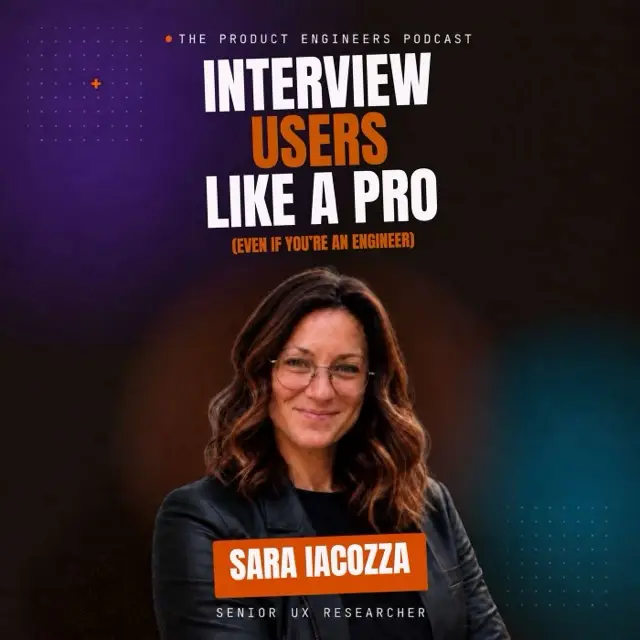
Everyone tells engineers to talk to users. But what should you ask, and how do you turn the answers into better product decisions? Sara Iacozza is a Senior UX Researcher and Product Strategist with 7+ years of experience helping teams understand user behaviour and decide what to build.
Sara walks through a practical way to build your interviewing skills: prepare questions with a researcher, practise with colleagues and an AI coach, then get support in your first real interviews. We also explore how to get beyond polite answers, spot patterns across conversations, and bring what you learn into engineering decisions.
In our conversation, we discuss:
- How understanding users helps engineers make trade-offs and find simpler solutions
- How to practise user interviews with colleagues, an AI coach, and a researcher’s feedback
- How to avoid leading questions, use plain language, and ask about real experiences
- How to turn interview notes into shared insights and check AI analysis against the evidence
- How to get closer to users by shadowing interviews, watching recordings, and talking to colleagues
Where to find Sara Iacozza:
Lessons Learned
- Start with a question you need to answer. Research has a purpose. You might need to understand whether people can navigate a screen, or whether a product solves a worthwhile problem. Be clear about what you want to learn before choosing how to investigate it.
- Use user context to challenge the proposed solution. Sara describes engineers who recognised that a branching questionnaire could meet users’ needs without a chatbot. Understanding the problem gave them a basis for proposing a simpler implementation.
- Learn interviewing through practice and feedback. In Sara’s workshop, a researcher prepared the questions and colleagues took turns interviewing each other. Treat your first attempts as practice, with someone who can help you notice where your questions or follow-ups need work.
- Rehearse with an AI interview coach. Sara used a custom GPT that could hesitate, contradict itself, and evaluate the interviewer’s approach. Practise responding to those moments, review the feedback, and try again before taking those skills into conversations with real users.
- Get support for your first real interviews. Sara joined early interviews to take notes and ask additional questions. Having an experienced researcher present gives you room to learn while helping the conversation reach useful detail.
- Listen long enough to ask a useful follow-up. A quick answer, especially one that confirms your expectations, can hide the detail you need. Ask why, request context, and invite an example instead of moving straight to the next prepared question.
- Ask about a specific past experience. Questions such as “Would you use it?” invite speculation, while “You like the feature, right?” suggests the answer. Explore when someone actually used something, what happened, and why it mattered to them.
- Use words your users recognise. Even familiar product terms can be confusing outside your team. Match your language to the person you are interviewing, and review your questions for jargon that might prevent them from explaining their experience.
- Share what you learn while it is fresh. Bring observations into regular team conversations. Comparing stories helps colleagues question assumptions, notice contradictions, and connect individual interviews to the decisions the team is making.
- Look for patterns across interviews. A shorter transcript is only a summary. Synthesis means connecting observations across conversations and examining which themes recur. Check how many people support an apparent insight before treating one person’s experience as a broader finding.
- Review AI analysis against its sources. Ask for supporting references and inspect the underlying interview evidence. Apply the same care you would bring to reviewing generated code: a convincing answer still needs to hold up when you check it.
- Start with the access you have. Ask to observe an interview or watch a recording if you cannot run one yourself. If you build internal tools, your colleagues are users too; a short conversation about how they use your work can be a useful starting point.
Chapters
Resources
- Sara’s User Interview Coach (announcement and access link): https://www.linkedin.com/posts/sara-iacozza_chatgpt-user-interview-coach-activity-7296141061372993536-pWZQ
- Continuous Discovery Habits by Teresa Torres: https://www.producttalk.org/continuous-discovery-habits/
Transcript
9,131 words
Everyone tells engineers to talk to users, but what do you actually ask? How do you keep your own assumptions out of the conversation, and what do you do with the answers? Today, on the Product Engineers Podcast, I'm talking with Sara Iacozza, a senior UX researcher and product strategist who's spent over seven years helping teams understand their users and turn what they learn into products.
You'll learn how to prepare for your first user interview by practicing with colleagues and AI, how to ask follow-up questions that get beyond polite answers and uncover what people actually struggle with, and finally, how to find patterns across interviews and use that evidence to make better engineering decisions. If you want to get closer to your users but aren't sure where to start, this episode will give you a practical way in. Enjoy.
Peppe Welcome to the podcast, Sarah. It's, it's great to have you here
Sara Iacozza Thank you so much for having me. I'm super happy to be here
Peppe Nice. I, I'm very excited to talk with you about research. I know you have a lot to say about that, and I'm sure all the, the audience and all the engineers listening to this find it very useful. So yeah, let, let's get into it.
Sara Iacozza Let's go
Peppe So I can imagine, I mean, a lot of software developers, engineers, they may know what is, what user U- UX research is, right? but maybe they've never been in, uh, uh, they were never involved in it, didn't really, never spoke with a user, so it's a bit vague, right? So would you say is, like, in terms, UX research?
Sara Iacozza Yeah. So think of, I mean, first of all, it's not super common to have a UX researcher in your team. So sometimes what I do as a UX researcher, maybe it's what product managers or UX designers do. So sometimes we are lucky enough, you know, to have a dedicated resources like a, a product, um, UX researcher, but not necessarily, right? And so UX research is actually, um, like, it's a bit more than just talking to user. It's like talking to user, having specific questions in mind. Uh, let me maybe give you an example, and I can give you like, a, maybe a couple of different examples.
So maybe you are developing a website or you're developing a mobile app, um, and you just wanna try to understand, like, is this gonna be user-friendly enough so that people will understand where things are hidden? You know, maybe you're trying to test like a menu and how the architecture works, whether the architecture works. In that case, you would employ or you would try to use some UX research principles. You would have maybe, um, um, like a, a testing, a user, usability testing.
You know, you would try to understand, like, okay, uh, if I put this in front of real users or real people, will they be able to understand where to go if they need to find, I don't know, the contacts page, right? and so this is UX research, very tactical, so it's very based on the UI and the front end in this case. Uh, but maybe you have a very different problem, and the problem is like you're trying to, I don't know, to build a whole new company or whole new product, and you want to try to understand who are the right people to sell this product to and what exactly you are solving for them. What are their needs? Uh, and maybe we can think of, like, this podcast, right?
So this is a product, uh, in its own, in its own, and you have specific audience. So what I would do as a UX researcher, I would talk to product engineers and try to understand what are you suffering with when it comes to become more product-minded, right? So how do you, um, what are the struggles that you have, or do you need to have more guidance in this topic versus the other topic? And so this is very, what we call very strategic, uh, UX research, where we really try to understand before we build a product, who is the right audience and what exactly we're solving for them. So that's a kind of a nu-nutshell.
I'm not sure if I, you know, nail it, but, uh, ask me more question if you think, uh, I need to
Peppe Yeah,
Sara Iacozza give it more.
Peppe very clear. Um, so how does it, uh, what's the difference between then a UX research and what a PM does? Because it seems there is a lot of overlap there, right?
Sara Iacozza Yeah. I think in, in general, this is becoming a more, uh, nuanced, you know, area where everybody is asked to do everything, right? And so, um, you have like small startups where they don't really have resources for dedicated UX researchers, and therefore they asked, uh, the product manager in this case to run interviews, to think more about the research side as well, um, because, you know, maybe, um, it's just, uh, the closer role in that sense to, uh, the needs because they are in charge. Like, they are the owners of the user needs, right? And user problems, and how the solution should fit those problems.
Um, but then you have other cases, you have like bigger companies or scale-ups or simply in some markets, in some countries, uh, compared to others, um, you actually have like more understanding of the extra bits that user researchers can bring to the table, and then you have a dedicated resource. Um, so it really depends, right? And, um, I was speaking to a friend, uh, that is... She, she was, uh, looking into new opportunities in this area, uh, UX research in general, and I was telling her there is not really, uh, one formula that fits all companies. It really depends how the company, um, it's set up and how it's structured and architectured in a way.
Peppe Yeah.
Sara Iacozza yeah. So
Peppe Yeah. At times it feels like it's, it's like a, a skill. Other time it feels like it's a role, right? So
Sara Iacozza Yeah, exactly. Exactly. Yeah, I have a feeling that it's gonna become more a skill than a role, you know? Uh, it's part of the skill set, right? And here we are talking to engineers, uh, grasping and earning that product mind. Uh, but at the same time, in my, you know, area, I'm talking to researchers that needs to, uh, grasp more engineering skills as well, right? So
Peppe Right
Sara Iacozza uh, it's really about becoming 360 expert on anything more than anything.
Peppe The expert generalists
Sara Iacozza Yeah, exactly. Yeah
Peppe Right. So great as a, as a context. That was great. Um, so now why do you think engineers should care about UX research? What's, so what's in it for them?
Sara Iacozza Yeah. In general, I think that whenever you're building something for someone else, and building, I'm really thinking like the whole scales of building, like cont- conceptually building, but also of course putting the codes together to build. Like, having that extra bit of empathy that makes you connect with the people you're building for, um, I think that's really like the what sets you as apart from other people that are just, uh, you know, writing code without really having that context in mind. 'Cause you're able to, um... I remember there was, like, the, the moms test.
This was something that was, uh, you know, a concept that seems super far away in time but seems so contemporary at the same time, right? So you need to think of who you're building with to be able to really build it properly for them, right? And I know that AI, you know, really helps maybe, um, bringing that context a bit more clearly for people, but I still feel like that the human factor, uh, makes a difference in this case because, you know, you, you... Having that ability to connect and to listen to and to understand what is the, uh, natural language of people you're building, you know, apps and websites for really makes the difference, right?
So, um, I think that, that it's, uh, it's like more... It used to be maybe a differentiator. I don't know if it will become like a table stake, right? And everybody will be expected to, to have that skill on the,
Peppe Mm-hmm.
Sara Iacozza on their skill set. Yeah.
Peppe Yeah, that makes sense. uh, personally, I found that having this mindset, this empathy, it's even useful for engineering work. Like, because
Sara Iacozza Yeah
Peppe are the other developers, So the, the, the, the way you, you write code, the w- the way you, um, write documentation and everything, you are-- you, you should have them in mind, right? Because to make the, their job easy.
Sara Iacozza Nice
Peppe the old DX field for-- that is actually user experience for developers. So,
Sara Iacozza Yeah, yeah, yeah
Peppe it's, it's something that we are already doing, and we can learn a lot from it
Sara Iacozza This is super. I, I love this, uh, connection, this example, because I... I mean, it was completely out of, you know, of my context, but it's really right, right? I mean, when you write documentation and you have yourself just in mind, that documentation is gonna be crypted, right? Nobody else will be able to do that, uh, will be able to, you know, um, really understand your, your workflow. So I, I love this, this example. Um, and I actually come-- Like, my first job was in developer economy, so it was really about, like, investigating market research within the developer tool ecosystem, and this was back in 2019, you know, and we were trying to...
This was a agency, and we were trying to sell, uh, reports for big companies to understand how to speak to developers that were building and using their SDKs, right? Um, and this is a perfect example. Like, it's really impacting. That empathy, it's really impacting the work you do in very different layers, right? So I love the, the connection
Peppe Yeah. And on the other hand, it's also useful, like, to know more about the users, um, for the actual product, right? personally, I found it very useful, when I had to maybe communicate some trade-offs for the solutions. Okay, maybe if we do it in this way, we can have the same outcome, but it's simpler, and we can do it faster, right?
Sara Iacozza Yeah
Peppe you don't, if you don't understand where we're going, then you would just say, "Yeah, okay, let's do this solution. It's perfect. I, I don't care."
Sara Iacozza Hmm. I like it. I like it. Yeah. Yeah. I, I guess that most of the time when, you know, you have a PRD coming from a product manager, it will be highly... I, I mean, I've been part of the team putting together PRDs, right? So I know that whenever you're there, you have token... You have spoken to users, you have, like, a very beautiful solution in mind, and that solution is, like, the super shiny, uh, fantastic, uh, idealistic, you know, idea and solution that you have in mind. And then you indeed have to speak to the engineering team, and oftentime, like, if we don't have that unders- mutual understanding of what are we trying to solve, maybe we're cutting also the wrong things, right?
Peppe Mm-hmm
Sara Iacozza so I remember something that we had in mind that was more, um, connected to whether we wanted to have, like, an AI, you know, chat experience or maybe more like a questionnaire-like experience in a, in a flow, in a user flow. Um, and we, from the product, we had in mind like, yeah, this is like a AI chat. You know, it's like a chatbot experience. And then the engineering were actually saying like, "You know, maybe it doesn't have to be that way. Maybe like a classic smart questionnaire with very, with branching and logics would be enough," because they knew the users, right?
This team had been working with, you know, users for that specific user type for a long time, so they really contributed and then indeed it wasn't needed, right? So they actually were very right in that choice that they, they made. So absolutely, yeah
Peppe Yeah. That, that's, uh, that's interesting. I, I imagine with AI this is happening a lot now because we're trying to push AI in everything and
Sara Iacozza yeah.
Peppe and then, Yeah engineers have to deal with the, this non-deterministic part of AI, which is very painful to deal with.
Sara Iacozza Yeah
Peppe maybe deterministic is better s- most of the times. Yeah, so I get it, yeah.
Sara Iacozza Yeah, yeah, yeah
Peppe Cool. So, you know, one thing that I hear often is, well, yeah, it's great, I mean, engineers, they l- they can talk to users, but a lot of times they say maybe they should not do that because they will just make a mess. They don't know what to do. Like, they may-- they will maybe just say yes, yes to all the things that user is saying, not trying to get into the problem space. Um, so, uh, i- in my opinion, this is like a skills, skill issue, right? So it's, um, because we don't know how to do it. We've never done it before, so of course, like, uh, that will be difficult. So how does a good interview look like?
So if maybe an engineer said, "Okay, you can talk to a user," how, how can they start?
Sara Iacozza Hmm. I mean, let me say first before going into what does it look like, let me say first that it's like the same, like you wouldn't ask me to right now code in PHP directly, right? Without having any training, right? I mean, it's a bit like, uh, a skill that you have to learn. So even if someone would tell me the theory of how to code properly, like without having any hands-on practice, I would probably struggle, right? Likewise. So it is like, um, it seems like a very, uh, soft skill, but actually it is a bit more of a hard skill. And like with experience, you really, uh, learn how to do it better.
And maybe the first couple of interviews, you know, they don't go exactly as planned, but this is like something that y- you build a buffering, uh, you know, space for that to happen, and you assume that you need a bit more, right? Um, and so the way I think about this is more like, it's not like what does the good interview look like, but like what does the good skill looks like in practice when you're building it, right?
Peppe Okay
Sara Iacozza so if you want, I can, I can try to, uh, navigate you through, you know, what you can do as a, as an engineer to try to build a skill, a- and then maybe we can think of like a good enough interview, what it would look like, right? Does it feel good?
Peppe Yeah, please
Sara Iacozza So this is something like, um, um, I also did, um, in the past because I had a team, and we were very, um, we were really building new things, so we really needed the team actually to be active and doing a bit more of research and, um, we had like users across, you know, the different markets and different countries, so we also needed different languages to be spoken, right? And having the whole team running interviews was also solving, you know, it's like two birds with a stone. So the team was empathizing, but also we were speaking multiple languages, and we could reach out to more users.
And so what I did, it's like, um, now it feels like old-fashioned, but I built, um, a custom ChatGPT, um, and... Sorry, a custom GPT, um, which seems super, you know, something super, right? It, it was just... Yeah, it was just, uh, two, two and a half years ago, right? It feels like, uh, wow. But it was very innovative at the time, to be sure. Um, so what I wanted with this, like what the, the problem was is that, uh, engineers, uh, and in this case it was like the engineer manager, he was like, "I'm not sure I am ready to do this. Like, I feel a bit uncomfortable," you know. And this person, he was really...
In general, he was really, uh, good at, you know, um, interpersonal skills, so it was already, you know, like someone that could have done it, uh, but he felt like, "I'm not ready to do this, so can you help me?" And so I built a little workshop, I call it, for, uh, I call it, like, not new ex-researcher, uh, workshop. So very, you know, didascalic, um, in the title. And what I did is, like, building a bit of, like, an experience for people, and it was, like, literally, like, I'm not talking about, like, months of work. I'm just talking about two or three hours in one week, and that's it. Uh, just to contextualize it, right? So I had like a first, um, um...
I build myself, like, the script because I still think there are some things that you, uh, need to chip in when you're allowing people to run interviews. So we're not expecting people from start to go and be able to run the questions that you're... By script, I mean the questions that you will be asking users, right? I mean, that maybe it's a bit more trickier, you know, and requires a bit more of understanding, a bit more of experience. So I prepare the questions for them. Um, and I, um, had the team first do like a kind of a, like I call it... I was telling them like, "This is like Dungeon & Dragons kind of things," right?
You are playing a game, and this is like you are the interviewer, and the other person is the user, and then you switch, right? So role gaming, um, and that was it. Um, and so I had the, the questions, and I had them with their own colleagues try, try it out and give them feedback at the same time And then what I did is like, okay, this is nice. People are gonna be nice to you. These are your mates. They're not gonna tell you, like, these questions were not asked properly, you know? Um, w- let's switch to AI. And the same way I use, you know, maybe I use Claude to, uh, write, uh, SQL code, right? Uh, without having, like, super massive experience.
I was like, let's use it also to train, uh, developers and engineers. And so I built this custom GPT, and I told them like, "Hey, you go and you try and the, um, the GPT, it's gonna react very similarly to what users will react when you ask those questions. So they will be hesitant. They will be-- They will contradict themselves because that's hap- this is what happens in reality. And this is, like, maybe one of the rules is, like, users, people in general contradict each other, you know, all the time, themselves and each other all the time. So, uh, just take that into account, um, and ask question and maybe, um, try to dig deeper. So if someone asks you, uh, for some...
If you ask something and then they give a, a generic superficial answer, maybe even one that you're really happy with, ask deeper. Go and ask why. Why is that? And can you give me a bit more context? Can you tell me an example that you had in the past about this?" Um, and they tried with the custom GPT. And at the end, the custom GPT was built to give, um, like, an evaluation, and I prepare it to have, like a different type of, um, dimensions to be evaluated, uh, on. So, like, clarity of answer. Were you asking questions that were pushing the user, like a biased question? Uh, they're pushing users towards a specific, um, you know, response.
Peppe Mm-hmm.
Sara Iacozza you being, um, adaptive? Um, and they did a couple of rounds of tests, right? And then they went back to interviewing, uh, their colleagues. Um, and they were super, you know, excited that with this feedback, you know, that was really constructive feelbad-- feedback, they managed for the second round to be much more smoother in the conversation. It was easier. They would know how to expect that to happen. Um, uh- And so it went better. And, and then I try to be there for their first interview, uh, with any user, I try to be back, to be there with them. So it's called shadowing.
So I'm just there, you know, and, uh, you enter, you know, a Google Meet call, and you just say like, "Hey, it's both of us here. Sara is taking notes, uh, and I'm here to interviewing you." And I'm there, and we leave space for the shadower to ask additional questions. And I just make sure that we, um, we feel, like, comfortable, uh, running that interview, and that people are not, like, feeling like they're re- they're pushed to be there and asking to users without any safety net, right? That's the point, is like safety net first. Um, and so going back, sorry, to your original question. So how does a good, um, interview look like?
Most of the time it's like, uh, I think you're doing it good if, like, 70% of the time you are, uh, silent and you're actually listening. This is usually, like, a first, uh, sign. Uh, so if the other per- you, you know, it's not, this is not like a, you're not like the FBI asking question and the other person like tick, tick, tick. Um, it's more like, uh, you create a safe space for people to, to go and share, and you're listening, and you make them feel listened to.
Um, and then it's like, uh, try to go deep, right, in the conversation, not be shallow and not being satisfied maybe with the original answer if that's the answer, especially if that's the answer you, you're expecting or you want to have, right?
Peppe Right.
Sara Iacozza yeah. I
Peppe Okay.
Sara Iacozza these are two points. Yeah, go ahead.
Peppe sounds like a good skill to have even, like, in everyday's life. Just silent, don't talk all the time if you, if you want to have a good conversation. But yeah, wow, I think this is, this is a great, great, um, thing you did. I really appreciate that. So j- just to recap it, you started with, um, like playing D&D, like s- like, like a D&D
Sara Iacozza Yeah.
Peppe thing, which I think it's, very UX of you because, like, putting yourself in the shoes of the engineers with maybe very fans of D&D, right?
Sara Iacozza Yes
Peppe And then, uh, like, uh, you used the GPT. Uh, I wanted to ask, did you train it, the GPT yourself, or
Sara Iacozza Yeah.
Peppe Okay, that's
Sara Iacozza Yeah. Yeah, yeah, yeah, yeah, yeah. So I built it, like I, I test it myself and I had like a, I think I had like a very few iterations because at the beginning it was very pleasing. I mean, this was back in the end, the end of 2024. So it was very pleasing and very not much US user-like.
Peppe Yeah
Sara Iacozza so yeah, absolutely. I train it and I, I iterate it a lot. Um, yeah. And they gave me feedback and I, I iterate it again. This is a public GPT. I mean, nobody's gonna be using custom GPT anymore, but it's public and they really helped me also make it better in that sense.
Peppe it c- it could make a Claude scale, something like that. It would
Sara Iacozza Yeah. In the, In the, in in the new era, yes, absolutely. Yeah.
Peppe Cool. Um, okay. Then yeah, there is the, the actual review, so of how things are going, and then you shadow the engineer, to, to see how it's going during the, during the call. Cool. Very cool. we spoke about what a good interview looks like, but in your experience, what are the most common bad questions or, like, behaviors that you've seen from all the people that are new to interviews? Hey, Pepe here. Quick pause. I promise it's a short one. Season two of the podcast will be all about helping engineers become product-minded. Want to know when new episodes drop? Subscribe to the YouTube channel, or even better, rate the podcast on Spotify, Apple Podcasts, or wherever you're listening.
It helps more engineers find the show. You can also find everything at productengineers.com. And now back to the episode.
Sara Iacozza Yeah. So I think like the, the worst question it would be something like, "So you, you do like the feature, right?"
Peppe Please like the feature.
Sara Iacozza So you do like, I mean, I've seen it happen, right? It seems like so obvious that you don't wanna say it, but then, you know, uh, it's just that you wanna recap, and he goes, "So you do like the feature. You would use it, right?" So that's like the, the worst, but there are, of course, more subtle ones. Um, it's like a way of like asking question that the other person just can answer with a yes or no, right? So very specific like, um, as I said, like, "Would you use it?" Or maybe something like, uh, um, "We discover that users have this problem. Um, what about you?" Um, and then of course, this pushes people to...
It's, it's like a bi- it's, it's a biasing question because it pushes people into, uh, "Of course, I also have this problem. Why wouldn't I have this problem if the other people have this problem," right?
Peppe Mm-hmm
Sara Iacozza they try to pick up, um, examples that would fit, and this is called, uh, the Matthew effect, if I'm not mistaken, uh, which is like, uh, the researcher. It's called like researcher bias. So you push people into pleasing you, right, when you ask questions. Uh, and so it's a bit hard to be, you know, neutral in interviews. Sometimes I also, uh, struggle with that because it's, uh, I mean, you wanna make people feel like at ease, but then you become, you know, likable as a person to talk to, and then they try to please you, right?
And that's why being deep in the question and ask questions that, um, triang- to triangulate, so to make sure that the answer comes from different points, and you're not driving conclusion based on one single response. So do you like the quest- do you like the feature? Uh, maybe they would say yes, and then you try to say, "Okay, but why is that? And how, how do you use it? When do you use it? And how did, did it make you feel when you, uh, when you use it?" And, you know, really try to bring back the conversation to the actual usage at the time and speak about the past experience that they had, not like an, uh, ideal one, and then connect the dots, right?
So, uh, go beyond the, uh, the result is not like all users like our feature, right? That's a vanity metric. The, the results are really more about like they like it when they do X, Y, and Z. They maybe don't fi- find it intuitive when they are in a rush or if they are commuting or if they're walking. You know, and, and that's like the insight, right? That's what people in the product team need to hear
Peppe Mm-hmm.
Sara Iacozza for that information to be informative, right? And make actions out of it. Yeah.
Peppe Right. Right. Yeah, that's a, a really nice book I read, uh, from Theresa Torres, "Continuous Discovery."
Sara Iacozza Yeah
Peppe talks about story-based interviews, so
Sara Iacozza Yeah
Peppe could be a very, very good starting point. I, for, for me, it's been very useful actually, yeah. So it's been...
Sara Iacozza Yeah, It's a beautiful...
Peppe yeah.
Sara Iacozza Yeah, yeah, yeah. It's a beautiful book. I mean, she has been, for, for years she has been pushing into this mindset, and it's nice, you know, that now, um, it's like expanded because this one, this book actually was originally for PMs that were also starting, right? Uh, getting the right mindset. Um, I guess again, because at the time, you know, like, m- it was like, uh, you had these roles very much defined, right? And it was easier for UX research to be only done by UX researchers and UX designers maybe, and PMs were struggling with that. So I like the fact that now it's becoming, um, a much more diffused and shared, uh, practice.
Uh, and I really recommend, you know, maybe, uh, even just ask Claude to summarize the key points, you know, if you... I know it's a, it's a b- big, big, big book, but it's really, really, uh, interesting. Yeah.
Peppe Yeah. Yeah,
Sara Iacozza Highly recommend it. Yeah
Peppe Cool. So, um, you know, um, someone from your s- your audience may be asking, "Okay, but, you know, as an engineer, I have a lot of technical knowledge. much of that technical knowledge I can bring into interviews?" Like, is it, is it a bad thing to talk about technicalities? Or like should I, should I, should I avoid them completely, or maybe is it okay to mention them?
Sara Iacozza Yeah I think this is a bit like, um, like I would l-like to, uh, like bounce back this question to you. How much of your technicality do you bring in your daily life with your family, friends, uh, you know, and, and the people around you, right? So I, I mean, I my partner is an engineer, so I have to train him to avoid using technicalities with me, you know, and his family. But it's, it's very similar, right? I mean, maybe, uh, like really depends also who you are interviewing, right? I'm expecting that imagine you are developing tools for developers, right? I mean, maybe in that case, some technicality can snip in and it makes sense and it will be able to share, uh, knowledge and language.
Um, but would you... Are you building for, I don't know, for a completely different user base, maybe elderly? Would you start talking about feature with your grandma, right? Uh, or maybe kids, right? Would you start being hyper-technical? So in general, the rule of thumb is like, uh, let's keep all the jargony word out. But I guess it's also hard for us to know what are the jargony word, right? It's like we, we, we speak about features all the time, but actually even the word feature, it's really complex to, uh, explain to some- what is a feature, right? And even just reaching it with functionality seems easier, right? For people, "Ah, this is how f- things function.
Okay, now I have a better..." Or app. I, I remember we were reaching out to people that, uh, were using our mobile app, but also people that were not-- uh, they hadn't downloaded, uh, the mobile app, but they just were using the, the desk- the, the web app, right? Like making them understand that we were talk- What does it mean an app, right? It's like the, the website, the, the web app, the mobile app, they were completely lost. And sometimes they, uh, it can happen that people, like regular people not in tech, that they don't understand basic things that for us are super simple.
So I think here in this case again, maybe AI and Claude's, you know, can help in that case by running the script like, "Hey, can you check my script maybe? Can you check the question I need to ask just to make sure that I am using a language that it's accessible to, I don't know, my user base who are usually be- um, like average seventies, right? In their seventies, uh, they're not tech, uh, they're not doing that." So maybe Claude, you know, in that case, Claude or whatever, you know, uh, next, uh, tool will come next. Um, but they can really help maybe pinpoint some words that can be, uh, not that common in the Regular population maybe. Yeah.
Did it happen to you maybe that, that you, like maybe I'm bouncing a question to you. Did it happen to you as well that you, you found yourself talking and using technicalities and people were completely Lost
Peppe Yeah. Sometimes with the, you know, the, the app website thing, that was u- it's a very common misconception 'cause people think, like, the website is an app or like it... I don't know. Um, yeah, but even with the, with AI, I mean, a lot of people talk about AI, but, um, lot, like, a lot of people think like it, of it, of it like a, a search engine. So they don't know all the, uh, what's, what's a skill? What's a... It's like, "Oh yeah, you can have this skill that it does this for you." "Yeah, but what, what are you talking about?" with, with AI, I'm st- I'm still learning not to use those words with, 'cause I use it every day, I, I, I live in a bubble for sure. So, so
Sara Iacozza Yeah. We all do. We all do, right? I think, yeah
Peppe Cool. So, so let's say that I'm an engineer. I did an interview. Um, I'm getting good at it, right? What do I do next with, with this information that I got? What can I do, uh, um, to integrate data, those information in my engineering work as well?
Sara Iacozza Yeah. So let's say that you have like, um, um, two different, let's call them tasks or maybe activities or two different goals. Yeah, maybe that, that's a, uh, better word. Like two different goals, right? So you have a very, uh, tactical and, um, immediate goal that it's like sharing this information that you're reading, y- you're learning as fresh as you have it, right? So, and let me give you an example. So one thing, one of the things that I, I did in the, in the past is creating rituals.
So the same as you have your dailies, the same as you have your retrospectives, the same as you have, you know, the whatever ritual you're using in your, in your team, um, you build the You build the muscles, right, for people to pick up the information that you're sharing. And so what we used to have is, like, we used to call them discovery meetings, right? And this was, uh, an opportunity. We had them once, was, like, one hour every Monday at 2:00 PM, you know, and we had, like, this opportunity for the whole team to be there and share what they were learning. Um, and this is very rough. You know, it's not like a, like a deck. It's not anything fancy.
I mean, we were just using for convenience, uh, FigJam, you know, board just to keep things in the same place, but it could just be just speaking, right? And you start sharing, like, "Oh, I learned... I, I was talking to these users and they told, they told me X, Y, and Z. Uh, they liked the feature when they were doing this, but they didn't like it when they were doing the other thing," or maybe they have this need and the product is not solving it. So it's like, um, a safe space for people just to share without much, you know, uh, uh, like complexity or much work, just to share what they heard from the users they spoke to.
Um, and so this is really about, like, going to the gym and building the, the muscle for the discovery and for the information coming from users, and to also be able to not be biased too much by that because maybe now you talk to a user that told you a story and someone else talked to another user that told a completely different story. And because you are sharing it, uh, you're like, "Oh, wow, that's completely different from what I learned. I actually learned this other thing." Um, and so it builds also some critical thinking, uh, because it's very common that if you're running interview, you're gonna believe that what you hear, it's truth, right?
So you have to build also that muscle, that, to push back. And then we, we of course, you have, uh, something that it's a bit more, like, um, official or a bit more like, um, um, yeah, like you need analytical work to, to do it. It's like extracting insights. Um, and a lot of people, especially at the beginning when we start having, you know, uh, LLMs, at the very beginning people were just throwing transcripts of conversations into an LLM and asking the LLM to, you know, give and summarizing things. Um, and I had, you know, I also had my own, uh, uh, skill, let's say.
I had my own skill, I had my own thing, but it was very common at the very beginning that the LLM was just summarizing, right? And what we don't want is summaries. We want nuances. So we want synthesis, which is different from a summary, right? So a summary is just, uh, make it plain, uh, so that I can read it fast, and a synthesis like, no, we wanna find connection patterns. We wanna see things that are repeated. And so with time, um- Like for instance, in, in what I built in the past, it was like a, a notebook LLM, right? And then in this notebook LLM project, I had all the transcripts from all the interviews that I was running.
Um, and I built like specific, um, like practices, and I asked the, the LLM to actually always provide like... to, to give me like a number of like cita- citations. So, uh, how many of the many users that I interview were saying this thing? A- and try to quantify, right? To make sure that the LLM was not picking one single user and make it like, "Oh, this is the insight," right? Um, and so it's really again about iterating as well, and iterating in a way that you are a bit more sure and able to check what the LLM is doing for you when they are synthesizing the information.
Um, and so I know that, you know, maybe 95% of us will now, with the tools that we have, will go and rush into Claude, you know, and pop it. Um, and I'm... You know, I, I don't wanna go against this. I'm just saying like make sure that you do good prompt engineering beforehand, uh, or you're using a skill that it's well prepared to critically, you know, revise also. It's like you, you have to eval what you're doing as well in the same way, right? So you cannot say that for your code, you have like a code review, uh, practice, but then for interviews you don't, right? And you just take whatever it's spit it out of it.
Uh, so I would apply the same, you know, principles that you do when you revise code and you make sure that AI is supporting you properly, uh, when you analyze this type of qualitative, um, yeah, data. Yeah, exactly
Peppe Yeah, yeah. Yeah, and that makes sense. And I mean, even as, as an engineer, this has become very appealing because it's v- it's very analytical, right? And that's something that we also like to do, and now we can also have fun automating the process with AI and creating the, the evals, as you said. So it's, it's really getting closer to what us engineers can do in that sense.
Sara Iacozza Yeah. Yeah, yeah
Peppe I mean, then there's still the part, okay, we need to understand if the outcome is good or not. That, I think, requires experience. Uh, but yeah, there, there are a lot of the, like more like, uh, mechanical things that,
Sara Iacozza Yeah. Yeah.
Peppe yeah, we can, we
Sara Iacozza R-
Peppe do as well.
Sara Iacozza yeah, and right now you have many, I mean, um, people that there are teams that are building their internal MCP for research, you know, that they're building their internal, uh, product OS. So they have like engines that take, you know, product reque- product, um, uh, product goals or product visions and are extracting, they are connecting to the repository of interviews, and they are creating PRDs. There are, I mean, there are, uh, different degrees of automation that you can do. You also have a lot of like tools available on the market that are popping out at the moment for doing that.
Um, m- my only maybe suggestion is always being like for everything, just being a bit critical to try to make sure that you're not, uh, building something that, uh, it feels right, uh, and then we f- follow the flow because these tools are meant, uh, also to please us, right? So let's keep this in mind. I mean, I don't wanna sound like a, a negative, but they, this is how they're built. This is like the, the hook it's called. Um, in the past, we used to have like this book called "The Hook," uh, "The Hook Model," which was how Facebook was built, right? And the whole point was like pleasing and creating a connection and attachment to a tool, and the same happens with these LLMs, right?
So you really need to make sure that there is an eval, um, step, and the evaluation is done, and then there, um, you double-check what is done. And I found myself, you know, m- many, many occasions, um, just because I paid a bit more of attention, but I found myself like being told, uh, a story that at the end it wasn't true, right? Um, and so you have to make sure you, you spot that, uh, before you go and, and, you know, try to pro- produce something and, and sell it to the C-levels, I guess.
Peppe Yeah, yeah. That's, uh, that's true. That's, that's true for even for engineering work, right? So you need to, to just don't trust, just check Sam always.
Sara Iacozza Yeah. Yeah
Peppe Yeah. Um, okay. So you have been talking a lot about, um, making user research and discovery more accessible for the whole team, and you actually did this in one of your, the companies you worked in. and y- you call this democrat- democratizing research. um, how, how does that look like? W- what, what was the experience?
Sara Iacozza So we had like, um, uh, I remember like, um, uh, as I mentioned, like we were trying to reach out for different people. Like, uh, um, I can give you like the first, the first iteration of this, right? We had like the engineer manager running interview with, with patients. We had like the product analysts running interview with patients. We had like the designers. Everybody was doing that. I think, um, we still have, like whenever we were meeting in person, 'cause this was all done remotely, we still had this like fond memories of like the first time you go and you talk to users. Um, and so, uh, like, uh, my engineer manager was always saying like, "This is like super..."
Like, I still remember, I still have like goosebumps when I think about that moment, that person. I mean, in this case it was a good interview. The user was actually saying like, "Oh, you, you changed completely my, my life, you know, I'm super happy." And it made him feel he was building something useful, right? He was building something that was really impacting people's lives. Um, and we start building like, like we didn't have that practice at all and we started building. I also wanna be honest, it wasn't always needed, right? For everybody. I'm not saying that now we go from engineering not running interviews into engineering running, uh, 100% all the interviews.
Sometimes, you know, I mean, not sometimes, but we're all busy with our own tasks, right? So it can happen and in some cases this doesn't make sense. Um, but I think especially for like this discovery work, which is how I call it, and by discovery was the example I gave you before. You are building this podcast, you wanna try to understand what is the audience and what are their needs and how you need to frame your story and the, the product, product that you are, uh, creating. So that's discovery for me. Um, in those specific cases it really makes sense to have the team joining and feeling like this is like a democracy of information, right?
And then everybody's able to, uh, understand and to have that clear in mind, and then maybe you have a roadmap and it's very tactical. I mean, it's more like about really building things. Maybe there is not such a need, right? To be always involved. Um, maybe if it's a usability testing, maybe it's good that a designer is there, right? And they are part of it so they see what they are designing and it's not working. Um, in general it's just to be always good to have the person that needs to be owner of that piece of the product to be just there and responsible for it. Uh, but the discovery, it's great to have everybody, right? And everybody really getting the idea, uh, behind that. Yeah
Peppe okay. Um, so I, I, I imagine someone from the audience may say, "Okay, you know, this is great, but in my company, we don't do that. We are not allowed to even s-spend time with designers because they are in their department, and everyone is doing their own things." So i-if, if an engineer is in that kind of situation, how can they... what can they try to do in, uh, to get closer to the users, in your opinion?
Sara Iacozza I think probably this is very common, right? I mean, I'm assuming you're asking this question because this is like, uh, real life examples, right?
Peppe Very. Real life
Sara Iacozza Um, so I have like a, a, like, um... I would say that On one hand, I would still try maybe to push inside the company to have a bit more visibility in that. Um, but it does require a bit of proactivity, right? So you need to build a case why you believe that's good. I mean, um, and I'm not just saying, like, I'm not saying you have to go to the, uh, CEO and ask like, "Hey, I wanna run interviews." But it could also just be like, "Hey, um, next time you run an interview, would you mind if I just join?" Uh, because that's also very lightweight, right? I mean, you don't have to be running interviews to be close to users.
You could just be there shadowing or maybe, "Hey, would you mind share the recording?" Everybody now it's recording interviews, right? So would you mind just share the recording and I just wanna see, you know, re- I, I wanna hear from the real users how they're struggling with that. And maybe you watch it two X, right? And then, you know, maybe it's not half an hour, it's 15 minutes, and you, you watch a few of them. Or it could be, yeah, simply showing proactivity and I, I wanna be exposed to this. Maybe I don't have the space or maybe people don't give me space for running those, but I can start hearing those things. Um, and, and I, I think this is maybe lightweight, right? Maybe...
I don't, I don't think anybody would say like, "No, I'm not gonna share." Maybe if you're working with an external agency, you know, interviews, maybe it could be a bit trickier. Um, and in this case, maybe I would move into build the skill for yourself, right? This means maybe, uh, create the space for doing this in your free time, you know, if you, if you have that space, if you're lucky enough, uh, to, to have space, uh, in your free time. Uh, so try to, to talk to people. Try to, just for fun, do this like synthetic user with clothes, you know, like pretend- pretending that you're speaking to a user if you want to build a skill.
Um, or, or simply try simply whenever you are using any tool, which could be like LinkedIn, which is, this is another like, uh, maybe, um, potential like, uh, light way. Try to build this ability of like poking and probing, uh, people saying things, right? So I don't know. I go on LinkedIn, and I see someone is saying bad things about, I don't know, uh, this product, right? So try maybe to probe. Uh, I know it's a bit hard to go there and get yourself out, uh, but like ask like, "Why is that?" You know? "Why do you think this, this is the case?" So when have you used it? So- Fake the interview mode, the interviewer mode. Fake it in, in any kind of, uh, experience that you have.
Uh, try really to understand, you know, if you can go into the next level. Uh, and maybe if you have that skill a bit trained, also inside the company, you feel stronger in asking for being part of that, um, practices as well, right? 'Cause if you feel, like, uncomfortable, it's hard for us, for anybody. It's really hard for anybody to push if you feel like, it's like, "Oh, can I go and, and develop the next, uh, feature myself?" Um, you know, maybe if I have a bit more, like, uh, ability, um, I also would be able to be more precise and more there. Um, just try to, uh, be exposed to real words said by real users of any product.
Peppe Right. Or even maybe you can try on like a-- I don't for a company that develops software for doctors, and you go talk to doctors
Sara Iacozza Yeah. Ma-- Your own doctor, right? I mean, you go to...
Peppe Yeah,
Sara Iacozza yeah,
Peppe Yeah
Sara Iacozza Like, you, you go to your, uh, kid's, uh, pediatrician appointment, and I'm not saying that you have to go and be like, uh, again, like I'm asking you some question. But like very casually ask questions that are a bit like, uh, deeper, uh, in that sense. Um, uh, uh, yeah, give me a-- Let, let's maybe we can have like another example, but like, uh, mayb- also, I, I think like also, uh, platform teams, right? Build, uh, like, uh, I'm thinking like engineer, engineering, engineers building tools for internal usage, right? Which is, is very common, right? In that case, users are your colleagues, right? In other departments.
Uh, you don't have to set up an official, uh, interview to talk to them. You can just talk to them at a coffee machine or, you know, going to the toilet or in any, any call that you are joining and maybe you have people there and, uh, uh, the, the, the room is not full. Like, I'm talking about like a vi-virtual call, right? You can just ask a question. It doesn't have to be 30 minutes, uh, interview. It could just be like, "Hey, um, yeah, I wanna try to understand how you're using this new thing that we built. Um, how is it going?" You know, and, and try to be, uh, re-receptive to the information that people are sharing in that case.
Peppe Awesome. Yeah, I think that's a, that's a great tip. It's gonna be useful.
Sara Iacozza You're fast.
Peppe Nice. So yeah, I think with this we can wrap up this episode. Um, thank you very much, Sarah. I want to ask you, where can people find you, uh, if they want maybe to reach out, asking questions, anything, or just follow you? What-
Sara Iacozza Everybody can find me on, on LinkedIn, um, Sara Iacozza. This is my LinkedIn, and I am happy to, you know, if you have any question, if you have anything, I try to be responsive, and I, I'm, I am there. Maybe I don't post that often anymore, but I am there, and I look, um, you know, at my inbox. So text me or connect. I'm happy to connect and hear more stories as well.
Peppe Nice. I'll make sure to add the link in the, in the description of the episode. Okay. Thank you very much, Sarah
Sara Iacozza Thank you for having me. Super happy and good, good work. I mean, awesome work, and I'm really looking forward to seeing more people, you know, having this empathic mindset in, in product, and this is gonna make a change, I think, for everybody.