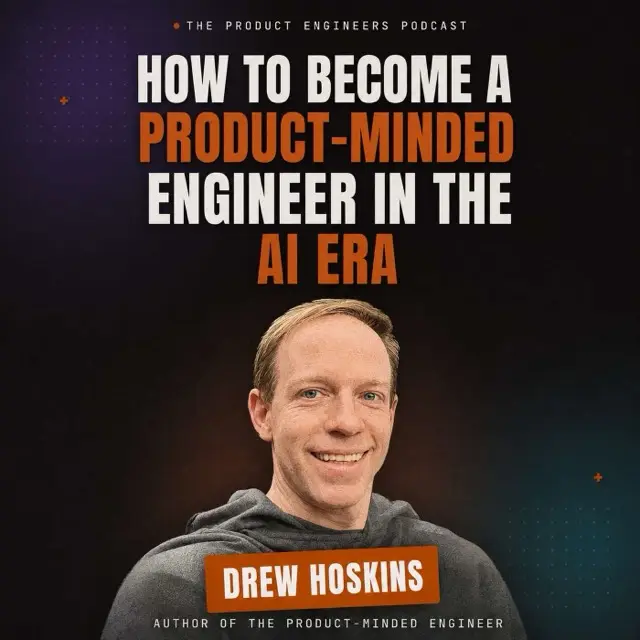
Drew Hoskins is a senior staff software engineer at Stripe and the author of O’Reilly’s The Product-Minded Engineer. After more than 20 years in engineering at companies including Microsoft, Meta, and Stripe, he moved into product management at Temporal before returning to engineering.
In this conversation, we explore how engineers can make more impactful decisions without becoming product managers. Drew explains how to uncover customer needs, use detailed scenarios to expose gaps and design better tests, build tools that sustain product thinking, and prepare for an AI-enabled future of end-to-end software generalists.
In our conversation, we discuss:
- What product-minded engineering means and why teams need both a system view and a user-story view
- How product judgment helps engineers choose higher-impact companies, teams, and technical investments
- How to learn from sales calls, support conversations, GitHub issues, product data, and direct customer contact
- Why detailed user scenarios reveal plot holes, guide prioritization, and become stronger end-to-end tests
- How AI could create software generalists who own the complete product cycle while specialists tackle harder problems
Where to find Drew Hoskins:
Lessons Learned
- Ask why before touching the ticket. An impact statement gives you the context to resolve missing requirements, make better trade-offs, and avoid implementing the request too literally.
- Hold the system view and the story view together. Components, databases, and interfaces explain how software works, while the sequence of user actions reveals whether the complete experience works.
- Treat developers as real users. APIs and internal platforms require discovery, clear concepts, safe defaults, useful errors, and thoughtful interfaces just as customer-facing products do.
- Seek customer evidence where it already lives. Search sales recordings, support transcripts, Slack conversations, and GitHub issues when direct access to users is difficult.
- Instrument the user journey. Track activation, retention, churn, and where people abandon a flow—not only application errors—so you can distinguish acquisition problems from usability or value problems.
- Write detailed user scenarios. Describe who the user is, what motivates them, how they discover and understand the feature, what they do, how the system responds, and what happens next.
- Hunt for plot holes. When a scenario assumes that users magically find a feature, understand an unfamiliar concept, or skip an unexplained step, treat that gap as a product problem to investigate.
- Turn important scenarios into tests. Exercise connected steps together so the test proves that the real journey works across pages, links, state, cookies, and other integration boundaries.
- Prioritize impact over technical fascination. An elegant optimization creates little value when it addresses no meaningful bottleneck, while product context directs engineering effort toward outcomes users notice.
- Build tools before expecting culture to change. Searchable customer knowledge, useful metrics, and strong test infrastructure make product-minded behavior a natural part of everyday engineering work.
- Scrutinize AI-generated tests. Tests are the auditor of the product, but an agent can produce shallow assertions that merely confirm its own implementation. Review whether they prove the intended user outcome.
- Preserve collaboration as ownership expands. AI may let one engineer carry discovery, specification, implementation, and delivery, but colleagues remain essential for challenging bias, sharing context, and preventing solitary rabbit holes.
Chapters
Resources
- The Product-Minded Engineer: https://www.oreilly.com/library/view/the-product-minded-engineer/9781098173722/
Transcript
7,284 words
There's a popular idea that as AI writes more code, engineers will spend less time on implementation and more time deciding what to build, why it matters, and whether it works. Today, I'm talking with someone who has approached this from both sides, Drew Hoskins, a senior staff software engineer at Stripe and author of O'Reilly's The Product Minded Engineer. Drew spent more than twenty years as an engineer at companies like Microsoft, Meta, and Stripe before becoming a product manager at Temporal and then returning to engineering. In today's conversation, what does it mean to be a product-minded engineer?
How engineers can get closer to users through support conversations, sales calls, product data, and GitHub issues. How user scenarios reveal plot holes and become better tests, and why AI may create end-to-end software generalists. If you want to make your engineering work more impactful, this episode is for you. We'll answer the question: Is coding still enough? Spoiler, Drew's answer is no, but you don't need to become a PM to be product minded. Enjoy!
Peppe Welcome to the podcast, Drew. It's great to have you here.
Drew Hoskins Thanks. I'm glad to be here
Peppe Nice. So, uh, Drew, I want to make this episode a bit fun for the audience a lot of engineers in the audience may, not be comfortable or, may not really know what being product-minded means, you having wrote the book about it, I think you have a lot to share. so let's pretend that, being product-minded is the product, right? So we have,, people in the audience that you have to sell this product, that may be skeptical about it, and what would you promise to them? What would you pitch them without saying the word product-minded?
Drew Hoskins Well, I guess if I wanna be really product-minded about it, I should probably ask them first, like, what are the-- where their skepticism lies and, like, dig into... Because, like, you don't wanna straw man somebody. You don't wanna be like, "Hey, like, you should think of it like this," and then it turns out they had, like, a totally different concern. And I do worry about that a lot actually, even with my book, where I'm like, am I reaching the people that are the most skeptical with it, you know? Maybe not. But is that a cop-out answer? Should I, should I give you a, a real pitch?
Peppe Yeah, I mean, you actually made a very good point, so maybe that's also could be the first lesson, right? So we should not, straw man our potential customers. W- what do you mean with that? Like, how should things be done usually?
Drew Hoskins Um, I, I feel like there's, probably common objections to like, oh, it's the PM's job, or I don't have time to think about users, these kinds of objections. And I think, these are very valid objections, and for some people they might even be correct, right? Like, not every engineer needs to be a product manager engineer. But I also think that every engineer can learn something, and you can put yourself on the spectrum from like product manager to like deep infrastructure expert, you know?
And you don't, you know, there's no one mold for every engineer So what I try to do is give people practical skills that blend into their engineering lives rather than just say, "Hey, focus on the users and go read a book that's d-designed for PMs or designers." Like, I wanted to write something that was really targeted at, like, the day-to-day life of an engineer and how to, like, incorporate product skills in. And so I think that's a good pitch for it, is like you don't have to become something that you're not. my way into product mindedness was kind of more of a, like a puzzling angle.
Like, "Hey, here's this user problem, and I need to get the user to successfully use my API, without doing something unsafe. How can I do that? How can I help them discover it, understand it, and then use it without, causing problems?" And that's like a little bit of a maze that customer is navigating, and it's almost like a puzzle to try to write the right interface that kind of reduces ambiguities in the right places and gives you an error message if you do the wrong thing, and the error message is helpful to you, or is just designed so that you can't even make a mistake in the first place.
I got into it from a sort of interface design perspective and sort of solving puzzles, and then that kind of bloomed into a more product mindedness. And as far as, like, why it makes an impact, there's really, like, two ways of thinking about the world in software engineering. There's the system view, which is like the components and the databases and the interfaces, and then there's the sort of story view, which is indexed by time and user actions.
And to really do a good job of writing a product, building a product, you need to have both representations in your head or in your team's heads, and then combine those together, and it's only when you synthesize those two views that you're gonna build something that's great. And so due to the nature of communication and human intelligence, it's just very convenient to have both of those representations in the same brain because you... they can bounce off a back and forth from each other, and you can think through them and go back and forth much more quickly than you could ever do by communicating with human being.
Peppe Mm-hmm. So you said that you started to develop product minds, as you were working on interfaces, right? you like an engineer in that moment, or you were like more a designer?
Drew Hoskins Yeah, so I was in Visual C++. So I was like very, very much not a product engineer starting out. and I was working on a compiler, and doing like back-end optimization, so nothing at all producty about that. And my team morphed into a compiler framework team. In other words, we were building APIs for people who were building compilers and static analyzers and jitters. If you've ever heard of LLVM, it was sort of Microsoft's take on LLVM. And the team was, combined with people from Microsoft Research and people from the compiler team, and so nobody had any idea how to build an API. The chief architect's vision for it was the assembly language for building compilers.
And so I sort of noticed that in the C# community, there were a bunch of people thinking about API usability. and I really kind of read some stuff from them and got inspired by that and tried to bring that into, my team.
Peppe Mm-hmm.
Drew Hoskins where I got the bug
Peppe That, that's equivalent of what today we would call DX, right? Developer experience.
Drew Hoskins DevX,
Peppe I mean, that's also something that maybe people don't think that there's much product work involved in building the VEX, but actually it... There is a lot of product your customers, your users are also developers, and they have their pain points and everything. So I guess that's also points for engineers to get closer to that way of thinking, right?
Drew Hoskins Yeah. It, it's actually a great place to become a product-minded engineer for a few reasons. First of all, you can... You have some intuitions about what you would want. And so it's easier to break into that. But you do have to think through that, put yourself in other people's shoes. one of the things that you'll do is, like, pretend you're new. Like, you, You just have to forget selectively what you know about your product and pretend you're new. you're already a developer, and so now you just have to pretend that you're new to your product. Second is that, most PMs can't do it. Like, they just don't have the technical depth to make good developer-facing products.
There are some that do, of course, and a lot of the PMs that can are former engineers. and so you're often in teams that just don't have PMs, and so if you-- Who, who's gonna be the product role if not for somebody on your team? And third, like, a lot of the people that gravitate towards this area are not product-minded. They are, like, intentionally avoiding things that are, like, fluffy user-facing products, right? And so you may be surrounded on a team that really doesn't have much product taste. And so if you can fulfill that niche, then productive. And so that's where I kind of got into this, right, was I, found that I was surrounded with people that had zero product taste.
and I could fulfill that role and that really started to differentiate me from the other people
Peppe Right. So we identified that potential customer of being problem-minded is our engineers. what are the pain points that they are having that being problem-minded can solve? what's in for them when they
Drew Hoskins Yeah The biggest one and the one that happened to me is like you do good work and you're proud of it, but then you don't get promoted and people aren't really adopting what you built. Right. I think that's the most important one. and there's so many reasons why that might happen. company selection, like startup selection, like is this startup gonna make product market fit? And if you can't tell, then you're probably gonna join some bad efforts. Team selection within a company. Are you choosing teams because you think the tech is cool or because you think it's gonna make an impact? If it's because you think the tech is cool, then you might have fun, but then you're gonna be sort of stuck.
maybe you get laid off, maybe you don't get promoted. you're not gonna be in control of your own career and destiny. And then even if you do get onto a team that has promise, you make choices that hinder adoption, and you don't realize that you're making those choices. You aren't connected enough to the users to understand why they're not picking up your product. So once you have product taste, it can be incredibly valuable for picking the right companies, picking the right teams, and then actually succeeding when you build the products.
Peppe Right. So it all comes to having an impact, that you can demonstrate to the company,.
Drew Hoskins I don't know. Early in my career, I wasn't thinking much about impact. I think that's natural because, you know, at that point, you're really just trying to learn the craft, and that's actually okay to spend years learning the craft of engineering. Maybe that's compressed now because of AI. Like, you should really not spend too much time doing that. but then I think that there's a natural transition towards caring about your impact and your users, and if you don't make that transition, gonna get stuck absolutely.
Peppe someone from the audience right now may be thinking, "Right, I would love to do that. I would love to that kind of impact to really, see if, the users are, adopting my work, the company I work in doesn't really enable me to do that, right? Because I am far from the users, and the only people that can talk with users are PMs or designers,
Drew Hoskins Yeah
Peppe sometimes they don't even speak my own language. So I don't know, how can I communicate with them?"
Drew Hoskins Yeah
Peppe what would you tell them?
Drew Hoskins Yeah. So there's definitely harder and easier companies to be in. And so I have a lot of empathy for that problem. There are some things that you can do. So one idea is if you have any kind of, knowledge repository, maybe it's sales recordings from the salespeople, maybe it's, support chats, transcripts, or like Slack support, depending on the type of company you're in. Maybe it's, GitHub issues if you're a developer-facing company. Find whatever it is that's like the records of people interacting with your company and see if you can search those. AI helps a lot here. It's making it actually easier than ever for engineers to sift through things.
It could search through all these things and like Claude would-- We could say like, "Hey, do we think any users would like such and such a feature?" And then, it would search for people who have either asked for that feature or maybe I could query for, "Has anybody had this problem that I'm thinking of solving?" And then it could find those people. So that's one way. Another, I think, is data and metrics, right? Like it-- you may be empowered as an engineer to add more instrumentation to your product that then goes out and then collects data that could be helpful, quantitative data that could be helpful.
you obviously need to have some sort of metrics and infrastructure to do this, but that might be something that engineering teams are empowered to do if you can convince your management that it's worth the investment. and that's a bit of a cultural thing, like being metrics-driven is something that not every company has, but it's a really good thing to try to drive. okay. Sorry,
Peppe yeah, sure
Drew Hoskins tag into sales calls or do a rotation on customer support, right? And just be a fly on the wall. Or you can go there and say, "Hey, like, I'm-- I'll be technical support if you need any dev." And you need to make the salesperson feel... If it's sales, you need to help them feel comfortable that you're not gonna screw up their deal. So you don't wanna be like... You wanna, like, set boundaries with them before it and establish trust. But then usually customers feel honored to have an engineer on the call. They're like, "Oh my God, like, this company really cares about me. They're putting an engineer, here." And so it usually goes over really well.
Peppe So you're suggesting to either watch or read, like, watch recordings of sales calls or customer interviews, support tickets, Slack ch- conversations, GitHub issues. you have data, you can read the data or either join sales c- sales calls, just for clarifying, maybe some people don't-- are not really familiar with what, instrumenting your product means. could you like maybe, give a practical example of how they can do that, what tools they can use?
Drew Hoskins So, there are a lot of observability solutions these days. there's things like Grafana, Honeycomb, Anyway, there's a bunch of tools. You can look them up, and they are, useful for collecting metrics. And so if you wanna find out the error rates of your application. another one is like a more user-centric view where it's like I wanna find out if my users are churning, how long they're staying activated in my product. And so, okay, they sign up on day one, and then you check in, have they been active in the last week? Have they been active in the last month? how long did they stay on the app? And then what was the last thing they did before they churned, right?
If you can identify patterns, it's like, "Oh, well, you know, we're not getting anybody to sign up," is very different from, "Oh, they're signing up, but then they don't stick around," is very different from like they do one thing and then they don't ever come back. You know? So it's just like figuring out where they're falling off in that funnel. It's called a funnel. well then, like just unleash your creativity on like, "Oh, maybe it's this, maybe it's that." And you could even maybe make some decisions without even talking to any users just based on the intuitions that you get from looking at this data.
Peppe okay, that's great. So we understand what's in it for engineers if they become problem-minded. but what's the alternative that they are using right now instead of buying this product? I mean, now that they are not problem-minded, what are they doing differently? What are they doing instead of that?
Drew Hoskins Yeah. Well, you think about what you know, right? And so if you are only f- familiar with the system, then you're going to optimize for the system. And so what you might do is, "Hey, this function is really an N squared algorithm, and it should be a linear algorithm," right? and so you optimize it, but, like, what if that makes, like, zero customer impact because it's just not a bottleneck, right? And so, a lot of what non-product-minded engineers end up doing is either re- they, they rely on the sort of intuitions of the, of their manager and the people that they're working with.
and if those intuitions, if, if those people don't have time, are too busy, or they just rat hole on things that aren't that important. so that's, that's the, probably the most common thing that I see. Certainly, I did a lot of rat holing earlier in my career. the thing that I find is a better focus for attention is the user scenario. So tell a story, and this is really the central theme of my book. tell a story about what a user does or what a set of users do with your application.
And, start often from discovery, how are they figuring out about the feature, finding the feature in the first place, and then how are they understanding what it does and then using it safely, and then what do they do next? And how does the system react? And then do they get a follow-up email or whatever it ends up being that tell a detailed story about how they're gonna use your product, and use that to focus your attention on what really matters. So if you haven't built the product yet, then this story is gonna map into the jobs to do.
Here's the, okay, I have to build the-- like if it's a coffee ordering application, then I first have to build the sort of, you know, the login or maybe there's no login. Then I have to build the menu and then the shopping cart experience, and then the payments and then the fulfillment, all these things. It's just telling me what I need to do. And I can also use it to look for what I call plot holes. So like, where is the story not adding up? where am I skipping steps?
Where am I making a leap where the user suddenly, found out, like they just suddenly, know about my app without ever having seen it, or they suddenly, figure out, to dig through this menu to find the favorites so that they can favorite an item. Like what am I relying on that doesn't re-- like the user's not doing what they would do in real life. Those are plot holes, and you can use those to bug your stories and flesh them out. And so this scenario is really-- what it's doing is it's directing your attention to what matters. And the point of the paper is like, as you know, we've all heard that like an LLM's goal is to predict the next token as it's generating text, right?
How is it doing that? Well, it's looking back at what it knows and what it's wr- written so far and what the user said, and it's directing its attention towards the bits that are the most relevant to what it's writing today. It's using the story technique to, at every moment just focus, what is the thing I should be paying attention to? And then I write the next word, and then now there's a new set of things I need to be paying attention to. so if I say Pepe, is ordering a coffee, and then what are we gonna say next? we know? We know there's a store. We know there's a male who has a car. he wants a coffee. That's his motivation.
And then we use that to the next token, and now we'll start to fill out the story from that. And, that was the insight that sort of kicked off everything, is like you must just figure out what to pay attention to every moment, and that's how stories work, scenarios work too. as an engineer, what are the technical components you need to build? What are the interactions that you need to enable? What does the user know at every point? How do I facilitate that? And those details, at every moment is really what differentiates a great product from a crappy one.
Peppe Right. how does, a scenario differs from a user story? 'Cause a lot of people maybe are used to work with user stories, which probably have something in common, but the same thing or are they different? Hey, Pepe here. Quick pause. I promise it's a short one. Season two of the podcast will be all about helping engineers become product-minded. Want to know when new episodes drop? Subscribe to the YouTube channel, or even better, rate the podcast on Spotify, Apple Podcasts, or wherever you're listening. It helps more engineers find the show. You can also find everything at productengineers.com. And now back to the episode.
Drew Hoskins I think that the thing that I do in my book is I structure them a bit more so that there's more-- you can tell what's a good story versus a bad story. but it's just a scenario. it's a synonym for a user story, basically.
Peppe Okay
Drew Hoskins it's, depending on which literature you read, it's either called a user story or a scenario.
Peppe Yeah. another similarity that I see is with, acceptance testing, right? Where you
Drew Hoskins Yes
Peppe like with Gherkins, like you write exactly a scenario and then you automate that.
Drew Hoskins I call these scenar-
Peppe yeah.
Drew Hoskins call these scenario tests. one of the outcomes of a good scenario is that you then literally just, translate it into a test, and now you have a proof that your product works.
Peppe Right
Drew Hoskins an example of a scenario test, if people are like, "Oh, what's the difference between a scenario test and a unit test, or a scenario test and a functional test?"
Peppe Mm-hmm.
Drew Hoskins A scenario test is gonna test the most common and important scenarios. So one example would be, let's say I've got, a query that returns a webpage, and then, like you're gonna click a button to, like, go to that webpage. So a scenario test might actually do both things in the same test. It might, like, render the first page, get the URL from the button, and then load the second page and make sure that works, rather than just testing them both in isolation. If we think this is gonna be a common scenario, we test it together and make sure that everything joins up. The cookies transfer over, you know, everything, works
Peppe Yeah, I think that's gonna be useful for the audience. so I want to touch with you upon your previous experience at Temporal, because I, I remember you were a PM there, right?
Drew Hoskins I was, yeah
Peppe what did you do to kind of, help engineers being more problem-minded there when working with you, and how much your background influenced your work as a PM?
Drew Hoskins Yeah, absolutely. So just to give a little bit of context for everybody, I was an engineer for like 20 years, and then I was working on this book, "The Product-Minded Engineer," and I thought like, "Oh, what a cool way to get better at the product part of that than to like go be a PM." so I literally, I joined Temporal on Monday, and then on Tuesday I got the book deal from O'Reilly to write the book. And I was hoping that would happen. But then I realized I was kind of an idiot because I suddenly had, book deadlines and ramping up on a new role at a startup. But I did learn some cool things, being a PM.
As far as I helped h- helping engineers, I think actually it was harder as a PM because... so Temporal does developer-facing work, and I was a former customer of Temporal, and I had a lot of like user empathy built in because I had been working with, at Stripe I had been, using Temporal and so like I knew a lot of more details than basically every other PM there. and they put me working on the core product. So we built this, so I was working on a feature called worker versioning with the crew, and we built this table of user scenarios. We called it the use case compendium, just to be a little fun. And it was this big table of all these different user scenarios that we wanted to enable.
and it was sort of a brainstorming at first. It's like, "Here's some scenarios that we think are important." And then we prioritized them. "Okay, this is priority zero, one, two." and that really gave us based on the impact of that scenario, and that really gave us a great prioritization. And then we kept that table up to date, adding new scenarios, refining old scenarios when we realized-- the engineers sometimes would realize, "Hey, like, we oversimplified this because there's this technical problem." So then we would change the scenario to sort of match with what we could actually build. And so we just agreed we would keep this up to date, and we used it to like guide our milestones.
and I would also lean on the engineers to help write the stories. Like, I wasn't just me dictating them, right? and I really wanted it to feel collaborative. And if an engineer was ever talking to me like, "Hey, I think we should build such and such a component," and they weren't talking about the user scenarios, I would always ask them, "Okay, what's the impact here?" Okay, and then if they said something that was sort of halfway impact but they weren't confident, then I would ask again, like, "Okay, well, why? You know, why, why, why, why, why? write me a story that demonstrates how your feature idea would be used."
And, before long, they realized that they, they would start writing the scenarios themselves without even me prompting, right? And you could tell that they were making the transition to being product-minded. just it was just becoming part of them. But, no, they-- Joking aside, they-- th-this really did start to change the way that they were thinking about the world. And, so yeah, I'm proud of, of that impact. It was a great crew.
Peppe that's regarding the last thing you said, like they were doing it only because of you. it's interesting because I heard some friends of mine where they were working like in a company where they were very close to the customers as engineers and everything, all because of of the leaders which was kind of pushing this. the moment that that leader left, things went a bit differently, so they-- it kind of drifted back to not talking to the customers, to the old, ways. I, dunno why it's so... Like it's-- it becomes so fragile, this kind of way of working somehow. I don't understand why yet, have you got like an idea why it's so...
Like we need to literally fight for this sometimes in your experience, what do you think happens?
Drew Hoskins we spend all day in the code bases and design, and it's just easier to engage with what's in front of you than to look out. I think I'm a big believer in the idea that tools precede culture. And so what that means is like if you wanna make a cultural change at your company, first ask: What are the tools that I'm using to enable that cultural change? And so if you don't have a knowledge base of user interactions, then maybe it's too hard to get customer signal, so build a knowledge base, right? Or build an AI tool that can search the knowledge base.
And as an example, really I think that's how to make these things enduring, is to build the tools that make it seem like a natural part of the job to do.
Peppe Right
Drew Hoskins is another one, right? Like being metrics driven, having a great, test infrastructure. If you want better tests, like write great te-test infrastructure
Peppe Okay. And that's interesting because, like, with AI now we are focusing all our energies to create better context, right? Better documentation. Everything now, like, even like speculative development. We have all these things that for some reasons, like for some sides, they look a bit backwards. But, the side effect, another good side effect is that, it's kind of, pushing some companies to adopt some good practices that we've been, pushing for a long time. Like, now we need tests, right? Because of the feedback loop. We need documentation for the context. need cleaner code bases because the agents, they can work better with the code. So I don't know. Maybe that's gonna...
It's finally gonna be the time that we're gonna have all the right tools we can use to be more problem-minded.
Drew Hoskins Yeah, and hopefully a little more time to do it, right?
Peppe Yeah. We're gonna have to spend all our time, dealing with low-level syntax and searching for the right idioms for every single thing we do so we have more time to look up and, see what the users are up to, Mm-hmm. how do you imagine role of an engineer evolving in the next five to 10 years? personally, I'm still in kind of a limbo here because sometimes have a lot of fun, and most of the times, because I don't have to think much about the code and everything. I can focus more on the product things, which for me are the most fun things. but on the other hand, I feel a bit guilty not looking at the code or maybe doing things a bit faster than I was doing before.
I don't know, maybe it's because of a habit. how do you see this changing for you, but also for the industry?
Drew Hoskins Yeah. I've been back to engineering literally for like a month and a half at this point. So I left Temporal and I went, I boomeranged back to Stripe and back to engineering. And I did some coding while I was a PM, but I'm pretty early on this. Like, I'm still kind of building trust with my LLMs in like a production code base. And I'm still reviewing every line. of course I'm having the agent build it, but I'm reviewing the code and I still find I'm contributing a vast amount to the structure of the code, and decision-making. So like I'm personally not in any danger of stopping to read, of ceasing to read the code.
But for right now, I'm still finding tons of stuff that I don't like, that the agents are doing. And I think one of the things I would differentiate here on the code review side and how in touch with the code we are is tests and implementation. I feel like these are actually pretty distinct things. Like, if you're gonna spend time reviewing, I've been actually surveying a bunch of engineers lately, "Hey, how much of your time are you spending reviewing the tests versus the implementation?" And I'm getting pretty different responses from different people. It seems to be some people just think, "Oh, well, I assume the tests are good.
if I can read the code and the code is good, then I assume the tests are good." But The tests are the thing that should... they're like the auditor that's deciding whether the product is good, right? The tests should be scenario tests that sort of show the product doing what it's supposed to be doing, and there's nobody putting pressure on the tests, right? Like, the LLM can just write the tests that pass I had one recently where I asked the LLM to remove a feature, and it tested this by literally asserting that the line it had removed from the source code was no longer in the source code
Peppe Really?
Drew Hoskins You know, it's like if, if you've got a fox in the henhouse, you know, who's watching the fox, right? The, the tests are putting pressure on the code, but who's putting pressure on the tests, right? And so that's your job. And so I feel like tests are gonna become more scenario-focused, more like proofs that the product does what we want, and we'll be spending more and more of our time code reviewing the tests and less code reviewing the implementation as we learn that we can trust the engineer, the LLMs to write the code. Now, there's still things like system architecture and like good refactoring and stuff where I'm still finding a lot to do on the implementation.
But you could see LLMs getting better at that, than faster than they are at writing tests. And so, you know, Because, like, think about it, the training data is so bad. Like, we've been so bad at writing tests for so long.
Peppe Yeah
Drew Hoskins average human being is doing a good job of tests, and so what are we training these LLMs on? I do think, you know, in five years we'll have this software generalist role, which will be a product-minded engineer. They'll be able to do a lot of- Strong work with like medium difficulty problems end to end, right? Like they can have a product idea, do some discovery, write the spec, write the code, deliver it all in one person. And that's finally, after many, many years, given us control of the complete product cycle all the way from inception, all the way to delivery. And we've been adding more and more stuff.
You know, back in the '90s, you had an architect, you had a developer, you had a QA engineer, you had a delivery engineer and then when we got the internet, we had site reliability engineers. And so like, but over time, as developer tools have gotten better, we've added more and more stuff to our responsibilities. And finally, with the ability to do product discovery and learn from users and think through the use cases, we can do the whole thing. And that means you can be a solo entrepreneur. That means you can get something done by yourself at a larger company. And so it just seems to be like an inevitable, like economic imperative that we grow our skill sets towards product thinking.
Now, that's not to say that there won't be specialists. There will be product people, there will be security people and so forth, but those people will be more like, "Hey, I've got some particularly hard problem, hard product problem, hard security problem." Like, I'm gonna review the work of the software generalist or I'm gonna add to that," rather than somebody that's in every single project.
Peppe there are already some companies doing this right now, right? Like, Postdoc, for example. Like, that's the most famous example for sure. but yeah, it's starting to happen, and I think it will make some PerlMind engineers quite happy, I guess. regarding the, the one-person team, let's say, I may imagine some people in the audience that will think, "Okay, that's amazing," what about, biases? And what about, innovation and, like, brainstorming things together? where is that gonna go now if one person can do everything? I- is that still important, or is just chatting with our agent enough?
Drew Hoskins I do absolutely see a role for product people. product is the hard part still, right? every product needs to be unique, otherwise it's gonna fail in the market. And so there's still a lot to do there. and so I don't see product people going away. And so like dealing with, things like bias, they might be able to help with, doing detailed user research, things like that. and on the collaboration, I feel that too, I'm spending much more time with my LLM and when previously I would've been meeting my colleagues as I've been ramping up at Stripe. I've actually been forcing myself to like go talk to colleagues and say, "Hey, can you fast-forward me here? Can you help me, go faster here?"
And the ulterior motive is just to like spend some time with colleagues. And so, I'm trying to keep that spirit, that collaborative spirit, 'cause that's one of the reasons I like working at a company. I still think there's gonna be plenty of room for collaboration. I think that anytime we silo, you can go into a total rabbit hole by yourself, and there's just so much to learn from your colleagues that we just have to maintain these connections.
Peppe Okay, so we go back to our product that we're selling here, right? So the preneur mindset,
Drew Hoskins Yeah
Peppe someone in the audience actually bought it. they started using it. how is their day changing for them, like in practice? what are they doing differently? how their day looks like at work? would you spot them in a crowd of engineers?
Drew Hoskins Yeah. less code. I mean, it does slow you down. it will seem like your throughput will go down because you're spending more time thinking about users and talking to users. I think you, become more of a leader because you start to ask people why. You know, "Hey, why? Why?" and give them more targeted feedback on what will make an impact. So you find yourself more in sort of tech leadership positions. what else? Better tests that actually do what the product... Like, that have fidelity with what the product should do in production. And so you find that you still have bugs, but those bugs have lower impact because you tested the stuff that mattered the most. writing user stories. Yeah
Peppe Scenarios. Right. before wrapping up the episode, I mean, I read your book and you have a lot of interesting exercises that engineers can, do to develop their product mindset. let's
Drew Hoskins Thank you someone wants to start tomorrow, so they get an Xticket, they say, "Okay, I want to get my product mindset now." Drew would suggest them to do as a practical exercise, like a simple thing to get started Well, if I were to get a ticket, I would ask why. If I see a ticket that just like, "Hey, do this thing," and doesn't say why, doesn't state the impact, I would be like, "Hey, give me the impact statement here." therefore, as I execute the ticket, I'm now empowered to make better decisions about what to do, because I know if they underspecified the ticket, then I will be able to infer that specification based on the why.
so that's a really great exercise to do when getting tickets is ask why. the other thing I would say is, like, take a feature that you are working on and tell a user story about it. And there's a few kind of components. I mentioned that scenarios are structured, right? And this is detailed in chapter one of my book, but basically you need to have a motivation for the user. you need to have, like, some information about the user, right? Like a persona, like what kind of person are they? what's their motivation for using the product? And then a sort of like simulation of like how they proceed through your product.
And then you can kind of structure that further into like discovery and understanding and usability. and really just try to be a bit more detailed than you would normally be, and look for problems in your stories. just like get into the details, and usually what happens is you write a bad story at first. You just sort of sketch something very high level, and then you go back and you look at it and you sort of like realize, "Hey, h- how did we..." Maybe it's like, oh, I saw a story about, hey, they clicked a button. Okay, well what-- How did they get to the page in the first place? so I'm gonna tell m- the, the previous part of the story, and then what do they do after they click the button?
So I'm gonna flesh out the story in time. And so anyway, that, that's basically it, is like get used to writing stories. Right. If you don't know something about the story, then, if you don't know why the user would do it, then that's a good time to go ask a PM and seek information that will help you flesh out your story
Peppe Okay, so ask why when you get a ticket and then write a user scenario, user story, to understand better what's going on. And if you can't understand that, talk with your PM, your designers, I think they will help you. But yeah, if anyone reads the book will find way more of these exercises, I highly recommend it. So,
Drew Hoskins Thank you. I'm glad you liked it
Peppe Yeah. Absolutely. okay, Drew, we are at the end of this episode. it's been great talking to you, and thank you very much for being with me. where can people follow you if they want maybe ask you any questions or just follow you in general? Yeah. First, I just wanna say, Pepe, thank you for really trying to build a community here. the Discord is awesome. the podcast is cool. Like, I really do think that this needs to become a movement and I'm really glad that you're pushing on this. it's not the easiest lift, and so I'm really excited to be part of it and thanks for inviting me.
Drew Hoskins Mm-hmm. I also have a Substack called "The Product-Minded Engineer." I post regularly, and I have a post coming up on the Async era, which I hope people think is really cool. basically the rise of asynchronous software. And then, the book. you can get the book as a book or online on O'Reilly. they have an online subscription thing, and if you reach out to me on Substack or LinkedIn, I can get you a code for like 30 days of free O'Reilly.com if you like to read online.
Peppe Awesome. Yeah, I'll make sure to add all the links in the description
Drew Hoskins Oh, great. Thank you so much
Peppe All right. Thanks again, Drew
Drew Hoskins Yep. Take care