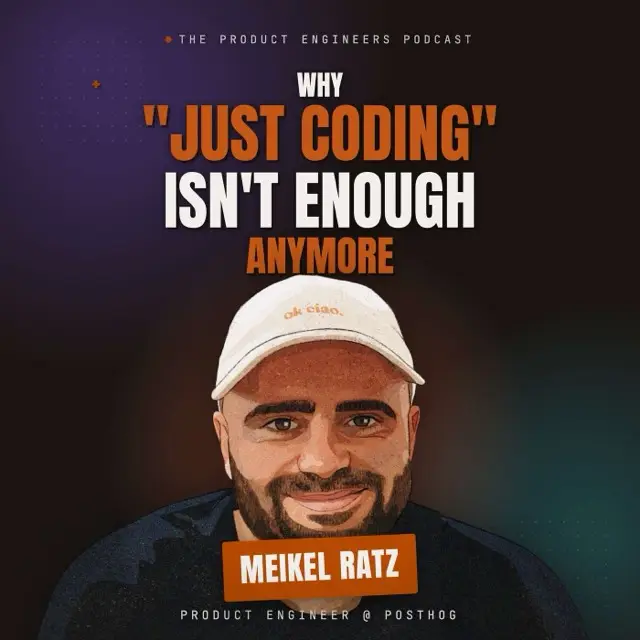
Meikel Ratz is a product engineer at PostHog, where he leads the messaging team. In this episode, we unpack the product thinking behind that role and what it takes to become a product-minded engineer: understanding customers, making product decisions, thinking about revenue, and deciding what to build instead of simply working through tickets.
In this conversation, we explore what happens to software engineering when writing code is no longer the scarce skill. Meikel shares how product engineers work at PostHog, why “snacking work” can consume your day without moving the needle, how engineers can develop business sense, and why data, customer context, and sometimes gut feeling should drive what you build.
Listen on YouTube, Spotify or Apple Podcasts
In our conversation, we discuss:
1. Why solving problems, not writing code, has always been the real job of software engineers
2. “Snacking work”: the small, satisfying tasks that consume time without creating much impact
3. How PostHog gives engineers ownership over customers, product decisions, reliability, and revenue
4. How engineers can develop product and business sense, even if they’ve spent their career being handed tickets
5. Why data should drive product decisions, when gut feeling is still useful, and how AI changes the economics of experimentation
Where to find Meikel Ratz:
• LinkedIn: https://www.linkedin.com/in/meikelratz/
Lessons Learned
- Optimize for outcomes, not output. Finishing tickets or writing more code is not the goal. Ask what actually improves the product, customer experience, or business.
- Eliminate “snacking work.” Small bugs, cleanup tasks, and tightly scoped chores feel productive because they give quick dopamine hits. Automate or delegate as much of that as possible so you can spend time on harder problems.
- Start with the customer. Before building something, ask: Does the user care? Even deeply technical work should connect back to performance, reliability, cost, or another user benefit.
- Get closer to product decisions. Join customer interviews, read support tickets, study usage data, and understand why features are being built instead of only how to implement them.
- Learn the business behind your product. Understand revenue, pricing, costs, free-tier limits, competitors, and which customers create the most value. Product judgment gets much better once engineering decisions have business context.
- Use data to challenge assumptions. Instrument what you ship. Look at usage, adoption, churn, revenue, and failure points instead of relying purely on opinions.
- Don’t wait for perfect evidence. When experiments are cheap, intuition is enough to test an idea. Ship behind a feature flag, measure what happens, and kill it quickly if nobody cares.
- Build something yourself to develop product sense. A small side product forces you to choose what to build, talk to users, process feedback, prioritize, and think about value instead of implementation alone.
- Own reliability as part of product quality. New features are not automatically higher-impact work. Bugs, outages, poor performance, and scalability problems directly affect whether customers stay.
- Reduce attachment to your code. The useful question is not “Was my implementation preserved?” It is “Did the product get better?”
- Seek context instead of waiting for it. If your company keeps engineers away from customers or business data, ask for access and demonstrate what better decisions you can make with it.
- Choose environments that reward ownership. Product-minded engineering is difficult in organizations built around rigid ownership, handoffs, and layers of approval. Culture can either amplify these skills or suffocate them with quarterly planning documents.
Chapters
Resources
- PostHog: https://posthog.com
Transcript
8,437 words
There's a belief that has ruled our craft for decades. Writing great code is the job, but code is now commoditized. Agents crank it out while you sleep. So what's left? Today, I'm talking with one of the best people to respond to this, Michael Ratz, product engineer at PostHog. He leads the messaging team at a company where engineers make the product decisions. No tickets, no backlog. Every morning, he decides what moves the needle most, and then builds it. In today's conversation, why most of your day is snacking work, little dopamine hits that don't move the needle. What engineers actually do when nobody hands you a ticket.
How to build business sense even if your company keeps you in the dark. And why data, plus a bit of gut feeling, should drive every single decision. If you've ever suspected that just coding isn't enough anymore, this episode is for you.
Peppe Welcome to the podcast, Mike. It is great to have you here
Meikel Thanks a lot. It's really nice to be here
Peppe Nice. Nice. Yeah, you have to, you have to know this is gonna be the first, uh, episode of the all season, we have a big responsibility on our shoulders to set the scene for what it means to be a product-minded engineer, and I'm sure you have-- gonna have a lot of interesting things to share with us.
Meikel Uh, I, I hope so, and for sure that's not a lot of pressure already on our shoulders.
Peppe So, okay, um, I want to start with, uh, you know, very, very abstract question, I would say. Because, you know, s-since AI came to our world, we got-- our identity as a s- as software engineers has been kind of shattered a bit, and we are trying to understand what's gonna happen for us, where we're headed. And, um, I think it's, it's useful to th- to talk about what's always been the, at the most fundamental level, the, the, the role of a software engineer.
Meikel that's an interesting one. I think, like, it has always been solving problems from day one. I think there is different sort of views on that. I feel like for some people or, like, in some, some companies, like software engineers were treated, like, as a, uh, department that, you know, like you, you give work, uh, that PMs or maybe sometimes even, like, C-level sort of crafted, and then software engineers were just, like, the implementation layer because, like, you had the craft to write code. Um, I think there were always companies that did it differently. Um, but the, the first sort of company type that I mentioned I felt was still the majority.
This is how I worked for a very long time in, in a consultancy that I worked in. Like, it was a lot of, like, writing the code was the job and not actually solving the problem. Or you could maybe look at it in a way where- In the past, solving the problems meant writing the code, as in, like, technical challenges that needed to be solved. And nowadays I feel things are thankfully shifting. Um, and AI, AI just makes it a little bit easier, I feel like, for those new roles, like product engineers, to pop up, where solving problems actually means way more. So it can be solving problems from a product perspective.
It involves, uh, I would say generating the code nowadays more than writing it yourself. Um, but then also, like, having an understanding about the business of, like, what things should we even build, uh, what, what is not worth building, um, and how much revenue are we making from, like, certain things. Um, so I think, like, engineers also need to step up if they want to sort of work in that sort of environment
Peppe Right. So you make a good point there, um, that we've been very focused as engineers on the coding part. Um, it's been a bit on our side, but also our-- what companies ask of us. what, what do you think, in your experience, output, so the assets we produce are so easily confused with, with value?
Meikel So, huh, I think they always were, and still are. I think like now, again, like the, the whole point of all of this shifting is I think like rethinking what value means. I think in a very c- classical company, you had tickets, and, uh, you looked at engineers, um, or like rated them the highest when they were able to chunk through a lot of work, meaning this is tickets. Uh, in, for example, other companies, um, like for example, like at PostHog, we don't have tickets. We don't have, uh, issue tracking, really. So every morning you kinda wake up, and then you decide, cool, what is the, the thing to build that moves the needle the most?
Um, and I think value becomes customer satisfaction, and that turns into revenue. Um, so I think overall through AI now, people have way more time to think about these things, especially from the engineering perspective, which to me is a very good thing 'cause we don't get sort of assessed on the code that we produce. That's still part of the job. That's not going away, 'cause we are still responsible for the code going into production. Like, you sign it, sort of, although it got sort of generated. Um, but you're ev- like essentially measured on value when it comes to, are you satisfying customer needs?
Are you satisfying, um, revenue goals, uh, that you might have set, like making a product successful? Um, yeah, I think like it, it changed in a good direction
Peppe Right. uh, for, for, for what we know from what PostHog writes in the-- on the web, you guys have been doing this for a while, even before AI, right? So PostHog came out in two thousand and twenty, and, uh, you were already hiring product engineers. So y-you had-- f-for two years, you didn't have product managers, so all the product decisions were on your shoulders. Um, how, uh, how challenging do you think that has been without AI, and how are things changing with AI now, uh, in terms of working as a product engineer in PostHog?
Meikel I don't think it changed that much. I think it accelerates things. It makes, uh, expectations higher on the things that you're actually building. So I think pre-AI, a lot of, uh, work was also like, uh, we, we call it keeping the lights on work, um, which is sort of toil, right? Like it's, it's fixing little bugs. uh, addressing issues in a customer support ticket. So we at PostHog, like we do customer support as well. Um, so that's part of your job as well. Um, it's, it's, those little things that like snacking work.
Uh, mean, like we, we had this on the, on the talk that I did in Berlin, uh, where snacking work is basically all of those little things that give you a dopamine hit, but they don't really move the needle. And I think at PostHog we are very determined to remove that work completely, um, so we can focus on the hard problems
Peppe Could, could you give maybe an example of what's snacking work for you, and how do you define problems?
Meikel Right. Um, so I think snacking work is like little bug fixes, is maybe a customer saying, "Hey, uh, we have-- we are missing a little thing to make it work better for us," which is very trivial. It's very scoped work. Um, so it's very easy to like scope out the work, give it to an agent, and the agent does probably a way better and faster job than you do.
Peppe job than you do.
Meikel it's, uh, cleanup work, right? Like you release something behind a feature flag. You have a lot of code paths, Um that you then, once you roll out completely, need to sort of gather, remove, make sure everything works as well. These types of things took quite a, a lot of time, like in the span of your whole week, uh, where now you basically... Or like how I work, I go like @posthoc in the, in the Slack threads, uh, and it does all of that work for me. So that's sort of the, the kind of snacking work. Um, it's also like little features, bug fixes, uh, all of those very scoped things. And the hard work is actually deciding what to build.
I think like talking to customers, uh, maybe taking a look what competitors are doing, working on the vision of the product, uh, that's sort of the product-y type of work I would say that we're doing. And then the, the hard bit is building these things, uh, in a way where they also scale. And I think like maybe that's also different for, uh, different companies in different stages. Like at PostHoc, everything's quite large scale, so you need to make sure you don't blow up like our databases or everyone has a great experience. So like architecting it in a way where it's still is doing a good job to serve the customer needs is quite a big part of the job.
Um, but it's overall also building the things that are very hard to build. Like if your product is, um, like something like Zendesk where you raise a ticket, uh, you can leave a comment on a ticket and, uh, and then resolve the ticket, that's very easy, I would say. Uh, so like Alex, one of our like product engineers working on the Conversations product, he built that alone. So like we are fully off of Zendesk with a self-built product that we're offering now for free. Really, really hard things are very, I feel very, infrastructure-heavy things very It's things, that take a lot of exploration work that have not been done yet.
And I think like that's actually the things that are not easy to crank out with AI and to like sort of vibe code your way through it, but they just, they would involve so much work that it's still worth paying a SaaS for it rather than building it yourself.
Peppe I don't know if you had this in your experience, but, before AI, we had s-maybe some b-big issues, bugs, and problem to solve that I would categorize in the snacking as in, as you, as for your definition. And usually those-- the people fixing those, those bugs, those, those issues were seen like, uh, heroes, right? So, oh my God, you saved the day. You're doing all this hard work to make a product stable again, you know? so yeah, I, I think this is a... It's, it's a good time to, to also have, uh, maybe these engineers that are a bit more, um, interested in impact
Meikel Yeah.
Peppe that...
Meikel maybe like one thing to add to that. I, I think both are equally valuable. Well, I, I think you need to do both types of work. Like, yes, having impact and building big features is super important, but people don't churn because you have not built maybe one or two features fast enough. Like, as long as you ship, you're good. As long as you talk to your customers to ship the right things, you're good. People might churn because your product is buggy as hell. They might churn because it's very unreliable. You have a lot of outages and all of these things.
So I think like bug fixing, scalability work, like basically making a product reliable is equally as important as cranking out new features. For sure, in different stages of your company, I feel like if you're a early startup, probably like your biggest sort of goal should be finding product market fit, cranking out those features, and, uh, seeing sort of what sticks and talking to customers.
Peppe would
Meikel that's more maybe of the size of PostHog, where people actually build business logic on top of your like self-driving product or,
Peppe to
Meikel that we offer, like for example, I l- I lead the messaging or like the CDP team, people send out like emails to customers. They build up like those graphs that contain business logic. If that doesn't work very, very reliably, people get pretty quickly and are leaving your product. So I, don't think... I still feel those people in the shadows that do reliability work like deserve the credit, 'cause that's al- that's hard work as well. So I would not say like impact work is the feature work. I feel like impact work is whatever needs to be done in
Peppe them what we need We don't aim at what works after the
Meikel the product
Peppe is done for the order it belongs product bugs and poor performance and all of that, it's, it's still part of the user experience, right? So it's, yeah, it's, uh, it's all important. So you, you were also mentioning regard like the, the, uh, hard problem, your hard problem definition and what, what it, what it means that. Um, and I, I can imagine someone in the audience may, may think, "Isn't that something that product managers are supposed to do?" Like dealing with, customers, thinking about what to build and, uh, what impact these features are-- have on the, on the business, on the users. Um, what, what would you say to them?
Meikel I think it depends. Uh, I think it depends on capacity. So I, I don't want to make it very black and white as in engineers should do everything always. I think it just depends, first of all, on the company that you're in. Uh, sometimes you do need quite a lot of, like, industry knowledge as, again, like if you work for a renewable energy company, uh, like knowing your way around laws, knowing your way about regulations, um, having deep knowledge in, like, certain areas
Peppe deep
Meikel just necessary to talk to customers.
Peppe very helpful for
Meikel with other companies like, again, Postdoc, where it's a very it's very Where the customer are basically ourselves, it's very easy to say, "Cool, we don't need that traditional layer in the way that it was done before." So my team still has a PM which does an amazing job of, like, giving us context. Um, he is also doing, like, customer interviews, especially in the times where we are just very busy building. Um, he's bringing in a lot of, like, revenue data, like structuring the data that we have, so we have the right context as well in numbers. Um, I don't think necessarily you don't need product managers.
I think you need to sort of rethink the role, and you might only need to hire a product manager maybe later on you work in an industry where, like, engineers or, like, engineers
Peppe engineer,
Meikel can do the product work as well. But it also depends, thing is hiring, and not every engineer wants to do that.
Peppe being an engineer
Meikel PostHog is working in that way 'cause, uh, Tim and James did an amazing job early on hiring the right people with the right mindset, with low egos that are not attached to code. So if someone goes ahead tomorrow and refactors all of the code that I've ever written, uh, and it's better, I would go like, "That's fantastic." Like, I'm not attached to any line of code I've ever written, as long as we make the product better and we all succeed as a company. But it just takes a very distinct, very homogenic group of people,
Peppe I enjoy my
Meikel to do that. Like we just can't afford, like, people that are very,
Peppe we make the product better
Meikel high ego, very attached to whatever they build. we we just need people to be very open and thriving in an environment where autonomy, to sort think about the product, talking to customers, also doing the engineering work and, if an incident happens, have an SRE team that's helping. Like, have an SRE team,
Peppe a degree
Meikel sort of a platform team helping us as teams to, like, deal with incidents in a better way. So I think, like, just need to hire the right people. It's not a very,
Peppe that "Oh, everyone can do it."
Meikel Yes, everyone can, but only if you really want to.
Peppe only to a degree. Mm-hmm. you made an interesting point before saying that, um, the way you work at PostHoc, it's made, it made-- it's made easier by the fact that you're working with a developer, developer tools. So engineers are the first users. Uh, it would be a bit more difficult in a more like a regulator or bureaucratic industry where you need more knowledge and/or experts. But would you say, just a question to you personally, would you think that if, if tomorrow you go to work w-with one of those companies, would you be able to transfer your, your meta skills there and do the same job if you're doing, doing a PostHoc?
Meikel Yes. So I worked at a renewable company, like renewable energy company before, where I my best to be as much as a, of a product engineer as I can, uh, with just certain limitations. Usually, those companies are shaped in a very different way. So I still believe if you shape your org in a way where people
Peppe To
Meikel products completely, like end to end, even if it's with a product manager that has just... Or like let's call it matter expert or something, um, I think you can still succeed cause like I was learning things about the energy market, how it works,
Peppe it works,
Meikel how you need to like sort of, buy energy, what that means, uh, what types of regulations are around it, like how do we need to handle like those cases. I think it just takes way more time. So I think it's also like a investment in your staff in a way. Like, do you want engineers to spend the time to become as well experts over time in the energy market to do more and more of this type of work? Um, or, or you just simply don't. So again, I feel like this is a very,
Peppe that by getting into it, this is a very
Meikel uh, top-down decision on how you structure and run your company from a C-level, 'cause if you don't like enable people to do that, you can have the, the best product engineer, the person who wants to learn the most, they eventually will get frustrated and leave the company 'cause they won't be able to do like the full end-to-end kind of thing that they always wanted to do.
Peppe Yeah, that makes sense. Um, you mentioned limitations. So could you give some examples of that you can have in these companies that would not enable you to be like a product engineer, like in Postmates?
Meikel Uh, I think it's culture mainly, to be honest. Uh, so I think it's how... First of all, culture is not necessarily only, uh, by the C-level enforce. I think it just goes hand-in-hand with hiring so much. So if you hire a bunch of high ego people that are very... You know, like people at PostHoc, for example, everyone can build everywhere. So if I see, I don't know, error tracking, um, or we could build a cool messaging integration with error tracking, but that involves me going into, like, their code space, I- I'll just do that, and I'll tag them for review. But they'll be very happy for me to do the work, uh, and to have a neat integration.
If your company is set up in a way where everyone's very protective, like you have a maybe blaming culture of like, "Oh, like now this, like, gone wrong, so I'm gonna point fingers." And like all of these people are not encouraged to, like, open PRs in other
Peppe PR is another thing
Meikel This creates like sort of
Peppe of a barrier to like prep and like build the sense like the families don't need a lot of prep. They need like teams to be comfortable,
Meikel barriers to like spread and like build the things necessary. Then you need a lot of plannings. You need Like teams being dependable, uh, dependent on, on, on each other. You need those big like, uh,
Peppe developers,
Meikel " Oh, like this quarter, this team needs to build this, and then this team can build that," and like blah, blah, blah. And suddenly a feature that could have taken a month to go live with the right people building it end to end takes up water 'cause, like, you kind of work in this waterfall kind of way, where not encouraged to, like, get together in a room,
Peppe the
Meikel hackathon-style thing and just build it. But you have PMs
Peppe have
Meikel You have maybe,
Peppe structure,
Meikel masters or, like, engineering managers or, like, whatever. Like, you have so many layers you need to go through. So I think, like, the more layers and the more complexity you also have in your, like, company structure, like that makes it way harder for people like me or like anyone else who likes to build across the whole stack, uh, to actually get to the goal Hey, Pepe here. Quick pause. I promise it's a short one. Season two of the podcast will be all about helping engineers become product-minded. Want to know when new episodes drop? Subscribe to the YouTube channel, or even better, rate the podcast on Spotify, Apple Podcasts, or wherever you're listening.
It helps more engineers find the show. You can also find everything at productengineers.com. And now back to the episode.
Peppe the product engineer, which as you maybe also seen is getting quite hyped ri-right now. I mean, I've seen the role growing a lot in the last four years. It kind of reminds me what happens a bit with Agile, everyone wants to be agile. Uh, let's have agile teams, and then what ended up ha-happening is that we have all these very agile teams isolated from non-very agile company, which is still planning like the whole quarter or the whole year. So it's, yeah, it's, it's always a culture problem. So it's, uh, it needs to change from, from, from the top, of course, as you were saying. Um, cool.
So, you know, following up on this, um, a lot of companies now are hiring for product engineers, uh, or for, let's say, product-minded engineers. Uh, so I'm seeing this kind of job posting right now. And Uh, I can imagine a lot of engineers in the audience, but in general a bit worried about this because they've never been doing that before. So you were saying that, like, to work at PostHog, you need to be a s- a specific kind of, of a, of engineer. You need to care about, product and impact, and you, you don't have to have this big ego about y- the work you do and the code you write.
maybe not everyone is this kind of skill set or this kind of personality, but companies are starting to ask about that. So if you, if you had to give like a generic definition of what it means to be, to be product-minded nowadays, so to help these engineers, uh, you know, get started with it. Uh, I wouldn't say the PostHog way, which could be maybe a bit, uh, too much to start with. Uh, but in general, how, how would you define a produ- produ- product-minded engineer, even in a company where, you know, there are still PMs and all the, that stuff there?
Meikel It's so hard. Um, I think, like I don't, I don't know about how anyone else feels, but I felt to me it came very natural, um, in the sense that I wanted to solve problems. So yes, I'm also very interested in the technical part and, uh, solving very hard technical problems is still, I think, my most favorite thing to do as well at PostHog. This is why I joined, uh, is yes, the product engineering bit, but also like the engineering challenges that you get,
Peppe managers
Meikel me very naturally there. I wouldn't say like you-
Peppe long run. I
Meikel feel for me that's just a good engineer, and it just depends on where you drop them. So if you work in a, a product company where, I don't know, your product is something like Postdoc,
Peppe something
Meikel a genuine interest in we building, why are we building it,
Peppe a
Meikel building it, and are we actually solving a problem with it?
Peppe What
Meikel charge for it in a way... Or like can we build something that
Peppe building
Meikel we charge for it, we actually can make money and sustain like a business around it?
Peppe And are
Meikel so
Peppe actually
Meikel that feeds into the whole thing, I feel. So like it... You need good engineering skills to build systems that don't all of the money your company has to solve a problem.
Peppe an engineer to build a good system that can earn honorable money your company has, solve a problem,
Meikel you, you need to be interested in the customer that you're serving. join, uh, user interviews, right? Like, I feel Like, the easiest bit to do as an engineer when you say, "Cool, I would like to, to be more like that," uh, just join, uh, product managers in, in the user interviews that they're doing get more involved in the work that they're doing as well. Learn from them. I feel like a big part of like PMs at Postdoc is, uh, as well. Um, like sort of how to look at, a problem through the eyes of a product person. I don't like the word product manager.
I don't like the word product engineer maybe necessarily, but like a product person is always interested in solving a customer issue or like a customer pain. Um, or I feel the best
Peppe feel
Meikel on how to become a product
Peppe start start a product Mmhmm Build something It doesn't need to be big It doesn't need to have the ambitions of hoping you know a billion in evaluation It doesn't need to generate a lot of money But build something that you're passionate about. Like, build a product for yourself maybe, or like something you know, uh, just passionate about something. Like I have people-- I know people who are like really obsessed of like, uh, I'm a coffee enthusiast. I want an app where I can get the right essence of my coffee and how long it, uh, sort of, uh, went through my tummy because it's, it's a passion for coffee. That's effective if you tell your coffee enthusiast friends.
Uh, and then you're getting begging to talk to the people, uh, who used the app to it's just part of the process for it Um but all of these things at
Meikel start, start a product. Build something. It doesn't need to be big. It doesn't need to have the ambitious goal of hitting, you know, a, a billion e-evaluation. It doesn't need to generate a lot of money. But build something that you actually care about, like solve a problem for yourself maybe, or like people you know, uh, that they care about something. Like I have people... I know people build like silly apps of like, uh, "I'm a coffee enthusiast. I want an app where I can save the grind settings of my coffee and how long it's, uh, uh, sort of, uh, ran through my machine to replicate this exact cup, cup of coffee."
Build an app like this, it to your coffee enthusiast friends, uh- And then you'll get feedback. You need to talk to the people, uh, you need to actually think about the product. So I, I don't think it comes for free. It's not like, "Ah, I wanna be product-minded, so I'll just be it." It still takes work to get there. And yeah, you just need to be, uh, open to do that type of work, and talk to customers 'cause it's painful sometimes. Do support tickets, like, it's, it's not always fun to do support. like, all of these things suck at points, but overall, the general bigger picture is just way more fun
Peppe is way more and more diverse than
Meikel working day
Peppe Did you start a product? Uh, what ex-experience shaped the way, the way you are today?
Meikel That's a good question. Um, to be fair, I think... So I'm not the biggest fan of consultancies, but I think consultancies give you a good glimpse into a lot of companies, how companies are ran. Uh, you serve the customer, right? Like, you, you offer a service, and you need to make your customer happy. So you need to be in constant sort of communication of like, "Hey, what's the expectations?" Um, like, "What should I do? How does success look like?" Uh, for, like, your customer to maybe bring in more people 'cause they're as awesome as you are. So I think, like, a big part of it is actually developing sort of business sense in whatever context that means.
So that can mean in a service, right? Like you can have a car wash where you basically need the same
Peppe same skill,
Meikel or you build a product where you design chairs. Uh, you need to talk to your customers. So I think, like, having this,
Peppe been, um,
Meikel being forced in these sort of situation helps a lot. And I felt, I felt like I, I've had really awesome projects in in the consultancy that I worked at. I was very lucky to have joined in the golden years where every startup also could afford consultants to come in and help.
Peppe and also different sorts of consultants to come in
Meikel so I think-
Peppe personally
Meikel This is a good start.
Peppe Just additional
Meikel Or joining
Peppe joining
Meikel a company that is of encouraging this mindset. So I knew,
Peppe So I knew,
Meikel I, I worked at companies in this consultancy that kind of hired product engineers. Like very early on I joined like a, a, the, the German Netflix, uh, where we were just given a problem of like, uh, "Hey, we have this very technical
Peppe there's even a starting, uh, maybe like six, seven people. Mm-hmm.
Meikel how, how would you solve that?" And then we formed a team, went out and talked to the engineers that were our customers to, like, see what kind of solution can we build that serves both ends, like, A, the end consumer,
Peppe group.
Meikel the engineers that maybe don't want to be disrupted in their day-to-day work too much.
Peppe day-to-day
Meikel if you are drawn to communication, to actually understanding how to solve a problem in the best way, you're already 90% there, then the last 10% to me is find a company
Peppe have been
Meikel that, gives you even more responsibility where you can, like, do those kinds of things. But eventually for me it was like I worked s- almost six years in a consultancy, um, and then I was just fed up with the work that I was doing. You are there for a very short period of time, you do a lot of firefighting. In the end, like once you're senior
Peppe once it's been there enough, it's probably time that I
Meikel the problems become very repetitive. So my thing was, "Cool, I want to join a product and actually have a completely different challenge of, like, driving revenue, driving a product from maybe zero to success, but actually sticking around to see what that means, like all of the pain that you need to go through." So I think it was like partially being sort of educated in that way very early on that drew me to it, and then just the curiosity of like, how do I now go to a awesome company that just enables me as well to do that day to day for as long as I can think of?
Peppe Yeah. No, I completely agree with you. Like I, I had a very similar experience actually, um, as a, as a freelancer. So I was freelancing a lot, when you had to work with clients or maybe even startups at once, like an MVP and everything, that's part of the job. You really need to understand what they want, what are their pain points and everything. Otherwise, you end up doing a bad job and then don't get back to you, right? So I think, yeah, it's, um, it's, it's a very interesting experience to develop business sense. And following up to this, um, so let's say someone in the, in the audience, um, um, to start developing this, this sense, this, you know, business sense and everything.
So what, what, what kind of context do you think they should start, uh, getting curious, uh, with or understand, beyond the implementation side? Um, so talking about users, business, product strategy, anything else, what, what do you think it's a good starting point?
Meikel I think users are the first sort of the most important bit, and everything grows from there. So I think And probably every engineer can relate w- that you always want to build the most shiny thing. Like you maybe, I don't know, you see a problem and your first thought might be, "Oh, I've never built my own database. This would be the perfect thing to build your own database kind of thing." Uh, and then you, you do that because you're drawn to the technical bit around it, and you just want to get better at engineering, which is fair. Um, but I think actually asking yourself every time before you build something to be like, "Okay, does the user care?"
And the user cares for more than only the thing that they see. So if that makes the product extremely performant, uh, and loading times decrease by, I don't know, tenfold, uh, or it makes the product way more reliable because you build something, um, that's very... It, it's a technical thing that you build, but it still serves the user in a, in a very, um, obvious way. Uh, and being very critical about your own work of like, it-- am I doing this for me because I want to build this, or am I doing this for the customer to actually solve a problem?
So I think like the, the, the best context always is the customer, and I feel like product vision and, uh, strategy and all of these things come very natural once you mastered the customer bit. 'Cause once you mastered the customer bit, you, you are in constant exchange, you get support tickets, you get a lot of context from your, uh, customers that use the product on a daily basis. Um, and then you sort of... Another thing kicks in of like, cool, now I, I have the context of customers. Now the business context of like, are we making money? If not, why not? And how can we make money off of that without pissing off the customer too much?
Um, and from that sort of comes, uh, engineering, where you maybe need to re-engineer things to be way cheaper. Um, there might be pricing where you say, "Cool, now I need to go out and see how are our competitors pricing themselves. Are we way too cheap? Are we way too expensive, but have too few users to actually generate it? Is our free tier way too high, so most people don't ever come above that threshold, but they get a lot of value from the product, so maybe we need to adjust that a bit?"
Um, then from that, like once you've figured out the money bit, comes product vision, I feel, where you go, "Cool, now we have a very steady product that if we develop it, like things will go very linear. Um, how do we get maybe the hockey stick revenue kind of thing? What cool thing can we build to draw even-" Like more customers into it. Like at, at the product that I'm building, uh, we build messaging, which is sending emails, push, like all of these things. So the first thing was always table stakes. What features do we need to even compete with other, competitors? What features-- Like what is the minimal set of features people need to use the product and get value?
The second bit was like, now that we have that, how do we price ourselves and position us in the market? What's our USP that's setting us apart from competitors? Once we've done that, now comes h- like what's the next cool thing nobody's doing that we can sort of be, we're the only ones doing that, and we're doing it amazing. And that's, for me, that's product vision. This is where AI and LLMs now can do so much magic, where you can prototype a lot of things, where you can think of like, cool, if we build something that's self-healing, blah, blah, uh, can we charge more for that because it's of higher value? Uh, and people might want, people might want that.
But like, you know, then you go back to understanding the users, doing user interviews about your idea. So you go full circle all the time, I feel.
Peppe Yeah, that's very interesting. How does this look like in Postdoc? So for example, you as a protein engineer, you want to access all this information, uh, maybe don't-- you don't have them. Uh, so what, what channels do you have in place? What processes that can, that can support you in that? So maybe, you know, other companies can get inspired by this.
Meikel I think data, as everyone agrees, is the most valuable thing. Um, and that also accounts for your business. So like having all of the metrics, uh, this is where PostHog, to be honest, is pretty amazing at. Uh, you can track your active users. You can, you can basically, um, instrument everything that you are interested in, right? Um, and that gives us a lot of insights. Like for example, in the messaging product that, that I'm building, um, we very recently looked at, okay, we have table stakes now. Um, we... Every two weeks we have, uh, we have We don't have growth review that's, that's happening once a month.
But, like, we talk to our PM, we look at the money that we're making, we look at the key metrics that we're interested in, as in, like, how many new workflows were created, how many emails are we sending out, like, all of that. How much money are we generating on a monthly basis? And if we don't see, uh, revenue growing a lot, like, we need to ask questions. As in, is this product... Is there a demand for this product? Um, are we offering the right features? Like, are we missing something? Do we need to do, uh, go do user interviews or, like, a, another competitor analysis to see why are other companies doing better?
Um, we, for example, like, uh, very recently had the thing of, uh, pricing, where we said, "Hey, we're sending quite a volume of emails and, like, uh, destinations." Like, people are getting a lot of use of the product, a lot of value, uh, but we kind of, uh, don't utilize our pricing in that way. Which means, like, are we... Our free tier is way too generous. People get value, but, like, we don't charge for it. And then we, we only had, like, our pricing was very broad. So it was like, oh, maybe we only charge from, you get 10,000 emails for free, and then between 10,000 and a million we charge whatever amount. And then between a million and 10 million, we charge a little bit less.
by adjusting the pricing bands of, we, look at much money, um, or, like, what is the main user of the product, how much volume are they sending? How can we adjust our pricing bands maybe those users to pay more, and the people that get less value, we charge even less, and the people that have exorbitant amount of usage, we might even still be cheaper there because it's very few customers, and we're still making more than enough money off them. So I think, like, data is the thing that drives all of... should drive all of the decisions, especially when it comes around revenue.
Peppe the way
Meikel and talking to users. we would see usage not being great, would go and talk to customers, figure out why are people not using it, why are they churning. You can use session replays to, like, see maybe you have a bug where, I don't know, people fail to set up,
Peppe to
Meikel Um, they get frustrated and they churn, and they never come back. Like, so it's instrumentation is the best way to find out what's actually happening in your product. There is, there should not be any guesswork left, um, for you as an engineer as well
Peppe for you as an engineer to also present something and find out what's causing the problem
Meikel and find out what's causing the problem
Peppe Right. So just to recap, um, so you're saying data is very important, and so instruments, your, your, your software, so you can gather this data and use that to drive your decisions. But also, uh, have these kind of meetings with the TM, where you kind of see what's, what's going on based on revenue and everything, and then continue making decisions based on that information.
Meikel Yeah.
Peppe Cool.
Meikel be honest, just also sometimes gut feeling. If you feel this is a cool thing and you would use it, and you might maybe not have the data to back it up, just build it, roll it out, see if people use it or not. Code is commoditized. It's so cheap to build things, so just build it, roll it out behind a flag, see if you get usage. If you do, cool. Like, let it, let it be. If you don't, just kill it again. Like, it's so cheap nowadays
Peppe Yeah, absolutely. Yeah. So i-if you, let's say you, you don't have access to this information, you're not exposed to them, do you think are the, the side effects on your work as an engineer?
Meikel Well, I, I, I would be blind, right? Like, so you'd, you would not know what to build. Um, it would be very hard to, like, move forward, I feel. So for us, it's the most important bit is to have all of this data to act upon. If you don't have it, not much you can do, I feel. Like, you can... I, I would start building tools to get this data now. Like, now that I know how valuable it is, my day-to-day would shift towards building tooling to get this data so I can actually make informed decisions rather than just doing guesswork. Um, what you could do is just start building a bunch of stuff and see what sticks.
Uh, again, now that code's very cheap, you could do that, but then you would also need to instrument it to see if people actually use it or not. I would start to build things. Yeah. Yeah. so I think it would change in a way where if those tools wouldn't exist, if I would not have access to this type of data, would start building those tools
Peppe and what about a situation where engineers are, are told what to build, right?
Meikel Mmhmm
Peppe the majority of companies nowadays. Um, how, do you think not having access to that context affects their work even technically? Like, y- do you think there are some side effects there or is still feasible?
Meikel I think it's feasible because most of the companies work that way. Uh, and to be honest, like, companies are doing not bad, right? In the sense of like, there is companies that give engineers the tickets to work on, and then they do that, and they still are doing well. So I'm, I'm not being like, uh, I'm not being unrealistic of like, "Oh, everything will crash and burn." I don't think it will. I think people will just leave. Like, it depends on how you like to work again. Like, if you...
At PostHog, for example, we, we have very, very small teams, and we can have that because everyone's very motivated, everyone wants to build a lot of things, solve customer problems, and we don't need all of those layers, um, to abstract that away from engineers. So I feel like it allows us to run a lower headcount, which just means we make more money, and we can move much quicker. I think if you don't have access to the data and you, you are frustrated by it, uh, you can talk to the people responsible for it. You can talk to the C-level, maybe to your engineering managers. I don't know what the hierarchy is in, in most of the companies, to be honest.
But like, you can try to get access to the data, and then sort of showcase how much more you can do with access to that data 'cause I feel like that's the other thing. If you have access to the data, and you don't do anything with it that is very fruitful, what good was it, right? Uh, but if people say, "Cool," like, "We don't want that as a company." Like, your job is to write code, and you say, "Cool, that's not what I want to do", uh, leave that job. Just go somewhere else where working like this is encouraged, or build your own company to sort of do it your way, whatever.
like no one's forcing you to stay in a job, uh, that you don't want to be in, and I think a lot of companies will feel that pain because more and more positions of product engineers are sort stay in that you And I think a lot and a lot of people are leaving towards those positions 'cause it's just a more interesting job, to be honest. It's more diverse, and it's more fun, and once people start having a lot of churn in their staff, they need to either rethink or they might get disrupted by companies that are, like, a 10th of the size of what
Peppe need this
Meikel at the current state.
Peppe might be something about the company that oftentimes comes off the back of what they offer in terms of- Yeah. And also we can't really ignore the, the impact that AI is, is having right now and is gonna have in the future, right? Because we don't know in like maybe in five, ten years, maybe really agent will be good enough or some other AI technology will be good enough to all the code. I mean, even the, the entire system. So the-- I think the direction is actually the, the right one because you will have way more time that you can have as an engineer because you're not doing all that stuff. So what do you do with that time? Do you speed more features?
It's Uh, or you can maybe upscale and, uh, try different things in product design, whatever. But uh, it's already changing that. I, I can see that a lot. Yeah. Cool. So Mike, I think we are at the end of the, the-- of this episode. It's, it's been great talking to you. Um, where can people get in touch with you or follow they want to maybe ask any follow-up questions? Uh, what's your best channel?
Meikel Uh, probably LinkedIn, to be honest. Although it's a weird platform, but I think it's still the best in like a professional kind of use case. Uh, and it's-- To be hon- I don't check email at all, to be honest. Uh, so if you have anything, just add me on, on LinkedIn. I don't know if you can sort of blur in my th-thingy. Uh, and then, yeah, just reach out. Uh, ideally, so maybe to, uh, to say that upfront, I think there is just lots of people adding people with no context. and I usually, I, I usually don't accept those things 'cause it's just like, it's so meaningless, and it usually leads to nothing. And I'm not collecting, uh, people on LinkedIn.
Uh, so leave a note, uh, with, with the question or like with something interesting or like, uh, that you listened to the, to the podcast and, and you came to like, I don't know, exchange. Uh, and I'm more than happy to accept and talk about it. Uh, but yeah, just that you don't feel rejected or ignored, uh, in case I, I'm-- I might not accept when someone just sends a weird invite from a person I don't know, so.
Peppe Sounds good. Yeah, I'll make sure to add
Meikel Great
Peppe your LinkedIn profile in the description.
Meikel Cool
Peppe Thanks, Mike
Meikel Yeah. Thanks a lot for hosting. It was, it was a pleasure