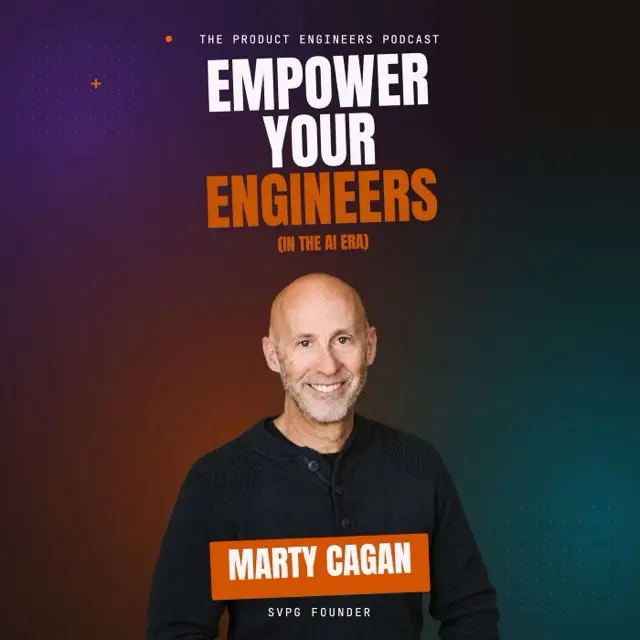
What happens to engineering judgement when AI makes building software faster? Marty Cagan, founder of Silicon Valley Product Group and co-author of EMPOWERED: Ordinary People, Extraordinary Products, explains why engineers need a voice in deciding what to build.
We explore what separates an empowered product team from a feature factory, and why automating delivery can leave a company shipping unsuccessful ideas faster. Marty describes how engineers can contribute to discovery through customer conversations and prototype reviews, while continuing to build reliable software. We also discuss the difference between empowerment and autonomy, how AI could change team dependencies, and practical steps engineers can take when their organisation still works from a fixed roadmap.
In our conversation, we discuss:
- Why engineers can be your strongest source of product innovation
- Why using AI to speed up a feature factory can deliver failed products faster
- How engineers can make time for discovery and help shape prototypes before a solution is decided
- How empowerment differs from autonomy, and why smaller AI-assisted teams could reduce dependencies
- How to start changing a feature factory from within through customer contact, usage data and small experiments
Where to find Marty Cagan:
- Silicon Valley Product Group: svpg.com
- Marty's writing and contact details: Marty Cagan at SVPG
- LinkedIn: https://www.linkedin.com/in/cagan/
Lessons Learned
- Start with a problem and a measure of success. In the product model Marty describes, a team receives a problem to solve and an outcome to achieve. It then discovers a solution and delivers it. A roadmap of predetermined features removes much of that responsibility. Completing the work tells you that something shipped; it does not tell you whether the customer or business problem was solved.
- Bring engineers in before sprint planning. Engineers work with the enabling technology every day, which gives them a chance to see possibilities other people miss. Marty argues that a team loses that contribution when engineers first encounter an idea at sprint planning. Include them while approaches are still being explored, so their knowledge can change the solution rather than only its implementation.
- Understand all four product risks. A solution needs to be valuable, usable, feasible and viable for the business. Marty assigns feasibility to engineers, usability to designers, and value and viability to product managers. Those responsibilities still leave room for everyone to contribute. An engineer may uncover an idea that creates customer value, while needing a colleague's expertise to understand its commercial constraints.
- Ask why a solution deserves to be built. Engineers should challenge an idea when its purpose is unclear. The idea may be weak, or the product manager may have important context that has not reached the team. Either way, asking helps establish a shared reason for the work. Marty sees this as an essential responsibility of a tech lead: build because the team believes in the solution.
- Use AI gains to improve the outcome. Faster delivery does not fix a process that chooses the wrong things to build. Marty describes companies accelerating their existing project model and getting failed products faster. His argument is to use AI within a way of working that discovers what will help customers and the business. Assess the result of the work as well as the speed of producing it.
- Give prototypes and production software different goals. Marty calls discovery building to learn and delivery building to earn. A prototype helps the team assess whether a solution is worth pursuing. A production product also needs reliability, performance and the other qualities required to sell and support it. AI can accelerate both activities, but a convincing prototype still leaves engineering work and product questions to resolve.
- Make discovery part of an engineer's day. Marty suggests about half an hour for activities such as joining a customer call or exploring the latest prototypes. Most of the day can still go towards production software and managing agents. Regular exposure gives engineers a developing understanding of the problem and the proposed approach, rather than requiring them to reconstruct that context from a specification later.
- Try the prototype and look for a better approach. Engineers do not have to create every discovery prototype to make a valuable contribution. Playing with it helps them understand the proposal, spot feasibility concerns and suggest alternatives. A technical insight might eliminate a step or derive information the design asks a customer to enter. Those suggestions matter most while the team can still change its approach.
- Keep the solution open when handing over a prototype. Giving engineers generated code and asking them to make it production ready can repeat the same feature factory pattern. A prototype communicates an idea, but engineers also need the opportunity to question and improve it. If the only remaining decision is how to implement someone else's solution, the team is missing the innovation Marty expects engineers to contribute.
- Learn how your customers differ from you. Building tools for developers can make it easier for engineers to understand their users. Other domains bring unfamiliar needs and business constraints, including sales, finance and compliance. Marty also warns against assuming customers want to assemble their own AI workflows. Having the tools available does not mean people want to use them; understand the job they actually need to do.
- Separate empowerment from autonomy. Empowerment gives a team room to find the best solution. Autonomy concerns how far it can deliver that solution without coordinating with other teams. Marty sees the possibility of smaller AI-assisted teams taking on broader scope and reducing dependencies. That is a prediction, and it does not make every dependency undesirable: shared infrastructure and platform teams can still provide useful foundations.
- Show a small experiment from within. Leaders decide much of an organisation's operating model, but engineers can ask to try a different approach with one team. Start by seeking customer contact, usage data and business context from product colleagues or sales. Turn a promising alternative into a prototype, show it to colleagues and, where possible, learn from a potential customer. Concrete evidence gives the proposed change something people can assess.
Chapters
Resources
- EMPOWERED: Ordinary People, Extraordinary Products, by Marty Cagan and Chris Jones: https://www.svpg.com/books/empowered-ordinary-people-extraordinary-products/
- The AI Productivity Paradox, by Marty Cagan: https://www.svpg.com/the-ai-productivity-paradox/
- A Fresh Definition of the Product Role, by Marty Cagan: https://www.svpg.com/a-fresh-definition-of-the-product-role/
- Benedict Evans on Another Podcast: Most people and companies aren’t tool-builders: https://open.spotify.com/episode/4NkYXMBNyXqxihujGGSytc
- Atlassian: The State of Teams 2026 (source of the 89%/6% figures): https://www.atlassian.com/blog/state-of-teams-2026
- Earlier episode with Meikel Ratz at PostHog: Why "Just Coding" Isn’t Enough Anymore: https://productengineers.com/episodes/season2/why-just-coding-isnt-enough-anymore/
- Product Therapy, hosted by Christian Idiodi (SVPG): https://podcasts.apple.com/us/podcast/product-therapy/id1738373011
- Claude Code: https://claude.com/product/claude-code
- Cursor: https://cursor.com/
- OpenAI Codex: https://openai.com/codex/
- Lovable: https://lovable.dev/
Transcript
8,466 words
Sprint planning starts. Someone shares a feature, explains the requirements, and asks how long it'll take. It's the first time you've seen the idea. For Marty Cagan, that's already a sign something has gone wrong. Marty is the founder of Silicon Valley Product Group. He's the co-author of Empowered, one of the most influential books in the product world on empowering teams, including engineers. In this conversation, we explore why engineers can be your strongest source of product innovation, why AI can help a feature factory deliver failed products faster, and what making time for discovery actually looks like in an engineer's day.
We also unpack why handing engineers an AI generated prototype to make production ready still misses their biggest contribution, the difference between empowerment and autonomy, and how AI could reduce team dependencies. If you want your engineering judgment to shape the product, there's plenty here to put into practice. Enjoy.
Peppe Welcome to the podcast, Marty. It's such a great pleasure to have you here today
Marty Cagan Thanks for inviting me
Peppe So you've been really vocal and you've spoke a lot about and wrote a lot about, the concept of feature factories, right? just, just to-- before getting started with this, I'm sure maybe some people in the audience, which I- is mainly made of engineers, maybe they don't really know what it is. They maybe hear about it, but okay, they say, "Okay, am I in a feature factory or not?" what, what's your definition on that? Just to get on the same page.
Marty Cagan Sure. And, and honestly, there's lots of ways people describe this. For many, many years, people have talked about, you know, whether it's a feature factory. For a long time, the most common, es- especially in Silicon Valley, the most common language was, are you a missionary or are you a mercenary? I don't know if you've ever heard that, but the whole i- it's all the same thing. If basically you're given a roadmap of features and projects to build and, you know, you're probably given some expectations about dates, but the solution is essentially already defined, and you're there to just build. Don't ask questions really, but build. That's a feature factory.
Now- You can make lots of the arguments about that, but the biggest one is just that, look, most of the time we're given roadmaps of features and projects to build. Most of the time, those solutions are not actually going to work. They're not gonna deliver the value. When I say work, it's not very common today that they're just so full of bugs that they constantly crash. That's not what we mean. We mean It runs fine. It just doesn't do what it needs to do. So it doesn't accomplish... The customer doesn't have their problem solved or the business doesn't have their outcome achieved. and so that-- Who are you gonna blame for that? Is-- That's not the engineer's fault.
they're just building what they were told to build. And so a long time ago, I mean literally more than twenty-five years ago, the s- the best product people, at least in Silicon Valley, realized the root of that problem was we're t- we're just telling the engineers what to build. there's a very famous quote from Steve Jobs, who said, " Look, we don't hire all these engineers in order to tell them what to build. We hire all these engineers so they can show us what's possible." And that's just one of many examples where, in fact, the person that coached Steve Jobs and showed him how to run a product company was a guy named Bill Campbell.
Funny enough, he was literally the same guy that coached Larry and Sergey when they started Google and literally coached Jeff Bezos when he started Amazon. So all those companies, this one guy coached, the leaders on how to build a product company, and he told them all, and he actually told-- I heard this as well. I didn't get coached by this guy. I wish I did, but I was actually, uh, my manag-- Three of my managers in my career were coached by him. And he said, "Look, the single most important thing is the idea of an empowered engineer."
And the idea of an e-an empowered engineer is an engineer that doesn't just do what they're told to build, it's an engineer that is there to solve the problem. So they care just as much about what they build as how they build. And so this idea of an empowered engineer, which is really something that m-mainly just makes sense in a product company, right? If you're not in a product company, you may still build things, but you-- it's a different purpose. You may-- In fact, if you work for a company like Accenture, your job is to build whatever the client tells you to build. That's, that is going to be a feature factory.
But if you work for a product company, then your job is to not just build, but to figure out what to build. And that's really the-- that's why, I feel so strongly about this. That's why so many of the best company leaders in the world feel so strongly about this. I'm also biased. I mean, I studied computer science and I worked as an engineer for the first ten years of my career, so I admit I'm coming from that bias, but I don't think this is an accident. The-- It's, it's been very well known for decades that the best single source of innovation is not our customers, it's not our executives, it's not our product managers. It's the engineers.
And it's the engineers because they're working with the enabling technology every single day. So that puts them in the best position to see what's just now possible. And that's why when you look at your-- pick your favorite AI company, whether it's Anthropic or whoever, look at the people who are inventing the new products that we love. They're the engineers. So-- And contrast that to any of the big old companies where the engineers, the first time they see... here's a useful test for you, especially if a lot of your listeners are in Eu-Europe. If the first time the engineers are seeing the idea is at sprint planning, you have failed.
Peppe so I, I'd like to, get at the concept of an unempowered engineer in a second. before that, so based on what you said about feature factories, so just to recap that, it's a pl- like usually a product company where, the roadmap needs to be done has already been defined, and engineers just execute on that, right? So, can we say it's also like there are two aspects here. So one is the, the aspect of engineers that are just told what to do without thinking about the impact on the product and the business.
But on the other side, there is actually like a company-wide side effect here because they are just pushing out features after feature without measuring impact or trying to understand if it actually worked. So it's really more of a holistic, negative effect on the whole company, right?
Marty Cagan Yes. In fact, we have a name for that. So, the model I described that Feature Factory lives in, it, it also goes by multiple names, but we refer to it as the project model. It's the project model. Everything's a project, right? You know, you get funding for a project, and you get staffing for the project, and then you do the requirements, a PRD, and you build, and you test, and you deploy. And maybe you go see if it worked or not, but even if you did, the team is now working on other things, so they're not there to fix it. So that's the project model.
What I'm talking about, of course, and when Bill Campbell was describing empowered engineers, he was talking about the product model, which is a different model of working. Um, and it's-- it looks upside down compared to the project model. Instead of the ideas coming from executives in a, in a meeting room every quarter, the ideas are coming from the engineers who are working on the technology. Now, there are a number of things you need to do to make it so that that happens the-- that way it needs to happen. Like those engineers need to be able to have access to customers and access to data, and they need to understand the problem that needs to be solved. And, and it's not only engineers.
when I say feature teams, those are cross-functional teams. That's normally some kind of product manager, some kind of designer, and a set of engineers. The difference is really what each of those people are there to do. On a feature team, they're just there to build, test, and deploy. In a empowered product team, they're there to solve problems in ways customers love but work for our business. And in solving those problems is two big things. We need to figure out a solution to that problem. That's called product discovery. And we need to build, test, and deploy that solution, which is what everybody understands. That's called product delivery.
Um, so the difference really is what those people are there to do. Are you just there to be a mercenary or just build what somebody tells you, or you're there to actually solve the problem?
Peppe so many interesting directions we can take here. But would say, even like in my experience, um, when we talk about empowered engineers, so we kind of expect them to, as you were saying, okay, getting involved a bit more in product and, in product decisions, so maybe even talking with customers, trying to create a case to build something, not just implement it. in my experience, a lot of engineers don't really know how to do that, right? They didn't, because they'd, they'd never been told how to do that because... they, they're very focused on, "Okay, I have learned this programming language, and the, the, these libraries, and just tell me what I have to do and I'll do it."
So, and that, that's one side. And the, on the other side, we still have other roles that kind of are involved in that, so product managers and designers. and I think a lot of engineers feel like, like, "I, I don't want, I don't really want to step on other people toes, right? because that's their job and I'm not, I, I haven't studied for that. I haven't got the experience for that." So what, what would you say to people that feel like, feel like this? What, what would be approach?
Marty Cagan It's worth pointing out, so there-- it is always true, there are some people that don't want to do what we're describing. And I, I will be honest here, even in the best product companies in the world, they have some engineers like that, and that's fine. But they also know that if that's all they have, they're in big trouble. So they need some percentage of their engineers. At a minimum, we refer to, the most senior engineer on a product team usually as a tech lead. they're individual contributors, but they're the most senior engineer.
If that person is not what we're talking about, someone who cares just as much about what you build as how you build, then we're in trouble, because then it's going to turn right back into waterfall, right back into a feature team. Much more often We have the other situation, the one you're really describing, where the engineers, of course, they want... Most engineers out there really want people to use what they build. They want people to like what they build, if not love what they build. They don't want to work so hard for nothing. They don't want to see it, you know, meaningless. So their question is really more what you came from. Well, how do I do that? And, and what do I do exactly?
Does that mean we don't need a product manager? Does that mean we don't need a designer? And so this is, this is the good question. and it's also very easy to explain this to people. there are different things we're trying to do in a product team. we're talking now just real empowered product teams, not feature teams, right? So in an empowered product team, the two big things, which we start with a problem to solve. We're given a problem to solve. If you've heard of OKRs, that's why literally Andy Grove invented them, so that you could give in the product model, a product team, a problem to solve and an outcome to achieve. So we're given a problem to solve.
It usually comes from product leadership, like we have to speed up the time it takes to set up a new account or whatever we're trying to do. And then we have a measure of success, like how long it takes to set up a new account. That's a business outcome or a customer outcome. So now we have two things we need to do. First, we need to figure out a solution that really works. When we say really works, it's one that solves for the customer and solves for our business. And now this is where it gets, really important to see, because now you can see why we need the different skills on a team. When we say a sy-- a solution that works, it means generally four things. First of all, it's got...
it's valuable. That means the customer will choose to buy it or use it. That's usually the hardest, by the way, you know. So it's not enough to just build it, and it's not enough for it to just work. It has to be better than the competition, and they have to wanna switch to it, so that's value. Second is it has to be usable. They have to be able to figure out how to use it without going to a training class or reading a manual or watching thirty minutes of YouTube videos. They don't wanna do that in order to learn how to use our product. They want it to be clear and intuitive, and that's why we need to design it, so it needs to be usable. So valuable and usable.
The third, it needs to be feasible. This is where, you know, the engineers are always very confident on this point. Because feasible, what does that really mean? It means that we have the tech stack we need to do this, we have the data we need, we have the skills on our team we need, and we have the time. if it has to be done before the holidays, we know it's either feasible or not feasible. We have that sense. So it needs to be something we can build. And then the fourth risk, another really big one, is it needs to be viable for our business. This is the one where many engineers don't understand all of this part.
and when they see this, they're like, "Oh my God, I didn't even realize we had to care about all these things." for example, it's not that hard to come up with something that your customers are like, "Yes, we've been waiting for this for years. We need this." But at the same time, it has to be something you can afford to build. It has to be something you can monetize. It has to be something that's legal. In Europe, for example, privacy constraints, security constraints. it has to, be compliant. It has to be all of these things so that it not just works for the customer, but it also works for our business.
So those are the four things that make it so that it's something that, works, w- in this sense. Now, valuable, usable, feasible, viable. Back to your point, what's... why do we need a cross-functional team? What are the people responsible for? Well, there's no question the engineers are responsible for feasibility, right? Anybody else trying to do that is just gonna make a fool of themselves, right? That's the engineers are, are responsible for feasibility. The designer is clearly responsible for usability and the overall holistic experience. And the product manager is responsible for the viability of the solution and the value to the customer.
And so we need those three skill sets because, you know, how many engineers do you know that actually, have been trained in the financial side of the business? Almost none of them. How many designers do you know that have actually been trained in that? Almost none of them. Just like how many product managers do you know that have been trained in the underlying technology? Not that many of them, right? So we need a cross-functional team. Now, I do wanna say that does not mean that we don't all help each other. So, for example, I already said the hardest one is typically value.
And yes, the product manager is responsible for that, but the person more often than not that comes up with insights to get the value we need is an engineer, because that is where innovation comes from. So all of us are contributing to those four things: value, usability, feasibility, viability. But we're each responsible for things. The engineer tech lead is literally the person responsible for delivering the so-- the, the solution
Peppe Okay. So when we say that, empowered engineers are there to solve problems, so, uh, on what you're saying, does it translate into, okay, engineers have a voice, uh, towards the direction we want to take in the product, even though they are not the ones that are gonna make, like, the financial decisions or the user experience decisions, but they can have a voice into where we're going in this specific product initiative, let's say. Is that correct?
Marty Cagan Abs-absolutely. It's not only can they, they, they are expected to. In fact, this is something that's not talked about that, that much, and I, I will tell you it bothers a lot of product managers. But in the best product companies I know in the world, the, the engineers do not have to build what an, a product manager tells them to build. They do not have to, and that's intentional because they know there's two possible reasons an engineer might disagree, two common good reasons. The first reason they might disagree is because they... the product manager says, "We need to build this," and they say, "Well, that's just a dumb idea. That's, that's just dumb.
And what you're hearing there is that the engineers don't understand why that is actually something we should do. Maybe it's because of the product manager just copying some competitor. That happens all the time, and that's a pretty bad reason to build something, especially if you don't have in-- access to the analytics of the company you're copying. You don't even know if it's being used. So number one, we-- they should push back if it's not obvious, or it's not clear to them why this is a, a good thing to do. The other reason is it is a good thing to do. It is, but the product manager has not shared with the team why it's a good thing to do.
And in that, the reason it's so important that the engineers say no right there is because we do not want the engineers to build it because they were told to. That's a mercenary. We want them to build it because they believe it's the right thing to build. So it's, it's a self-correcting mechanism that's designed into product teams that the engineers need to push back. Now, again, like we talked about before, not every engineer is comfortable pushing back, but the senior engineer, the tech lead, has to be comfortable if they wanna be a real tech lead. And, and that's really kind of what we mean by a product engineer. it doesn't just mean that you're a developer working on a product.
It means that you're a developer that cares about the whole product
Peppe Right. And how do you think this changes with, um, with AI?
Marty Cagan Well, it's still moving and shaping, as everybody knows, but I think it's pretty clear now. Uh, there was some, uh, you know, a couple years ago, it was a lot foggier, but I think it's much clearer today. Um, now, we have to kind of talk about... First of all, the short answer is it's very clear to me that all three of those roles are still going to be essential, arguably more essential going forward. However, there are some big differences. So the first one is, I don't have to tell you this, every engineer knows this, uh, the nature of the engineering is changing, right?
Instead of a t- like a, a typical team I would talk to every week, you know, maybe six engineers, seven engineers, w- at least one senior person and, and i-it was, it was a bigger team doing a certain amount of work. Today, it's a much smaller number of engineers and of course, it's continuing to drop, and they're playing more of an orchestrator role with a set of agents. So they, they're kind of doing the same thing at a high level, but really technology is doing things that people were doing before in many areas. So the nature. Now, fundamentally, though, those engineers that are there, they are doing what we're describing.
They are crafting the solution that will hopefully solve this problem in ways customers love and work for the business. So, the role I think is, is more important than ever, but, but it's, it's different clearly. similar, as everybody knows with design, design has got, you know, just like with engineering and lots of different kinds of engineers working on different technologies, it's the same with design. There's always been service design, interaction design, visual design, industrial design, user research, all these parts of design. Well, just like with engineering, a lot of the lower level stuff is being automated with technology.
The, the models are actually quite good at a lot of the... Especially if you've defined your, the principles and, and, um, uh- norms that you use in your design, it can just apply those. So a lot of the lower level design work. But the bigger picture design is even more complicated today, especially when you're building an AI product, not just using AI. And then the third one, and I think this is the one that, was causing the most confusion. Two years ago, there were a lot of people that said, "Oh, we don't need product managers anymore. We can just build whatever." That's true if you're a feature team, I argue.
But if you're an empowered product team, think of it this way: the cost to build has gone way down. So what's important? Deciding what to build, and that's the product manager role. It's funny because over the last couple of years, it went from all these people that mostly didn't know what they were talking about, but saying, "Oh, the role's gonna disappear," to today, you have people saying, "Oh, there's more needed than ever before."
Peppe Ja.
Marty Cagan So, so I think the roles are very clear, but the-- there's real differences. one of the things I'm most excited about is, that the same gen AI-based technology is making the job of not just... Everybody knows that it's helping developers build products better, or at least faster, not always better. but what they don't know is that it's also being used to help do product discovery faster. And that's a really good thing. So this is where, and this might be useful for your audience 'cause I mentioned there's two big things that every product team does. You have to figure out what to build, and you have to build it as a, as a product. deli-- discovery, delivery.
Well, both of those involve building, but not the same way. And so we refer to product discovery today as build to learn. The reason you're building is to be able to find out a solution that's valuable, usable, feasible, viable. Once you've done that, then we build in a different way using the tools that y-you know, most engineers use every day, like Cloud Code and Cursor and stuff, to build to earn. There they're doing a different thing. They now understand what they need to build, but they have to build it in a way that's reliable, performant, fault-tolerant, accurate, you know, internationalizable, whatever it all has to do. That's what we mean by building to earn.
You're building a product that you can sell and service, as opposed to in discovery, where we're building a prototype that we can learn to see if this is going to be worth building. Yeah. Yeah, absolutely. And, I mean, it's kind of something that we've been doing even before AI, but it was just way slower. And now both sides are way faster because of tools like Claude or Codex or whatever people like. so I'd like to kind of follow up on what you said a few mo-moments ago about, so the fact that in all roles we have some tasks, that are being automated, right?
So, you also wrote an interesting article a-about the paradox of AI productivity, where, there were some statist-statistics from, I think it was, Ja
Peppe McKinsey, right? So 89% of exe-executives say has increased the speed of work, but only 6% can point to actual organization-wide ROI. So this gap seems quite big. so the thing I've been asking m-myself as well is, since now we have a lot more tasks being automated, some of the tasks o-our roles, that increases the time we may have for other things. So, from what I've been seeing as well, the feature factories that have been always feature factories have used that time to more factory work, like pushing more features out, that we know doesn't really work, because maybe we are just pushing towards the, the, the wrong direction.
On the other hand, the thing I was, I've been wondering is, can we use that time a bit better? So, for example, on, on my side as an engineer, now I can... I can have code to write my code, and maybe I have something that used to take me four days, I can do it in, in one day. What if I can use that time to maybe do more discovery work, as, as you were saying? Maybe I-I'm going there to talk with, with some customers and do prototypes, and then iterate on a solution which, it may also be useful because, I can already start thinking about feasibility, right? So, okay, I can see this pain point. Maybe, we don't have all the tools to do that. We have a lot of technical debt.
think something like this can work or i-is a bit more nu-nuanced than this?
Marty Cagan Well, you're bringing up some big points, some really good ones too, that we need to talk about.first of all, the point of the AI productivity paradox is just that most companies are... most teams are using AI, yes. And they are getting faster, yes. But they're not seeing, you know, an improved outcome. So let's hold off your point about what you could be using with the time and stuff for a second because that's the f- the foundational issue. Why is that happening? Because they're working... All they're doing is speeding up the project model. That's why. That's the problem with the AI productivity paradox.
If all you do is speed up a process that was still, you know, generating fifteen to twenty percent of successful roadmap items, then yeah, you get more failed products faster. That's what companies have been seeing. And the point is It's not AI that's the problem. The problem is the way they were working. And so we were saying, "Look, the way project model companies are using AI is so different than the way product model companies are using AI." And what you really wanna do is look at the product model companies, a lot of them we've been talking about here, that a-and they are working much more like you're de-just describing. So now that we kinda...
That's the key issue with the productivity paradox. Then we can talk about, well, okay, well, in the product model, what does that really look like? Now, it is true that there are some companies that are using the speed up just to do more features, but that is the feature factory. What you were getting at is exactly what a product model company does, is they're... Well, I've published this for years, that if you're just using your engineers to code, you're only getting about half their value. And what you're observing is there's a lot of other value there.
In fact, when I first learned, uh, I mean, when I first was an engineer, um, and I, uh, worked at HP Labs, it was a, a very good company for, at the time, very early product model company. And they knew that the best thing you could do with your engineers was go have them visit real customers. And, and We all had to do that because we were building products for other engineers, and we had to, like, go visit them and learn. And you had to learn what was the same, what was different, what their issues were. I can tell you, it completely changed my worldview. I realized... And I, and partly it changed because I always, I assumed every engineer was like me, and they're not, right?
There's a very big difference of engineers around the world and working on different kinds of things, and some companies have a lot of money, some don't have much money at all. There's a lot of differences. And so, sending engineers out to customers is one of the most valuable things you could possibly do. Now, obviously If you're spending all day every day with customers, you're not having a chance to actually build products. So it really doesn't take all that much time. If you're an, a, what we would call a product engineer, sort of Silicon Valley definition product engineer, you're one of these engineers that care just as much about what you build as how you build.
Honestly, it only takes about half an hour a day in-- So we say that most of your day is doing your normal building to earn, right? Building production quality software, managing your agents, everything you're doing, making sure it's doing what you want it to do. But the other half hour is either understand-- you know, sitting in on a call with a customer or a visit to a customer or playing with the prototypes that were created in discovery. And in fact, this is the minimum. We ask every product engineer to spend a few minutes with the very latest prototypes. And just to be clear, we build prototypes many iterations per day. So those are very, very quick. But we want...
Now, could the engineers build those prototypes? Sure, but they don't need to. This is what product managers and designers build, uh, these prototypes. W-the reason-- The value of the engineer is not to build the prototype, it's to play with the prototype for two reasons. Number one, because once they actually play with a prototype, now they deeply understand what's being proposed to build. So it's not like reading a detailed specification and imagining what it might be. You are playing with a prototype and saying, "Okay, now I understand." For better or worse, now I understand.
The second reason we want them to play with the prototype is because now that they understand, is there anything in there that's like, "Oh, you should not do this. This is gonna be like-- this has got major tech debt implications or this is gonna be horrible," or whatever. So a lot of times only the engineers know that. This is feasibility. The second thing is now that they actually understand really what the approach is, s-sometimes they see a much better way of solving it. Because they know the enabling technology, they might say something like, "We can do this much better. We don't even need all of this. We can do it this way instead," or, "I can derive this information.
We don't have to ask the user for it." Whatever it is. Those are the two things we're looking for every product engineer to do every day, is play with the prototype and evaluate those two things. is it something we can build? Is there a better way to build it? if they're doing that, you heard me say earlier that if you're-- if the first time an engineer sees an idea is at sprint planning, you know you've failed. If they're doing what we're talking about now, sprint planning is they've seen it for two weeks already. They've seen different iterations. They know what this is. They know what they need to do.
They've already looked into whatever they wanna look into, and now it's just like, "Okay, when are we gonna build this?"
Peppe Yeah. So we are using prototypes as a, as a way to communicate or as, as a communication tool compared to before where it w- it was just maybe a Jira ticket, something like that.
Marty Cagan Yeah. Jira tickets or PRDs, yes
Peppe yeah. Uh, so I, I already know that someone in the audience may be thinking, "I mean, that, that's great. We would love that. in my company now, we have product managers or designers do th- these prototypes, they just want us to make them better. So they just give us the code, and we have to refactor it and make it production ready. So it's, it's not really used as a produ- a, a communication tool, but it's just like a just make it better." What, what, what, what would you say to them?
Marty Cagan Well, just to be clear, they're using it-- In, in both cases, they're using the prototype essentially as a specification.
Peppe Угу
Marty Cagan we need. We just need a real product." But your scenario here, this is what we don't like. But y- this scenario is they are, they're using it to clear, to be clear on what to build, but now they're just using the engineers to code. Like I said, you're only gonna get half their value. and what does that really mean? It means there's almost very little chance of any innovation. Because the innovation that happens comes from the engineers when they see better ways to do this stuff. So that would be an example of a product manager probably not understanding what the role of an engineer really is. Sometimes the issue is even further upstream.
Some vice president tells the product manager exactly what they want, and then the product manager just passes it to the engineer. So the, the origin of the problem can be lots of different places. But again, in a, in a, in the product model, we need these, like Bill Campbell said, the most important thing are these empowered engineers. And you just described a non-empowered engineer. You described an engineer that's just there to build what they're told to build.
Peppe Um, so in, in the first episode of this season, I spoke with one of, of the product engineers at, PostHog, which I'm sure you know the company. he was telling me that, in PostHog they are quite extreme with this way of working, so they really are involved in every step of the product development process. but he told me, "Look, at PostHog we can work like this, most of all because we are developing a tool for developers, for engineers, so that's why we can really do this." and I, I remember in one of your articles, one of the recent articles, you were also talking about this, saying that it's a bit easier for engineers to work like this in t- with the, tooling, products.
for any other B2B, software, I don't know, maybe working for, insurance or something like that, it, it gets a bit more difficult, right? So why, why is that? What, what really changes?
Marty Cagan Yeah. And, uh, this is really true. and I, I mentioned that I w-- I was an engineer for, for ten years, and then I was-- I moved into product. And what I didn't say is that through all of those years, really the first twenty years of my career, all I built were tools for other developers. And I, uh, I mean, obviously, that's so much fun, right? You're building for your friends, you understand.
What I came to realize later was it's also one of the very rare places in the product world where you really don't need a lot of business savvy, business knowledge, because they are much simpler situations for a developer than it is, say, like you said, an insurance solution or a banking solution or a manufacturing solution, where there are so many more difficult issues around sales, marketing, finance, compliance, legal. That's much harder. Um, so I, you know, you-- I think we, we both know, Claude Code and, um, you know, it's such a great product, but their own people are like: yeah, I mean, they had it so easy.
They don't realize how much easier they had it than most teams, because they were building developer tools. So now, just like me, when I was just starting, I didn't appreciate just how different it was, but it's true. It is much easier. and, and I just-- and if you're in that situation, you should enjoy it 'cause it's really nice, but it's not the normal situation.
Peppe Ja
Marty Cagan And it's not just B2B, by the way. Even with consumer services, it's really anything that's not building for yourself
Peppe Okay. I think in the last article you've wrote, you were mentioning, there was, something about, the fact that if you are the user of your tools, it doesn't mean that you are the best person to use it, right? Uh, I don't remember n- now the name of the person you were, referencing.
Marty Cagan Evans
Peppe Yes, exactly. Yeah. S- thanks for reminding me. so this kind of seems like contradicting this, right? Uh, so wh- where's the catch?
Marty Cagan Yeah. Well, what, what he was arguing was, um, in fact, he had a great quote. Uh, and I point people at his podcast, you can listen to this and, and it... I'd strongly recommend it. Um, his point is that just because you have tools doesn't mean you will use those tools. It takes a certain kind of person to want to use those tools. By definition, this is what engineers do. Engineers are tool builders. They, they build solutions. So engineers, this is good. And for most product managers, same thing. They love to build solutions, craft solutions, but most real customers do not. They don't want to.
This is what I meant when I said, it's a lot easier if you're building for developers because you're building for somebody that's sort of already selected to a certain pattern. Most of the world's not like that. This is Ben Evans was sharing that, look, all these companies are racing to put out, infrastructure for agentic AI so that, you know, their customers can create all these great workflows and agents and, but they're not using it. And he's like, "The reason they're not using it is 'cause they don't wanna use it." You know, you think it's so cool because you think they're developers. They're not developers. They're not developers. They've got their own job to do.
This is why they hire other people like, like systems integrators and firms. So, it, it's worth reading his, you know, his argument, 'cause I think that's a really important one, and it explains why just because there is this technology right now doesn't mean it's going to be used by the, by everybody that we think is gonna use it.
Peppe Mm-hmm. And, and so I think the other point there was that, that happens because we think that we're solving a problem, but there is actually a bigger problem there, right? And that's a very good skill to develop.
Marty Cagan Yeah. And it's it's confusing who we're solving the problem for. There is always been this trap of thinking your customer is more like you than they really are. And right now, in the AI world, a lot of people are assuming the customer is more like they are than they are
Peppe Right. Okay, so getting back at future factories. so, you wrote that great article, that explains how things are going. how, how do you think things are going to evolve the next five to 10 years? Are we still going to see future factories? How-- Are they going to realize that maybe this is not the way to work? H-how-- What's, what's your bet?
Marty Cagan You know, it's, um, and I have written sort of my predictions, even though I do try to say three to five years. It's so hard to say more than five years with AI especially. Uh, who knows, really? Who knows? But I, I am feeling increasingly confident 'cause what I do think there's some things that are clear. the biggest thing is probably around the shape of these teams. smaller teams that have bigger scope, which is actually a really good thing. Do you know, I bet a lot of the, developers you know, one of their biggest complaints is that everything they work on requires ten other teams to coordinate.
Peppe yes,
Marty Cagan It's a pain in the ass, and it's, it's all because of these interdependencies. Now, some of that is because of tech debt and, you know, architectures that are very obsolete and that companies have inherited. Okay. But m- some of it is just the nature of a lot of these changes will impact a lot of teams. One of the things that gen AI, or this more generally, the new generation of tools in it allows, is it allows a smaller number of people to have a bigger scope. And when you have a bigger scope, you have less of those dependencies. In fact, many more things you build, you could just build in your team, and you don't need to go talk to four other teams in order to do it.
And that is a really good thing. I mean, that's a really good thing, I think, because it addresses one of the biggest pain points in it. You know, there's a difference. We've been talking this last hour about empowerment. Empowerment just means that the team is able to go figure out the best solution. What we have not talked about until right now is a related concept called autonomy. Autonomy, of course, is how much... When we-- Okay, we've got something we wanna build, can we build it ourselves or do we have to depend on, on, you know, a whole, whole project management flow and interactions and all that?
And if you have full autonomy, you can not only come up with a solution but build that solution. We love that. But in most organizations, even the best, they don't have full autonomy. They always have... Look at a typical product model company, half the teams are infrastructure or platform teams, and those are by definition dependencies. But those are kind of good dependencies. We would rather have those kinds of dependencies than the old, the kind we've been dealing with. So I think that's gonna change, in a good way. there's a big looming question about just how smart the models will get, the, the foundation models, the language models will get.
Uh, because of course We're all sort of imagining that there will still be an essential role for a senior engineer, still be an essential role for a product manager. I think that's true, at least in the two to three more year timeframe. It's unclear if that will be true later. And if that becomes not true, then it's a different situation, and it-- I really don't, you know
Peppe Yeah, exciting times. It's, uh, you don't know what's gonna happen tomorrow. Yeah. Um, so before wrapping up the episode, I'd like to maybe give some practical tips to the engineers in the audience. So let's say that are in a organizations where they may, may be more like project model oriented. So what can they do to, kind of... Let, let's say they want to... They, they read your book, maybe they say, "Okay, I want to be more empowered." what, what, what, what can they do to, change their own habits to make this happen?
Marty Cagan Oh, good. Yeah, I mean, a lot of this, as you're observing, are-- is really a decision by the CEO or the CTO, so there's only so much. Now, of course, I'm doing everything I can to convince those CEOs and CTOs that the way to use AI is this model we're talking about. And it feels like it's getting faster, you know, it's spreading more, but it's also true that there are some people that... You know, the truth is those leaders have mostly never worked in anything else. This is all they know. And so it's very scary for them to talk about a different approach.
However, to your point, you can be that person, the engineer can be that person that says, "How about if we just run a simple experiment?" That's all. " Why don't you just let our team try this out for a couple months?" And see if it doesn't help us get better business results. So that is, one big point, and that honestly, so many companies, that is literally how they changed. Because ground up, usually engineers, said, "This makes no sense. Let me show you what we can do." And then once the leaders see it, of course, it's-- they love it once they see it, but they don't know what it looks like, so they're scared.
even simpler, every engineer, if they wanna be a product engineer, we talked at the beginning of this discussion that some people don't wanna really be a product engineer, and that's fine. But if they wanna be a product engineer, at a minimum, you wanna start caring about what you're building, not how you're building. So you need to do three things. You need to e-- ask questions and ask to visit some customers. Just ask to visit some customers. It, it'll change your life. Make sure you have access to the data. When I say the data, this is like usage data, so that you can see how people are actually using your products.
and you need access, at least to a product manager if they-- But a lot of companies that haven't made this change, they don't even have real product managers. They just have agile product owners that are, that are basically backlog administrators. So, in that case, you wanna ask like, "Can I go talk to the head of sales?" Just do that. talk to them about what, what they see, what they would really like to see. So you can show some initiative, go learn these things. And then the secret weapon that anybody can do today, not just engineers, is when you get an idea of a better solution, just prototype it. Now, when I say prototype, use whatever you want.
If you're using Cloud Code every day, use that. But if you're not, and, you know, Lovable, that's what it's for. Lovable is not really for the same thing that Codex is for. It's for the, these prototypes. Use it or use whatever you want. Just create a prototype, and that prototype is not meant to be shipped to anybody. It's meant to show and illustrate an idea. Because, the little secret with most executives is PowerPoint presentations are useless. You know, talking is useless. Showing is what matters.
Peppe Yeah
Marty Cagan Show them the prototype. And if you can show that prototype to a potential customer and get their feedback, that's even better
Peppe Nice. Thank you very much for this tip, Smarty. I'm, I'm sure it's gonna be useful. And really thank you for to, to normalize this in the industry. I think a great job there, and I'm sure-- I think one, one good things about AI is that it's really bringing this up, right? I, I'm seeing the same with software engineering best practices. Now, all these practices that we've been preaching for a long time, they're all coming up now because they're good for agents, right? So that, that's a good side effect.
Marty Cagan It is
Peppe Yeah. Right. So where can people, find you, follow you, maybe getting in touch if they have any questions?
Marty Cagan Sure.svpg.com stands for Silicon Valley Product Group. you'll see my email there. There's only five of us. We're just very small. So you can reach out to any of us anytime. And, uh, yeah, um, I have a partner, Christian Idioti, that does a podcast called Product Therapy. Uh, I do a newsletter couple times a month. Um, and there's lot of content. It's all for free on the website. There's four books, so there's plenty of books if you're interested. Uh, so yeah, hope it's useful
Peppe Yeah. I'll make sure to add all the links in the description. Thanks again, Marty. Great to have you here
Marty Cagan thank you, Patty