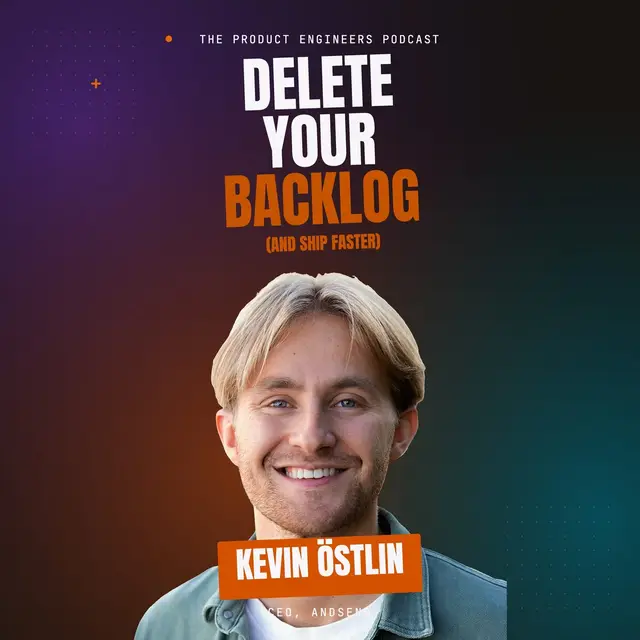
What if your entire sprint cycle fit into a single day? Kevin Ostlin went from running traditional Scrum with a perfect Jira backlog to deleting the whole thing and watching his team ship faster than ever. As co-founder and CEO of Andsend, he's built an organization where backend engineers design UIs, everyone talks to customers, and the team deploys more than one feature per engineer per day.
What you'll learn
- 1They mapped 40 days per week lost to bottlenecks in a 9-person team
- 2Kevin literally cried over deleting his Jira backlog
- 3Daily sprints aren't really sprints
- 4Backend engineers became UI designers through customer exposure + AI
- 5Evaluation is the hardest part
Chapters
Resources
- Zapplify (Kevin's previous startup)
- Andsend (current company)
- Amplitude (analytics platform)
- Lovable, v0, Bolt, Replit (AI prototyping tools)
- Tesla factory engineering culture
- AWS deployment frequency example
Transcript
9,483 words
says something very wrong. Okay, let's see if I things are online. Okay, YouTube is not live. LinkedIn is not live. Great.
No stress from my side. Just
YouTube is okay. YouTube is fine. And let's Are we live? Yeah, we're live. We're live. [laughter and gasps] Okay, nice.
Yeah, just waiting for people to Okay, so all the streaming is working. Great. Right. So, we we So, hello everyone, whoever is watching. So, I see already a couple of people watching. Um, we're just going to wait just a couple more minutes uh and then to see if more people join and then we we're going to get started with the with Kevin here. Awesome.
We already have some interesting questions on the Discord channel or the community. So we're going to discuss about it. Great. Okay, let's get started. So, uh hello Kevin, welcome to the product engineers meetup. This is a meetup after all. And um so Kevin is the founding engine one of the founding engineers of Ansend which he's an a AI relationship relationship agent that helps consultants and freelancers stay connected with their networks. Um so Kevin um could you share just a few words about you your story and um what what you do at Ansent you know what what problem you're trying to solve there. Absolutely.
So, uh thanks for inviting me first first and foremost and um I could share a bit of context. So, yes, I am I'm one of the founding engineers although I'm also co-founder and and CEO. So, I I have less uh time to uh to to do engineering so to speak in a traditional uh manner uh these days unfortunately but I am an engineer from the start.
So I started programming when I was very young and then um I've been building some different businesses uh over over the years and my last startup was probably the most um uh famous one very very infamous uh in the end because uh uh we um but what what we did was uh we built a sales automation platform called Zaplify and during that um project, we we managed to get to a few thousand customers. So, it got pretty big. But then, um in the end, um the the world changed and uh we didn't really believe in sales automation anymore. So, we we closed that startup down and uh instead we founded a new company called uh Ansatan, which is um the current the current mission I'm on.
And what we've seen is basically that as AI and machines are are automating outreach and uh that AI slot is filling our feeds and so on uh people are actually starting to go back to more relationbased sales and networking. So um the reply rates on automated campaigns and so on have dropped quite a lot and uh people are making people want to make business with people and that is the insight we've had. So with Anson, we're trying to make it easier to stay in touch with all of your hundreds, if not thousands of connections that you have. It's very easy often to lose track of who you're talking to and uh um or um drop the ball basically uh with with different people.
So that's the problem we're trying to solve. So suggest the right action for the right person at the right time which is quite a quite quite a um challenging engineering. It's a it's an engineering challenge for sure because it's about uh classifying a lot of data and understanding what's important and what's not. So that's that's the general story. And then um um if I if I'm gonna like roll over into uh me as a CTO maybe in from in my old uh startup Sapplify because there I was co-founder and CTO and uh I was leading the organization in a in a bad way or today I I see it in a bad way because the way did I lose connection there? Yeah.
So the the way I um was leading uh that project was basically with with traditional scrum. So we had uh UX and UI designers, we had engineers, we had QA and then product manager which was basically me as well. And the process was was great. We had like we had backlog with stories and uh epics of course at the top and uh bugs came in. We solved them quickly and we were working in one week sprints uh back in Sapplify. And what we what we did then was we figured out what is the what is the important aspects uh of like the important problems and gave those to the UX and UI designers and figured out solutions and then gave that to the engineers etc like just classic discovery delivery.
And the problem in that type of organization is of course that you uh you end up creating a lot of bottlenecks. uh that's that's one aspect of it like from from a performance perspective but of course the engineers are also very unmotivated which which we know the community knows right it's uh it's not a fun way of of working but it was the only way I knew uh and then I got in contact with actually one of the uh product engineers that we have now in an who has worked a lot in Silicon Valley and u seen a lot of different organizations his name is Andrew Frederickson and he's is one of the people who uh came with this uh idea like 3 years ago to me.
Uh and he came from the engineering side of things. He suggesting how can we care less about the product we're building and more about the factory was his kind of take on it. If we if we instead build a factory whose purpose is to spit out iterations of the product, can we actually um start finding problems ourselves and uh seeing the product from a higher level of ownership as engineers? And uh this was around the same time as chat GPT came out and version three. And when that came, I saw instantly what Andrews meant.
But I came from the product side of things more and thought that well this this changes things because it actually allows us to uh fill in the gaps uh in skill areas where engineers are not as strong. So if we look at uh typically what engineers software engineers are strong at it is uh the code uh on the understanding the problem turning into a solution and so on. Um but with AI it it it was looking like and now now we can see it more than ever that everything is pushing people more to be able to do much more and uh be broader.
Even if you have your specialty where you're strong, you you you um you are you get like a broadened skill set quite quite quickly if you utilize AI in a strong way. So we thought, okay, can we change our process here uh to actually make everyone care more about the customers in the end, right? Because I as a founder in in Zapplify, I knew that what what makes a um nothing makes you feel as much ownership as if you meet the customers, you feel the problem. You don't just see it, you feel the problem by actually creating a connection with the customer and uh making a promise even to the customer maybe on like, yeah, we need to fix this.
And then you go back to the drawing table, you sketch that wireframe out, maybe get some expertise, help from a designer if you need, and then uh you ship it to to production. And thanks to to AI, basically that that opportunity started to open up. So um we invested a lot in our factory then and invested a lot in the team just making everyone um first of all what we did sorry and stop me if I'm talking too much now.
No please continue.
Uh yeah. All right. So the first thing we did was we sat down with the whole team and just uh sketched out or like kind of uh draw drew out all of our bottlenecks that we had. So to make the engineers aware. So for example, how much time are we losing when we give a task to a designer and then you know it bounces back and forth maybe between the product manager and the designer and then eventually the product manager needs to deliver it to the team.
just that process where we're losing maybe two days on average because the product manager is in so many meetings and we did all of these bottleneck mapping and it came down to that we we lost I don't know what it was like 40 days per week or something crazy in in just bottlenecks and lead times and that was only a team of we were nine people I think in total at the most uh that made the problem very apparent And then uh we went on the journey to what if what if the engineers also get to care about the metrics that we have. So we we're using amplitude as our platform to uh track uh all our metrics and all our users and how they are interacting with the platform and so on.
And we then spent quite a lot of time on workshopping in amplitude like with the question of can we find what is blocking our uh one metric that matters. So basically our active users our weekly active users what's our one that matters back then. Can we find the bottlenecks that are blocking us from getting there in terms of metrics and engineers uh the engineers they loved loved that exercise because that was like yeah since it's it's it's numbers and everything. So that was how we even got the most heavy backend engineers to care to start caring.
Um that was I think the the incept or like the the starting point for this whole journey and that was I guess two or three years ago now and then uh most of the team today in Anson are actually people that were in that team as well. So that's why why it gives context. So even if Anson has just been around now for a year uh this uh what you say movement towards product engineering that we'll talk more about has been ongoing for longer and what has been really interesting throughout the journey is uh how people uh that were traditionally very heavy engineers. So like they even came from like being very they they they knew math and they wanted to do math and complex algorithms and so so on.
uh those people might as well be the ones becoming your best UI designers and UX researchers which is uh yeah in lack of a better word a bit almost beautiful to see that like people are finding their strengths through actually getting freedom and uh now you need to do everything you need to build you need or sorry you need to research you need to hypothesize you need to design.
You need to build um send to production, test it and evaluate it and then you know go back uh to the beginning and report of course like understand was this ch was this change successful or not and then you go back in iteration and if you can do that one person uh that's helpful but it's even better if you can go like two people on a pair to own one problem together. So it's like you do everything together or even three people. So that's where we come to pair programming and or even mob programming and so on. Uh but not just doing it on the programming part but doing it for the whole problem.
So these are things that we uh found during the process were very helpful for us because I I I don't believe in an organization where everyone is like solo product engineers. I think where everyone is just finding problems on their own and solving them because then we've tried that as well and it's the product is kind of diverging a bit and it become can become messy but if you work as small dynamic teams like product groups is is what we call it um it becomes yeah you you find teamwork within those small teams and you can work as fast uh or even faster maybe but with much higher confidence.
Yes. Um and there's there's a lot more to this process and the journey, but I want to stop there so we have time for uh for you to call as well.
Of course. Of course. No, it's it's very interesting. Thanks for sharing the the whole your story, the story line. Um the last point was quite quite interesting and I agree with you that when you have engineers trying to look for problems and then solve them by themselves can get quite a bit of like there's a bit of hierarchy there and you know you still need that kind of u teamwork so people can can can share um the effort and the goals together. So it's very interesting that you said that now pairing per programming I mean pairing doesn't only happens on programming side but also on on the whole cycle of product development. Um how does that work in practice?
So like do the engineers like they pair in interviews in doing design together. So just literally everything and um in that case what defines a team uh like what's what becomes the the the responsibility of a team in in that in that when everyone pairs and maybe even uh works in an ensemble even more more than two people. How how does how do things change?
Yeah, very good questions. Um so where I can start with this is I can just yeah start with um from from one thing I also mentioned this to a question in the discord channel yesterday uh that one thing we did during this journey was also to drop the backlog. I think it was about two years ago because since coming from scrum and everything, we had this backlog with everything we wanted to do and everything was figured out. We had it planned and and I I was the owner of the backlog as well and uh it was it hurt a lot. It was very difficult of course to let go. But basically what I did was we removed everyone from Jira because we were using Jira.
Um so I still had the project in case I would need it. But what's funny is that we never need needed needed it again. But that was like the the big bandage that had to be ripped once we felt ready for it because we exper what we found was that when you have a product manager that like is the gatekeeper for or like planner for everything then you have your sprints that are kind of planned and if of course the team can contribute and comment on that and so on but in the end it's kind of in a way predetermined uh which is not what agile was built for in the in the beginning right agile people over over process process and then scrum came and made it process over people I guess but uh
that's what we
yeah and that's what we had to remove um just to make it possible for everyone to actually get freedom. So uh I was still during the nights in the beginning you know sitting with my computer and looking at this perfectly structured project in Jira and just enjoying the structure and also um crying a bit that uh it it we'll have to let this go now. Uh I should be honest and say that but I'm so happy that we did because that was that was the enabler for all of this.
So back to your question then is then suddenly uh everyone realized that we don't know what to do anymore right because it's like so and we everyone knew then how to handle the metrics and everyone had started to go on some um user interviews or basically just on boarding calls that that's been our unlock for it.
So um once a user sign up in the service either they yeah they sign up by themselves and then they get invited to onboarding calls and we always make sure that there's not just a business business person not we don't have business people like that everyone's like part of the product team even if you're customer success manager you you contribute but uh still let's say a customer success manager then and also an engineer or product engineer and that was very important and then also to split up so that everyone got to talk to different customers.
Uh and now lately we've also been experiencing with that experimenting with that product engineers might be owning the relationship entirely uh with the user uh to also manage follow-ups and and so on. Um but you have to keep a balance of course not everything they do is is sitting in meetings. So they have to they can they can they can control that themselves by simply like how many meetings they want to be in but the goal is for everyone to be in uh basically one meeting uh or or three meetings per week
uh is is what we have. So that that is key because then they can discuss everyone can discuss in the team and everyone see the customer point of view and everyone sees the different aspects of it and uh from that and from the metrics we create hypothesis basically. So sitting in the in the room with everyone or on a call uh saying that I have a hypothesis on this or maybe you share your screen and you share an insight that you put together in a nice way and then um you might find someone else who is very interested on like exploring that problem with you. Just ask someone.
So it's pretty dynamic how those product groups are formed and we can be dynamic since we don't have a backlog and we don't have the the traditional sprints in that way. So we see it more as if we have daily sprints. So every standup is basically a sprint planning for the day and and it's it's silly of course uh to to call it a sprint. But everyone knows what a sprint is and everyone comes from that. That's like your your kind of lowest um unit of iteration in a way in a traditional scrum. Um so the mindset shift is very interesting how everyone just thinks about okay today we should get this and this to production like or this hypothesis to production.
So we we deploy on average more than one new feature or or iteration per day per engineer actually even though we're so basically two I guess two iterations per two people you could say. Um, so the frequency is is a lot and then of course we use feature flags to roll it out and so on so that not we don't break the app for everyone at the same time. We we do that sometimes as well because we're a startup but uh we try to use feature flags as much as possible. Um, and then our our biggest challenge is how do you evaluate it? Because you can't evaluate it the same week, of course.
And it's it's the same if you do a oneweek sprint because if you deploy something on Thursday, then you won't evaluate it until the week after. So that feedback loop is still like the main challenge because ideally when you talk about bottlenecks, it would be amazing if you wouldn't have any if you could actually get the insights on the same day as you deploy. But in reality, it's very hard because you have your cohorts and everything.
And especially in a startup like us, it's more about talking to the users and uh asking them and understanding how their experience evolves to get that qualit qualitative insight and then back it up with with data to support uh your experiments and hypothesis. So what I'm saying there is basically not everything can be attributed right uh especially not if you have only a thousand users or so
right
as we do right now. I'm getting a question already from uh the audience. Um they want to understand like if you can give like a concrete example of of an hypothesis how how does it look in practice?
Yeah. Um so that's a great question and um the hypothesis can can look different depending on like if they're on the like on the website or if they're deep in the product, right? Or if they're on the back end. But what we what we what we aim to do is to always have a very crisp way of describing like the the assumption that you have and then um of like what do you want to do?
So for example um let's say um introducing a product demo on the uh website uh in the hero will and then you need to define like a metric or some way to define uh like how do we know that we have been successful right so um to introduce a product video in the hero on the site that should not increase the number of signups because that's a bad metric but rather increase the act activation or something like that or the number of activated users so you have something further in and then you can have a supportive metric as well which is like that could be the number of signups to understand.
So it's about bringing bringing together uh the data in the end to evaluate if the experiment has been successful or hypothesis has been successful. But that's it can be as simple as that basically. So it's it's more like an experiment card almost.
Okay.
And that that's that's how we define it. And uh together with that you could have a could of course have a suggestion on what the video should be about like a few few lines of like in the product is easier to explain because then you would just have a simple mockup or something for what your hypothesis is. uh so you can present it to the team and um that's just something we drop in a slack channel or maybe you bring it up uh in a video presenting it to the team if you have a lot of things to talk about then you know that well this is a pretty big bet and then you need to have feedback from the team to understand is the confidence high enough
so like I guess you can see it as if every product group or every product engineer is almost like a product manager in that sense And that when we meet together and when we have this forum where we talk together and talk about hypothesis, we come together as product managers from different teams almost to form a product board where we debate some of the bigger challenges we have and so on. And then uh every product engineer or product manager lead their army of uh AI engineering agents in in cursor or or claw or whatever you use, right? That's that's uh that's the factory we're building at least um so to speak.
So um yeah, I'm not sure if that if that like explains the process more like how we go from hypothesis to then everyone taking ownership, deploying it and then back to to evaluate it.
Yeah. So these these hypothesis are generally like problem uh product problems, right? They're not they don't involve anything technical, just something that involves the product.
Yes. Okay. And it could also be like for the like pretty algorithmic hypothesis like for example if since our product is much about finding the right action for the right person at the right time. So let's say someone has hypothesis that if we introduce these three dimensions to our vector space where we have defined um like that our feed is basically uh feed of actions is is pulling data from to get the priorities then that should increase the number of clicked cards in in in the feed for example right then you have a pretty technical uh problem or technical hypothesis Yes.
Okay. Okay. So, you move from product to also the solution space. Interesting. Interesting.
Yes. Yes. Yes.
Yeah. Um Okay. Okay. And um uh cool. So, it's it's an interesting um choice of words when you say factory because I think someone maybe think
we're not a future factory. Yeah. Exactly. It's an iteration factor, right?
Yeah. Yeah, makes sense. Um, so would would you say that the output of this factory are outcomes? I don't know. It's it's kind of would you say that?
Yeah.
Yeah.
Um like what what the goal is with the factory or
Yeah. So I mean the feature factory has this kind of um bad reputation because you are focused on outputs doesn't matter the outcome
but I think in your case the outputs is actually the outcome so you trying to create outcomes. Yeah,
right.
Exactly. So we have our one metric that matters or maybe two or three one metric like northstar metrics and everything we do should increase or like make those improve those metrics, right? So that is the ultimate goal and then you of course you need to break down that into bottlenecks like what are our main bottlenecks to improve them. Um and that is usually where your experiments come from when finding those bottlenecks and so on.
So I could actually one more thing to the process there uh how we work that is very important is that um we have these daily sprints and so on but that's not everything because we also it's very important when we work like this that we also come together often to gather and form our focus for um the next cycle as we call it. So in scrum for example, you might have your product managers from different teams meeting um every quarter for example to set big initiatives for the next quarter, right? Uh or themes and we do the same but we do it every three weeks instead or every four weeks. So that's also like just compressed.
We have as many sprints in one of these but we set the big initiatives down. So we evaluate the initiatives from the last cycle and those can be quite large u um large aspects of of of of the product or of the growth model or whatever. Um so now this this cycle we're in now we're about one and a half week in and our current one of our current initiatives is uh to create a team offering uh attractive for larger uh teams because until now we've been quite quite focused on the freelancers and the smaller boutique sized firms but now we we think that um we we have like solved enough problems there to actually bring this to the larger firms but they want to solve different problems and so on.
So that's like one of the two initiatives that we have for this cycle. Um and then we spend about two days physically together uh doing a lot of workshops and and like debating different initiatives and like uh looking into metrics heavily and so on together. So
cool. I'm sure you're making a lot of engineers out there very jealous of the way you work.
Okay.
Yeah. Um so did um let's get a bit into uh the role of the product engineer within Ansen at the moment. So, one thing that stuck with me that you said before is that even engineers that are very uh focused on on the on the back end side of things, they started to bring some um work credited to UX or UI and they were working that sense as well because they had the freedom to try, right? Um so that um makes me wonder how um when you tap into a domain that is not yours. So it's been like something maybe you haven't been down for a while.
Uh there could be the challenge that maybe you don't know exactly what are the best practices, the best uh you don't have like maybe the whole tool set to make the right decisions. So um how have you been kind of tackling this this issue? have you been like maybe finding training or uh trying to get a bit more time to research the the best way to do things. So I think that could be an interesting thing to to get into.
Yeah. No, it's it's um it's an important uh aspect of it. So it's good it's good that you brought it in. And um the way we like I think the biggest missing tool set in a way has has been the UX research and the UI uh development for us at least uh um in the beginning it was actually front- end coding uh because we were almost only backend engineers and then everyone suddenly had to become full stack. That's how far we had to make this transition. So it was very specialized in the beginning. But front end was very easy for them for everyone to learn. Uh but then when it came to the UX and UI, it was not as clear because suddenly you started to move into territories that
you hadn't really worked with. Um no one almost no one had worked as a product manager for example or in a product team traditionally. So that's where I guess the ones that had for example me had to help others and like coach them a bit but also just encouraging everyone to read up maybe sign up on a on a course or like watch YouTube and uh try out yourself and that's one one part of it but then we also have the AI side of it here where AI can actually fill in the gap. So what we do is we gather all the transcripts from our user interviews uh in folders.
So we structure the transcripts and then you can actually ask uh your drive folder or or whatever we use Google drive uh what problems you have right now. Uh and you can start getting suggestions on like well maybe there's a problem here or maybe you have a hypothesis that you've seen in in calls. So you can put your hypothesis to the to the agent and ask is this is this a common theme among other interviews that I haven't been part of and so on.
And then of course you can start seeing something that triggers you to okay I want to investigate this in the metrics and then you start investigating the metrics and you can create a hypothesis suddenly because you see something in the metrics that also pops up in the interviews.
can marry the qualitative and quantitative data and build something strong and then you can just ask the AI agent to uh give you some suggestions on how to solve it like in terms of being a UI designer which is what we do um some more than others not not everyone has like embraced the this like AI native way of working but I'm doing it quite a lot actually myself when I have something that I want to design so I just ask it to give me some kind of UI hypothesis that like prompt for a UI designer and then I put that into lovable where I have a clone of of Ansand which is not really working but it's still like a clone so I can put in my UI prompt there and it just gives me a new prototype and then I can show show that off to the rest of the team after having done some fixes.
So with tools like lovable um bolt and replet etc v0 you can actually get quite a lot of competence so to speak from a from from a UI agent that helps you even though you might not know the right solution. So that has also helped us quite a lot just embracing AI in in building prototypes and mockups.
Yeah. So we don't use Figma.
Yeah, sorry. No, just to clarify, we don't use Figma at all anymore. We only use tools like lovable or even just prompt it away in first ser. So we make it on our local and then share it to the rest of the team.
Yeah, interesting. Yeah. Um I was saying I think also with the the the pace you you you have like you go quite fast with all your like daily sprints and uh you're very focused on on the impact. So you you I I I guess you get quite early a feedback about if the the the impact of of the UI choice you made. So you're actually learning also what what's working, what doesn't work very fast. So even with someone that doesn't have experience, uh you're learning on the job, which is surely the best thing to do, right?
Yeah. Yeah. And and since that's right and also since they everyone's sitting with customers, they also feel ownership in a different way of like actually making it good because they will have that customer that face and that voice in their mind when designing it. So
that's also good. I may be say I may be saying something maybe controversial here but talking with a lot of designers in my career I suspect that they don't usually have the chance to do this properly. So this is something that designers complain a lot about that they are like as in in our field we have code monkeys they have pixel monkeys so they are hired to just config and design UIs out out of nowhere maybe without doing proper research and everything. So it seems like product engineers for what I'm seeing in different companies they are actually doing that way more and way more often.
So I wouldn't be surprised if they become quite good in a in a short amount of time because it's kind of part of the essence of being a product engineer, right?
Yes. Yeah. No. Yeah. Controversial or not, I think. Yeah. It it's like uh we have to separate like traditional organizations and of course in traditional way of seeing it. I I think
it often can be viewed that way. Um yeah and I so um um just speaking yeah so I think I think you're right that the engineers are really close to the problem in a way and like that's what we've seen as well when we did this made this move that suddenly everyone was really good at understanding customer pain points and so on. it was just so much easier um to convince people about things like coming from the product manager perspective myself uh like just understanding that I barely have to be a product manager and maybe there's not even need for a CPO type of role that would only be when you meet once once a month or whatever to to
decide on these initiatives you need someone to facilitate those workshops and kind of uh set the vision and steer in the right direction. I think that can be AI as well in the future. Something just consuming all the metrics and transcripts really like but but we're not there yet.
Yeah,
I think it has to be a human. But uh anyway, with that said, uh we've seen also that when engineers that don't come from UI and UX um make changes and make designs, it will diverge and sometimes it can be a bit messy like the product isn't holistic in the same way. So for that reason, I think it can always be good to have an expert in the loop. Uh maybe you bring in fractional UXUI designers, someone that is really good at, you know, tightening things up and like challenging the team with an outside perspective or maybe like bring on a customer a board of customers together with the UX assignment that can even propel that further. I think that's that's good.
And there's there's like a need for experts to come in from time to time depending on what your needs are to fill in the gaps. Um and that can be really helpful to not solely rely on that everyone can build the expertise they need but also they just feel like what gaps do we need to fill in.
Yeah. Yeah. Makes sense. Makes makes me think about how postto works. It's kind of similar. So they have
small teams. Yeah. And um
they have designers but
there isn't like a designer per team. So it's just for all the company and they can console them maybe for more complex iter interactions.
So it's uh
pretty similar and um so about sorry just people calling me um talking about um scalability. So how do you think this approach can scale? like let's say now you're a startup and then you hopefully and you will grow and become a scaleup and how how do you see this this working and I think that that's going to be also a new challenge and maybe also different we would need a different way to organize teams to make this work and keep this kind of
pro engineering mindset. Yeah, that's a very good question and um yeah, I need to be honest and say that uh yeah, I haven't tested it yet, of course. Uh so
what's something I'm looking I'm looking forward to. Yeah, exactly. Something I'm looking forward to.
I think I think the most important part of it will be observability and and like some type of reporting um that you need to make sure to actually create document like now we have this hypothesis we made this change this is the metrics connected to it and somehow that needs to end up visible to everyone else to not make a lot of changes without uh everyone being aware of it because the more people you or uh we see that sometimes ourselves and then suddenly there's a change that you did wasn't aware about and it's been there for two weeks and then you've been telling customers something else or or whatever like since it affects everything when everyone's meeting customers and so on.
So that type of um observability and reporting I think that layer and I can um I can take an example of one organization who has or a few organizations that have made this and this is also to Andrew Frederickson u one of the founding engineers. So, um I personally wouldn't say that I'm a Yeah, you you you can you can think whatever you want about Elon Musk, but if there's one thing that he did, it is uh to have built Tesla, which is um a new company in a very old industry. And um like when when they started Tesla, it was like no one could understand h how how will you be able to challenge this this industry? And then now fast forward decade or two, it's like a Tesla on every fifth driveway.
I guess there's so many Teslas in the world. And how they did it was by doing it different, right? Uh thinking different. And um in in a Tesla factory, the engineers work exactly like this. So they go out in the production, they have hypothesis, they make a change and they observe metrics and they document their change of course but they can do that in a day and then watch what what what happens to optimize the the factory. It is a fac like it is a factory of course but still to make the factory better and uh that is why they were able to reduce their cost so much and uh improve their frequency and output.
I think their goal is to to output like one car every 10 seconds or something like that and they are like at one car every 90 seconds now. um don't quote me on that but but there's some some something like that which is just insanely much faster than any of their competitors ever were and that is a pretty big company um that's that's just one example and then uh uh you have EWS of course they were quite known for having pioneered yeah one of the pioneers at least behind just pushing to production and letting engineers have full ownership of that and they pushed I don't know the last article call is like from 2014 and then they pushed once a second or something to production.
Uh but u that's just it's a very big organization and I think the key is that everyone should cannot be aware of everything happening and so on. So you need to have observability and u different ways of rolling it out slowly and making it fail. If it's going to fail, it need to fail fast and with with a low blast radius. That's very important.
So that is how how I see it scaling like still maintaining the ownership and everything but um work a lot on the observability and uh sharing hypothesis and uh making that clear every morning when you get to work. You need to you need to know what happened what happened yesterday at least on some type of scale. uh that impacts what you're working on right now.
Yeah. Yeah. I can imagine also there could be some challenges in terms of um communication. So probably would still need some kind of coordinating role. Uh so maybe that's where PMs like the actual PM can start having more sense because like managing the context and then where that and they can kind of work as a compass for all the product engineers and different teams to understand what's the right direction because I think context also is a it's a big thing right as the companies grow all this context in just a few ads right Okay.
Yeah. Yeah. I agree. I think that's at least a good solution as long as the product uh that PM doesn't write tickets, right? Uh that's very important. Um and then only acts as a
I don't know facilitator of information somehow. if they can pick up that information has been missed or something that might be something if uh and ideally if you can automate it somehow and just have information being delivered by a slack bot or or whatever I don't know
but um yeah for sure communication is important will be a lot more important when you go
cool so before getting into the Q&A session um what's what's the the big next challenge for for you Kevin but also for for your company.
Um, that's a good question. For us as a company, it is um I mean we are we're a startup that is challenging uh old ways of doing things. Uh since we we believe in that the future the future of business basically is built on um building authentic relationships and being able to do that at scale.
So not using I I don't believe I usually say that I don't believe that you will send your AI avatars uh to have lunch together over a business meeting right so it's about how do we empower that future and the hard part about that is of course making people aware of the transformation that is happening and making them buy into the the vision and everything which is and it's it's so lovely to see when it's starting to happening. So we have we have about a thousand users in total.
Maybe not all of them are active still to be honest, but uh we have a few hundred at least consultants in our ideal customer profile that that really love the pro product and they're sharing it on LinkedIn and so on uh about their experience. So the challenge now is to make sure that they continue to love it and uh that we can um uh grow with them so that we can we can follow our vision. uh basically suggested a classic uh startup comment. But uh that is that is the challenge right now to
get from our our current we have a product we have customers and to get to the phase where we are uh proper sustainable company u that can that can continue do this uh to do this uh over time and um yeah grow with with uh with the needs of our customers. So that's that's that's the challenge. Yeah. Cool. So I wish you the best of luck. Of course. So let's get to into the Q&A session. Let's see. We have a few questions from
the community uh and also some questions on YouTube. Um let's have a look. So the first question is from Adam on uh on the community and so he had a question about the daily sprints. So probably we already answered this
um more of a mindset shift. Yeah.
Yeah. Yeah. So he says that uh sprints are usually used for uh demos and some to to reflect on uh on what you build on your work and then adjust you know the like whatever you're doing. Um so how does this work on a single day? So, how do you reflect on uh on what you've been doing and um are there any any rituals across the day?
Um
yeah,
and you know when people get sick, what happens all these dynamics? So, I think the main question is
how how do you translate the practice like the ritual of of a longer sprint to one sprint? What are what happens during the day?
Yeah. know. So yeah, it is a great question and what we do is uh we have stand up every morning. So that is that is like the ritual so to speak on a daily basis. But the standup is more about saying what you did. Yeah. And we say what did you do last day and what are your hypothesis for for today like what do you want to work on to the end? Um it's just that the way we work is usually something new, right? So that is what makes it makes it a sprint in a way. But then we have some uh room as well after the standup every morning to actually demo some of these hypothesis you have or what you did last day.
So you can inform uh the rest of the team or maybe even non-technical uh people on like what has changed or what is about to change and then get their input later. And then there's always a meeting leader uh for the week that is like um so we we we spin that around who is leading the meetings and then um and that person needs to be rigorous in like stopping a conversation if it spins out of control and then that has to become a separate meeting or maybe a slack thread or a video where someone can like explain it more thoroughly if if it's uh yeah so um there can be some spin-offs from from that standup meeting and that that is very that is something we do every day. It's very important.
And then we have once a week we have like a product forum as well where we talk more uh generally to make sure we're on track for our initiatives that we decided for the for the cycle. So it's like in a traditional process you might have your quarters where you do the initiatives and then you have a monthly review or something and you have your weekly sprints and we've just compressed it. So instead of pushing 15 sprints into a quarter we push 15 sprints into three weeks and then instead of having monthly reviews we have weekly reviews in a way.
So um it's yeah and it's possible because we don't need to hand over things between people right so you don't have to wait for a code review either uh it's just you just do what you want to do and what you believe in on a daily basis and um yeah we save 40 days per week that's what's making it possible per engineer I think but um yeah so very similar rituals and we have retros every um uh every now and then when we when we need it, but definitely we have a retro when we do our initiatives evaluation for for the for the quarter, so to speak. And that's probably because we're such a small team and we're very tight, so we don't usually we wouldn't need um a retro every week.
Not yet at least, but that might be something we have to introduce um to just make sure uh we don't fall out of line with each other or or whatever. So, uh that's that. And then if someone gets sick, of course you have these product teams that you form. So you shouldn't be alone. Um and um yeah, it has actually worked quite a lot. I haven't thought about that before, but it it's just working somehow and uh you might just have to pull someone else in then uh and it might be one day delayed once you know push it to the next sprint the next day.
Right. Cool. So next question. Um so I think it's from so it's from Daniel. Um so he's the same person that asked about uh the hypothesis before. So related to it it's so you you said it um product engineers can set their own metrics which is probably easier on the product side but as you said there there are also technical hypothesis things can get a bit more fuzzy there. Uh so how do you define impact in that sense or metrics when it's something a bit more technical?
Yeah. No, that's that's a great question. Um I think in a large if you have a very a large product software product with a lot of users, you can actually do attribution on quite a low level.
So you could evaluate like if you have two different algorithms, your AB testing for something specific like for example our recommendation feed that we have, you could actually AB test those different um I'm not sure like yeah if you have something very technical like for example that if you start fine-tuning models and you want to compare models that's the same thing and if you can attribute that to some kind of ratio some kind of qualitative metric that would be good but for us we actually don't have that luxury yet unfortunately. So since we we don't have a million users or not not even a 100 thousand users. So we need to rely quite a lot on qualitative interviews.
So that's also why we have to like build relationships with our users and our customers and to involve um the product engineers from the beginning from the onboarding in those relationships uh to yeah to to basically ask them and so on.
Then of course if we also we also employ um what's called session uh replays for people that accept cookies which is heavily debated of course but it's um if you accept it uh we will redact sensitive information and so on of course but um it gives us a lot of insight because you can actually follow the users how they're using uh your product and understand um what is um driving the pain points and so on on it's like a third data point apart for your apart from your interviews apart from your metrics you also have uh recordings and so on. So we try to build confluence with a lot of different data points to
figure out if it was good or bad changes and we do a lot of yeah not maybe the smallest smallest changes because those are the diff difficult ones to attribute but try to make even like mediumsiz changes more because uh then you can understand if it was good or bad in a in a better way. So try blast high blast but on a small radius because we roll it out slowly.
Right. Right.
Cool. Thanks. Um one last question before wrapping up. Um I think this question is not related much to the product engineering thing. It's probably more targeted to your entrepreneur spirit. Um so I think it's still Daniel wants to know uh so he he has this idea for a browser extension and he would like to understand how he can reach an an audience to test his ideas. So talking about hypothesis what would you recommend him as a first step if you have an idea to to to like reach out to the audience?
Yeah. So yeah, he has he has an idea for building this this product which is a browser extension and like to understand how
how it can it can reach an audience to test the idea.
Yeah. Yeah. Absolutely. Yeah. I think that's a great question. Uh I think it always starts with who is experiencing the problem and your ideal customer profile like who has this problem that the browser extension is solving and where where are those people today. So, for example, if I'm um uh if if I'm building some kind of email productivity app, I would for example uh join I could join a Reddit uh forum where people are very dedicated about like productivity or even email productivity. can find these small communities and um uh yeah like if I'm building a product for product engineers this would be a great place to to test it for example.
So uh the product engineering community and find those small communities to try it early. I think that's that's where you can find the early adopters and uh really test it out and then um they will spread the word as well if it's if it's great and they will probably very it's very likely that they also want to help you develop it. Uh so and if you build something for for farmers then you have have a very different target group a very different place. They might not be hanging out on Reddit but uh there might be a Facebook group for local far farmers or whatever or like a conference and so on.
So building the tools for for that small small group of people I think is always the the key and and listening to them as early as possible. I'm not sure if that answers the question, but
yeah. Yeah. Um, I'm sure it's been useful. Thank you very much, Kevin. Um, yeah. So, it's time to wrap this episode up and Kevin, it's been great having you and thank you very much for sharing all uh your experience uh and at you know with this product engineering uh culture. It's been it's been very inspiring. And u thank you. Thank you. Uh where can people find you if they want to ask you any questions or clarification?
Yeah, first of thanks a lot for for having me on. You can find me on on LinkedIn. I think that's the best channel to reach me. So uh Kevin Oslin at LinkedIn.
Cool. I'll make sure to add it in the notes.
Thank you very much, Kevin.