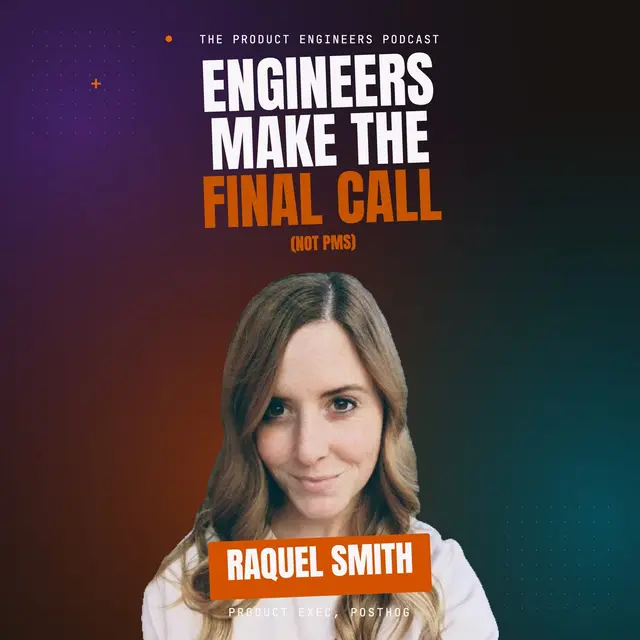
What happens when engineers — not product managers — have the final say on what gets built? Raquel Smith is a product executive at PostHog and has lived this model for years. In this episode, she unpacks why product engineering is still the most fun role she's had, how PostHog keeps engineers directly wired to customers with zero gatekeepers, and what it really means to own a feature end to end.
What you'll learn
- 1Engineers are the final call at PostHog — they decide what to build, when, and how. PMs provide context, not directives.
- 2Direct customer contact is non-negotiable. Watching a customer struggle is more motivating than any backlog ticket. No layers between engineers and users.
- 3Collaboration has a cost. Single engineers owning features end to end — from API to front end — is faster than consensus-driven teams. Limit who you involve and when.
- 4AI changes the feel of coding, not just the speed. It's more like managing a junior dev than writing code yourself — easier to get frustrated when something else does it wrong.
- 5DevEx becomes more critical as AI speeds up code output. A 15-minute slowdown that was 6% of a 4-hour PR is 100% of a 15-minute AI-assisted PR.
- 6Talent density is the hardest thing to protect at scale. When the org gets complex, it's harder to see who's actually pulling their weight.
Chapters
Resources
- PostHog: https://posthog.com
- "Collaboration Sucks": https://newsletter.posthog.com/p/collaboration-sucks
- Frictionless — book on developer experience in the AI era
- Raquel's article: https://posthog.com/blog/why-product-engineering-is-so-fun
Transcript
10,090 words
Raquel didn't want to have a pm telling me where to put the button or how big to make the font. I wanted to make those decisions myself.
Peppe how does this look at PostHog what's so different about PostHog
Raquel Engineers are the final call. They decide what to build and when to build, and how to build.
Peppe have you seen an increase in productivity because of AI
Raquel it feels at sometimes more frustrating. It's easier to be frustrated when you see someone else doing something wrong and you're like, no, that's not what I told you to do.
Peppe today's guest is Raquel Smith Smith she's an executive engineering a product executive from PostHog welcome Raquel It's great to have you here
Raquel Yeah. Thank you for having me.
Peppe Nice So let's get started a bit with with your background story So you you have very diverse experience You actually started with a degree in in a in a biology and microbiology and then you got into code So what happened like from that moment to when until you started working for PostHog What what's your story
Raquel Uh, yeah, I think, um. I think if I had had more of a choice or a little bit more maturity, uh, I would have studied computer science in college. Um, but I think that it's, uh, it ended up being somewhat of a blessing that I didn't, um, because then I was able to find my way on my own, which I think has been really valuable for me learning. Um, but just the, the short story is that I, uh, found a company that would let me kind of tool around with their website. Um, and I worked for them as a form moderator and then web developer, and then kind of grew into some more serious WordPress plugin engineering and then, um, uh, started building like an actual SaaS product with them.
Um, and then did that for, uh, a little while, decided to try pure product management. Um, and that was fun. I really enjoyed the like. Being able to, to think about the products, but I, I missed coding. Um, so then I started my own startup and did a large part of the engineering for that. Um, and, and really got, I don't know, deeper into engineering than I had been in the past because I was responsible for everything from the infrastructure, all the way to, um, not only the, the front end code in ux, but also like how we were, you know, reaching out to potential customers or partners to work with and, um, doing the wholesale cycle as well. Uh, so that was, oh, in marketing also.
Um, so that was an incredible learning experience. Um, and then when I wrapped that up, um, I didn't want to just be an engineer. I had been a product manager at a place where engineers, uh, weren't super empowered. Um, and. That I knew that, like I wanted to code, but I didn't want to have a, a pm telling me where to put the button or how big to make the font. Um, I wanted to make those decisions myself. So post hogs seemed like a place where I could potentially do that. Um, and, and so that's why I joined and, and I'm still here.
Peppe Yeah So I think it takes a lot of courage to to do what you did like going from something that you studied that was biology microbiology to something completely different and not everyone is kind of uh willing to do to take that leap right So um what was really the moment when we realized like I'm done with that and I don't want to do biology I want to do coding
Raquel Um, I think, well, I think I, I knew that like I just had more fun. Um, again, you said this podcast was about fun. Um. I just had more fun coding, right? Like, I think the, the first time I ever, my first line of code I ever wrote, uh, was I had a little WordPress site where I would post recipes and pictures of food and, uh. The, like, I wanted to change the header color to orange. And so I like found the style sheet and then I changed, I found the hex color that I needed to change or that, you know, the CSS property and I changed the, the hex number to the color that I thought it was gonna be. And I swore that I was like, gonna take the site down when I click the save button.
Um, but it worked and it was just this like, oh my God, it worked. Like, that's so cool. I think biology has some similar things, but it's just so much slower. Um, I am a fairly fast-paced person and the fact that I could like, make a change and see immediately what that change was, um, just was more, much more of a fit for how my brain works and the pace that I like to do things. I mean. With microbiology, you can have a bunch of experiments going at a time, but like, you know, you, you, uh, plate some microorganisms on a plate and then you have to wait literally 24 hours. And I just like to see if anything grows. Right. Um, and that just really wasn't, um, wasn't what I wanted.
And then the other thing was that I, at my job, a part of my job was, um, answering questions about our products. Um, like technical questions. Um, at the, the microbiology place I worked, which is a great company. Um, they're, you know, they're still here doing great. Um, but I remember I was like sending an email to my mom or something and, uh, my boss got mad at me for not, for like, doing something personal on my work time. Um, which it's like I get, but I was also, you know, I was just sending an email to my mom and. That just wasn't really, that didn't really vibe with me.
Um, I, you know, I'm not the the type of person who's like, I, you know, you need to sit in this chair for eight hours and do nothing but work. That's just not how I work. Um, and not how I saw my career going. And I got an opportunity to, to work remotely and, um, for this company and, you know, do some small WordPress development for them. And, um, it just was much more of a fit for my personality type. So I guess that's, that's the thing that I, I looked for and that really drove me was like, is this how I see myself moving forward? Or is there another opportunity that is gonna fit me better?
Peppe Yeah for me it was um the MySpace block I dunno if you ever used MySpace at
Raquel Yeah, a long time ago.
Peppe Yeah Like you could uh like uh all the the themes and it was great that that's how I got started So very similar
Raquel Yeah. Yeah.
Peppe so we we get to 2023 and you are working for Post already And you wrote this article where you say that product engineering uh is the most fun role you ever had And uh you you kind of uh say this is because of four specific reasons So um you say one is challenging problem to solve You have uh support from other highly motivated colleagues the autonomy to make important decisions for complete transparency into why your work matters So is is this still true In 2026 did anything change
Raquel No, I don't think anything about those things have changed. I think those are fairly fundamental and, and not only for product engineering, but I think those things describe why any job can or, you know, may or may not be, um, motivating. I think, you know, you could have a marketing role and if you can check those boxes, you know, transparency into why your work matters and challenging problems to solve, and coworkers who are, you know, just as motivated as you are though, that's, that makes for a fun work environment.
Peppe Something that We can read on a lot of job posting right So this is something that people companies do to sell their like work work with us This is what we do right This is what you can do with us but think how how how does this look at at PostHog So what's what's so different about PostHog that in how these these four principles are delivered
Raquel So, so I will say that whenever you join a new company, there's always the big question is this company on the inside, the way it is represented on the outside, and the more of a black box the company is, the more risky making that decision is going to be. Um. A previous job that I worked was definitely told one thing about my role, um, you know, what role I would be doing and what that would look like. And then when I got in there, it ended up not being that way at all. Um, and, and that's because there, like, I couldn't even use the software, um, before I, I joined the company. I had, I had almost no idea what I was getting myself into.
And um, and so I think the more open a company is, the more you can trust that what they say the job will be like, is actually what it's like. Um, so. For post hog, you can actually see that we're, you know, just drastically, wildly open and transparent. Um, and, and you can see in real time the customer, well, one, you can, anybody can sign up and use the product, but, but two, you can see on GitHub, uh, you know, someone filing an issue or commenting on an issue and then an engineer interacting with that person and asking a question and then saying, here's the PR to fix. Um, oftentimes the, these types of interactions happen in like a private support, uh, ticket as well.
But you can, as a customer, you can see if I file a support ticket, um, and it's something that isn't just like pointing me at the correct documentation or something. If there's an actual technical issue, the engineers are involved. Um, so I think that's. Really critical. It's, it's surprising to me how many people I interview and I ask them what their interaction with customers has been like in the past, which is a common interview question of mine. Um, and they've been unfortunately put behind, uh, a PM or someone's, you know, some sort of customer facing role and some people are never even allowed to talk to customers.
Um, which is just, I don't know, for me that, that's not like a fit, right? Um, I want to be able to hear why, uh, you know, why a customer is struggling, for instance. Um. We, we've had a conversation recently about, uh, fixing little paper cuts that exist across our app. Um, and, and some people are saying, well, you know, we have a ton of people internally who know what the paper cuts are, so we should just ask people internally what the problems are and fix them. Um, which it's like, yes.
I mean, I think that sounds like a great idea, but at the same time, when you get an engineer in a room with someone and that person shares their screen and says, this is what I'm trying to do and this is what I'm trying to achieve, and it's really painful for me to not be able to do this. Um, one thing is like, you can't right now drag a node in a notebook to a different location. You can drag other things, but you can't drag a text node. Um, and, and when you see the customer trying to do that, it's so much more motivating to be like, oh my God, I'm so sorry. I need to go fix that. Like, this is, this is a problem. Right?
So I think keeping engineers in touch directly with customers is, is just so huge. And so we're very intentional about not putting any, any layers in between engineers and customers because that's really the, the most, the best way to motivate people, your engineers, um, but also motivated people do the best work. Right. So it's, it's really a, you know, it's a win-win situation, um, when engineers are happier because they're motivated by directly talking to customers. And the business does better because we have really motivated engineers who are doing great work.
Peppe And how does that look like in practice How can engineers uh get in touch with users if they want to maybe do an interview or discovery
Raquel Yeah. In, like, in theory there are no guardrails. Um, I mean, there's minor guardrails around like, you know, if this is one of our large managed customers, ask the, ask their, uh, account manager if it's okay for you to reach out right now, it's possible that they're like in the middle of some sort of important discussion or something, and we don't wanna interrupt that flow. Um, so for the big managed accounts, then, you know, you should check in first. Um, but aside from that, there are no guardrails around, like, can you email a customer to ask for their feedback? Can you ask them to get on a customer interview? Um, we're, you know, can you send them a, a survey or whatever? Um.
So we're, we're very much like, honestly one of our big things is trust over process. I trust you to make the right call and, and do the right thing in terms of getting this customer's feedback. Um, so in theory, anyone can do it at any time. I think it does become a little challenging when teams are so busy, they have so many things to do. They have a backlog of feature requests. And when you have as many customers or as many users as post hog does, uh, it feels a little overwhelming to decide who should I reach out to? Who are the right customers? You know, who should I be talking to? Um, so we do have our product managers.
Um, they're oftentimes responsible for making sure customer interviews are happening on a consistent basis. Um, we are understand non-product managers, um, if there's any PMs who ever listen to this and you know, or engineers who wanna do more PM type work. Uh. Wait, you know, you should definitely apply. But, um, but I think that, uh, so it, sometimes that doesn't happen as often as it should, but we do try and set it up so that, um, while engineers can do the legwork if they want to, it does happen a little bit more automatically for them.
Peppe So back to the to the four ingredients for having fun right so the first one was challenging problems to solve And so I know that a PostHog engineers can work on problems hand to end right So not
Raquel Mm-hmm.
Peppe specifically a technical problem but also a product problem uh how how does that that working practice and what what are the let's say the the boundaries with with Purdue managers
Raquel Yeah. So in terms of working on something end to end, uh, any time a project has to be handed off to someone else. It slows down so much, uh, because then it gets in a queue, someone else's queue, you know, they have to prioritize it. It's possible they won't be able to work on it for, you know, a few weeks. Um, so we really value having engineers. Um, all of our product engineers are very full stack. Um, who can do something, you know, write the API, write the backend logic, create the middleware if needed, create the front end if needed, and like make sure the UX is okay so they can do the entire stack all the way up and down. Um, and, and that means that.
There's really only one person ever working on a single feature at a time. Um, there are some times when, you know, really big projects need to have multiple people on them, but even then, the vast majority of the time, um, we try and, you know, what, what are the vertical slices even within this thing? And have one person do one thing all the way from the bottom to the top. Um, so I, that, that just makes it so that we're not waiting around anyone who wants to build a thing can build the whole thing without having to get anyone else involved. Um, what was the second half of your question? Oh. What, what are the boundaries between product managers and product engineers?
Uh, so the, the boundaries, I think it's really important as a company to set up and understand what the boundaries are. Um, and this is something we're really clear about in our job postings and when we're interviewing product managers, um, I think a lot of people come to us because we've been so clear about what is the role of a product manager at post hog. Um, most people who come to us don't have any sort of issue with the, the way we've set it up, but the way we've set it up, um, and it goes for, you know, people in sales as well. I've worked at places where sales wants to be the decision maker on all the product features that are built. Um, but at post hog.
Engineers are the final call. Uh, they decide what to build and when to build, um, and, and how to build. Also, um, that doesn't mean that other people's opinions aren't highly valued. Um, we very much highly value the opinions of product managers and salespeople and marketing folks, and, and engineers like are, you know, really want that feedback and need that in order to make good decisions. Um, but at the end of the day, the engineers are the ones who write the code. And so they're the ones who are deciding what to build when. Um, so once, once that baseline has been set, um, the role of a product manager at PostHog becomes really clear.
The role is to do a bunch, uh, do the research in order to understand, um, you know, what are the things that need to be built first, what is the competitive landscape look like? What are, um, what do our numbers look like? What's our churn? What's our growth rate? This. So do the research so that they can give all that context to the engineers and have a really deep conversation about these are what the users need, these are, you know, opportunities that we see. Um, and then at, at that point, it's handed off for the engineers to say, okay, this is what I'm going to work on.
And it's not like, um, I don't want to, you know, people to go away thinking that, you know, a PM comes to an engineer and says, you know, this is a big problem. You know, I, I really think we should fix this. And the engineer just says, now I'm making the decision. You know, that's not, that's not how we work at all. It's, it's very, um, very respectful and, you know, everybody really values everyone's input, but because there is a clear decision maker, I think it makes it, it work really well. I think if you have, um, if you're a company that has PMs who are the decision makers, um, and then you try and make. Product engineers give them, give them more decision making capacity.
Um, you either have to say, okay, in this, in this thing, we're gonna try it. Where product engineers are the decision makers and, and PMs, uh, not need to, PMs not need to not be able to be the final call or you have to like change the whole org. But if you don't have that clarity around who owns the decisions, then things that are gonna get confusing and difficult.
Peppe Right So can we say that at PostHog um product managers are like managing the bigger context so the bigger picture they act
Raquel Yes.
Peppe like a compass right For the old everyone in the company And then the engineers kind of own a slice of that context so they can work on a specific problem end to end and then ask for help when needed Is it like that
Raquel Yeah. Um. I wouldn't necessarily say engineers own a slice of the context. Uh, we, and maybe, maybe it is. So, so a PM at Post Hog usually has a number of teams under them. Um, usually three is like a happy spot. Um, and, and we, we keep them stretched intentionally. But so, so maybe in that light, like if a, if a PM at PostHog has three teams, then they give one third of their context to the, you know, the feature flags team, and then the feature flags team owns that slice. So I think that could be true. It's not true that the PM. Has all the context about feature flags and then just dolls out the little bits that the engineers can handle. That's not it at all.
The, the PM is responsible for gathering that context, um, and, and bringing it all to the engineers. Um, PMs also, uh, own pricing at post hog, which is incredibly important. Um, and that's usually, uh, an area that the PMs own completely pricing and launch, um, that, you know, the engineers aren't really involved in those types of decisions. So I think maybe on the, on the pricing side, they're not always needing to give all of that context of the engineers, although with the, um, with the relationships that our PMs usually have with them, that that context is given. They're, you know, they're asking for feedback from the engineers, et cetera.
Peppe So regarding like asking feedback and collaboration between pro engineers one of the LA latest articles from the newsletter that said like collaboration sucks It was very it was very strong strong uh opinion there And I see I think it triggered a lot of people for sure but you know maybe could you get a bit more into that
Raquel Yeah. And that's about. Speed really. Um, and, and making good decisions. But I think, uh, it's primarily about speed. The worst thing that can happen at a company is that you just try so hard to reach consensus with everyone that you never actually do anything. Um, there is no world in which you get 10 people into a room and they're all going to agree on everything. Um, at least not within a short amount of time. Uh, and we're a startup. We want to move fast. We need to move fast. And if we are wasting, you know, half of our available time on trying to get everyone into agreement, then we're getting half as much done. So, so really, uh.
The, the reason that we try and limit collaboration a little bit is the, is the same thing. Like it's, I guess it, it can be seen in the fact that we try and have a single engineer who can do all the backend code changes and all the front end code changes because when you have to get multiple people involved, it just slows everything down. Um, whether it's because of a handoff or differences of opinion, when you can get a single engineer who takes the thing, does it all and ships it, and then they can hear feedback from customers and iterate from there, then um, then that works really well.
Um, so we, it's not that we don't actively look for opinions from others, it's that you really shouldn't try and get opinions from everyone, um, and, and to not insert yourself, um, where you don't need to be. So for instance, um. We were dealing with a, a, a people issue, um, on, on the, at the exec level. Um, and for some reason someone had tagged me into the thread, so I was aware of it and getting notifications for it, and then they'd say something and then I'd respond. Um, but then Tim ended up being like, Raquel, I appreciate you being here, but you don't need to be here right now. And I was like, oh, you're totally right. Like, I'm wasting my time, right?
I'm not being that helpful here. You don't need my opinions. Um, so I, you know, turned off reply notifications for that thread so that I stopped getting notified about it. Um, and, and I think that like being aware of what you, when, when you need people involved, who you need involved and who you don't need involved is really important as an organization. So we have an RFC process for instance, um, where a request for comments is an RFC, and that's where you write out everything. You lay all the context out. This, this is the decision we're making this, this is the context involved, these are the potential solutions, this is my recommendation and here's why.
Um, and then you tag certain people and you say, I think I need your opinion because you know about this one thing. I think I need this other opinion person's opinion because they know about this other thing. And then you can, you know, request for those specific people to give you their thoughts. But the worst thing is when you know you have a decision that needs to be made that isn't really all that important, and then 10 people come in with their own opinions and then it just slows down.
Um, so I think that was Charles's collaboration sucks, was Charles's honestly, very great take on like how to think about why and when you're getting people involved, because a lot of the time someone just needs to make a decision.
Peppe So I can imagine someone listening to this episode may think okay but if you work like this you may be losing in terms of like diversity of perspective Like if you don't have like you don't really act as a team You're like have like one person that is doing everything So maybe that you think that this could be like a concept work like uh this way Uh what what would you say to to to these people thinking like
Raquel No. Um, when you, when you talk about a team, um, so it, uh, teams operate more based on feedback after something has happened. So I played volleyball in high school, right? Um. I would go up to hit the ball and if I hit it out of bounds or something, the coach comes over and says, Hey, you hit that ball out of bounds. You should, you know, change the angle of your wrist or whatever. It's not like the coach is there holding my wrist while I'm going up to hit the ball. You know, like there's, so I do the thing and then I get feedback about how it could have been better, and that is hyper valuable and that is what we want to optimize for.
Um, that way I can make a better decision next time without having slowed down the decision that I made this time. Um, and then on the diversity of perspectives thing, that's assuming that there are only a few decision makers in the organization, but in reality, every single person should be owning their one thing, um, and, and be making decisions about that. So maybe, you know, you aren't making a decision over here about this thing, um, but you're making a decision over there about that thing. And we will get the diversity of perspectives and opinions and, I mean, I'm a. I am classically someone who throws my opinion in on things.
Um, and so, you know, it's not that we're like, nobody can come share their opinions about this marketing launch we're gonna do, right? But, um, it's more about like the, the urge to find consensus versus hearing opinions and then the decision maker knowing I can, I should listen to this or I shouldn't, and I'm just gonna say, Hey, thanks for your opinion. See you later. I'm not gonna listen to it right now. Um, you know, for, for whatever reasons. Um, so yeah, I think those aren't super, like the, especially diversity of opinions isn't super valid as a valid downside.
Peppe Okay So um back to the fun stuff So what's what's with with the why is the the the maco of PostHog
Raquel Why is the hedgehog the mascot of post hog? Um, I don't really know. Max predated me at the company. Max is the hedgehog's name. Um, we are, AI bot was called Max for a little bit, but now it's just post hog ai. But the Hedgehog is still named Max. Um, and I think the Hedgehog exists. Tim and James didn't want like a boring SaaS company. Um, and so one of the first hires that they made was Lottie, who's our illustrator and. This is again, like what happens when you just kind of give people free reign to, to do what they think is cool and important.
And so Lottie has drawn, I don't know, she should count the number of hedgehogs that she's drawn in her probably coming up on six years here at post Hog. Um, it's, it's probably insane. She probably doesn't even wanna know how many hedgehogs she's drawn, but, uh, but yeah, it just, I think came about because they hired her and said, do this, do this thing. And we don't wanna be a nor normal, boring SaaS company. Um, and so Max definitely has taken on a life of his own and, um, is a really important beloved part of our brand.
Um, I think if any, if anyone is thinking about starting a company and asking themselves whether or not they have, they should have a mascot, um, I'd say the answer is absolutely yes. You should have a mascot. It's, it's such a fun way for us to express ourselves. Um. Just with a silly little hedgehog mascot.
Peppe Yeah and also the the the website like there's there was a complete redesign It was it was kind of fun to see it like looks like an operative system
Raquel Yeah. Yeah.
Peppe it is
Raquel That was pretty wild. And again, that, that's a result of, uh, someone having a vision that someone being Corey, uh, our, our designer, um, he had a vision for the website. Uh, honestly, one of the, where it came from is post hog has so many products and it's really hard to make something simple with all the information that we need to be able to give about it. And so Corey was thinking like, well, what's something that has basically infinite possibility and flexibility, but that still has like good information hierarchy? And he thought about an os, right? Like your, your Mac Os or your Windows os.
And so he designed it around that and just was able to push forward and do this like wild, crazy project. I think it took him and Eli over six months to build and um, it wasn't perfect on, on launch, but that's not really what we're optimizing for. Um, we're optimizing for doing really cool things and I think a lot of people on the internet said it was like the coolest website that has been launched. I don't know, maybe since MySpace profiles were able to be customized.
Peppe Yeah Pretty cool And I I really don't want to don't want to ask you how fun are your like company meetups I I let's not get into that
Raquel Oh, they're so fun. We have so much fun. I just, uh, got back from a call or from a meetup in San Francisco with our data stack team and yeah, definitely have lots of fun, but it's like wholesome fun. Uh, post hog's a very wholesome company. We're not like having wild rages or anything like that.
Peppe Okay cool So um in in in your in uh in your article uh you write that uh of the formula of you know having fun as an engineer is also this kind of uh dopamine rush you get um uh with coding like solving problems and you know that's that's what we really like to do as engineers now uh with ai this kind of fun can kind of be threatened Right so how what have you been seeing in uh happening regarding this also in with engineers at PostHog
Raquel Yeah. Um, that, that's actually an interesting question in terms of how ai like. Makes the job of an engineer more or less fun. I think Dylan, uh, Martin wrote about this recently. I can send you the link later, uh, to his website. But he, he was saying that his role still is just as fun, but it's very different today than it was three years ago when I wrote that article. Um, and then this week I was actually doing some coding and the, the whole workflow is very different. Um, it's more obviously prompting than it is actually handwriting code.
Um, and if I think about like what it used to be back then versus what it is now, um, so I used to pick up a problem, say it was a, a part of the code base I hadn't worked in at all. 'cause that's the type of problem that I was working on this past week. Um. And I, I'd pick up the problem, I'd have to wade through the files to find what I'm looking for, kind of, you know, eventually find my way to a file that I think is what I wanna be changing, and then actually think about how to make these changes myself. Um, I, it wouldn't work the fir the first time. Almost never does.
Um, and so then there's lots of like, trying different things and, you know, wondering what I'm missing, wading through functions and, um, it's, it's very like I, I personally was so involved in the coding that I was doing, whereas now someone else is doing that coding, um, and someone is the ai, right? But it's like, it's not me, it's outside of me. So I think it actually, it feels at sometimes more frustrating. It's easier to be frustrated when you see someone else doing something wrong and you're like, no, that's not what I told you to do. Versus stumbling through it yourself. You're like, oh yeah, I, I understand why I screwed that up. Right?
So I think it can be more frustrating to have something else, do something wrong. Um, I remember, uh, I was trying to, like, I, I was building some little draggable nodes in our notebooks, uh, for the, you know, you can move a header, right? Um, and drag it around instead of copy and or copy paste. Um, and I said, these, this icon isn't lining up next to any of the headers or the paragraphs, like make it line up. And then it did something like totally off the wall. And I was like, what the hell is going on? All you needed to do was like, adjust the CSSA little bit for the paragraph tag in this, you know, H two, so that the icon was at the correct height, but it.
So it's just like, I don't know, it's, there's so much more of this, like, oh, this thing is stupid, what's going on? But at the same time, you can manage a lot of these processes at once and still feel proud of the work that you did because you know that at the end of the day, like I had to tell this thing to not do the stupid thing and actually hand write the code myself so that it was doing the correct thing. Um, so there is still that pride in the work. Um, and, and it can be faster, but you have to be so much more on top of it than, than you would normally expect, um, because you're, well, I guess maybe not than you would normally expect.
You have to be, you're really becoming a, a manager. You have to be a manager for these AI systems. Um, so management skills are gonna become even more important, which is interesting, I think, um, more than just the coding skills. But you still, it's, there's still that like, I don't know, 20% of coding that you have to do yourself because it requires a human brain at this point. Um, I think maybe we'll get beyond that. Um, I don't know, like the pace of change is, is incredibly fast, but, but yeah, there is still the pride in the work because of the work that you're doing.
And then once, I mean, say we get to a point where it's all just management, um, I am primarily just a manage, like in management at post hog right now. Um, and, and yeah, I don't get the dopamine rush of coding and shipping the features. Um, but I get to be really proud of the things that my team have done. Um, so I don't know. I think, I think it's a different type of satisfaction, I guess.
Peppe I'm a big user of and like Opus 4 4 5 It's of amazing of what it can do So like I generate 90 of my code nowadays with like that uh I mean of course I'm reviewing every everything but I I can I can see that I can do times more in a similar amount of time Have you have you have you seen an increase in in in like in productivity in in the teams you are you're managing because of AI helping producing more code and if like you've seen new bottlenecks
Raquel I think for. Areas of the code base that are newer and less complex. AI can really speed things up. You can, you know, you can basically create a, a whole new product in a very short amount of time, as long as you're not working in like, hyper complex areas of the code base, um, bugs that are really hard to track down. Uh, so for like product analytics, some of the stuff that we have to track down is so deep in there that prompting AI just isn't going to help. Um, you have to, you have to know so much about where this thing might be happening. Um, maybe some problem prompting helps, but, but a lot of that is, isn't sped up a ton, but in terms of like creating UIs and I, you know.
Bringing new features to life. Um, you know, I spent a couple hours this week and made a whole new variable scene to manage all your SQL variables and, uh, it, that, that is definitely faster. I read a book called Frictionless. Um, I don't know that I would, the, the first chapter of the book I felt like was useful in, um, kind of explaining why Devex is actually so much more important in the era of ai. And it's their hypothesis is that. Because code is made faster.
Um, if you used to have a 15 minute slowdown on a PR that took four hours, then, you know, a, a devex slowdown, meaning it takes 15 extra minutes to like deal with test failures or getting your stack up and running or, or whatever it is, um, that, that only represents like 6% of, I forget what the actual number is, four or 6%, um, 6% of the time that that actual PR took in order to write. But now if it takes 15 minutes to write a PR with ai, um, 15 minutes of the engineer's time, and then there's a 15 minute devex slowdown, um, that's 100% of the time that that PR took is now also taken up by devex issues.
Um, so, so their, uh, hypothesis was that like devex is gonna become more and more and more important, uh, as AI becomes more of the. The, the thing writing the code, I don't wanna say the person writing the code. Um, but, but so we, uh, we are prioritizing DevX, I think where we have a higher up right now for, uh, someone to work on DevX at post hog to make sure that. And it's not about like creating a great dev dev environment for agents. I mean, that is part of it. But also for the people who are having to manage the agents and manage getting their PRS through, what does that actually look like and how do we keep them moving fast and not slow them down?
Um, so I wouldn't say our Dev XI think our dev DevX is actually quite good. Um, if you, like, if you look at all the companies, you know, where's the median and where's post hog? Um, I think our DevX is actually quite good. Is it amazing? Is it standout? I wouldn't say we're there yet. Um, so that's definitely an area that we're looking at improving because really because it just matters so much more. One, as our workforce grows, the more engineers we hire, the more painful and the more time these issues, um, cost us. But, um, but because really AI just speeds up the, the workflow.
Peppe And and what about uh the impact of ai uh on on the cloud development process as a whole Have you seen any any any improvements there Thanks to ai
Raquel So similarly we've been working on post hog ai, which is our own agent for analyzing your data, right? And it's been kind of slowly, but then suddenly you look at it and it's like, oh, this actually works really well. So now we use post hog AI for a lot of our data analysis. Um, show me how many people click this button this week, or what's our retention look like over time for this feature. Um, those are things you could oftentimes do in our UI with the buttons or write your own SQL queries. Now, post hog AI can do a lot of that for you. We are gonna be releasing a, um.
I'm talking about our products because we use our products so much, but we're gonna for our product development process, but we're gonna be releasing like a, a deep research mode. Um, and our product managers have already started using that to create their, what we call growth reviews, which is like a monthly review, detailed review of all of our metrics for a certain product. Um, and so I know Anna, one of our PMs has already started using that to draft out her growth reviews and, and gather a lot of the metrics and do a lot of the analysis that can be done within our data. Um, so then, so those are two ways that like, it just makes the, um, the research process so much faster.
Um, and then in terms of prototyping, we have some engineers who will just head over to lovable and say, build me a prototype that looks like post hog or whatever that does that has these features, X, Y, ZI think a lot of people here don't do that because it's almost just as easy to prompt Claude code and like have it generate a. The feature or like what the a a mockup, a prototype of the feature could look like, even if it's not actually plumbed in. Um, so we see that a little bit less than I think, um, other companies might see it. Um, but, but I don't know. It's, it's something that, you know, we do definitely have people doing.
Um, and then I'm not sure how much the marketing and sales teams are using ai. I know they do demos all the time of tools they've built for chat GPT or cloud code or to make their lives easier or whatever. Um, so it's definitely, it's very pervasive. We're a very AI forward company. Um, we're, you know, we're all, all about it. Uh, as long as the, um. Security protocols are followed. Um, so, you know, don't share anything you shouldn't be sharing and make sure, you know, you're being smart about it. But, but we, we think there's a ton of opportunity to use AI to make us better.
So it's, it's really all throughout our, our like product research and development and even sales and marketing processes.
Peppe So the all all this sounds sounds very fun So it sounds like a very fun place to work with in and um but I think also one one important thing is that growth engineers are PostHog They have a lot of ownership and autonomy and they take responsibility for for the outcome right So um how how how do how do they um deal with with this weight Of of being responsible for the outcome
Raquel I think we, so we, in our hiring processes, we look for people who are high ownership. Uh, I don't think that. Someone is like, someone wouldn't be happy at post hog if they weren't a high ownership person. Um, it just, that's not how we work. Um, in fact, that's one of the things that we ask, you know, a, a team lead when we bring a new person onto the team, um, during their probation period, is, does this person, are they a driver? Do they own their work? And that means they have the thing that they need to do. They're pushing it forward, they're finding the next steps, they're making the decisions about what needs to happen.
Um, ultimately those types of people are okay with the ownership after the fact, after it's shipped and saying, oh, that didn't go very well. Right? Um, I, you know, sometimes there's a disconnect there, but a lot of the time, people who have ownership before launch also have ownership after launch. So really, we optimize for people who are just kind of naturally that way and it doesn't bother them. Um, we also are, we don't blame people for things going poorly. Um, the, you know, if you ship something and it, it flops, it's, you know, it's not like you get in trouble. But we do expect that you are learning from that and making adjustments.
So if something flops, we would expect that you don't do it the same way the next time. Um, or that you say, oh, I did these things poorly and here's what I learned. Right? So that's what's most important. Um, everybody fails. I have done things poorly in the past. I have failed. Um, so it's not like we're expecting people to be perfect, but we do expect that everybody is failing forward and being really honest with themselves about what could have gone better, what went right, what didn't go right, and what can I learn for next time.
Peppe And I can imagine someone from from the audience can can be thinking if everyone has this kind of autonomy and is so senior and they have this kind of entrepreneurial spirit right Um then uh how do you actually coordinate anything and how do you make sure that people people aren't building duplicate features or maybe they're not being consistent with the rest of the product how does that get handled
Raquel Yeah, you mentioned having senior people. Um, and I think that's honestly something to be very aware of is that the way we are set up, we are not set up to help people learn how to be good engineers. Um, we, that doesn't mean we only hire seniors, we do predominantly hire seniors. Um, every now and then we will bring someone in who has less experience because they, we think that their relevant experience is really strong. Um, and they, uh, we, we say high slope, so they're gonna learn really quickly and they will be learning, they will be teaching themselves. They're not waiting around waiting for someone to mentor them necessarily. Right. Um, it's a downside.
I mean, I would love to be able to. Mentor, more junior engineers, but just at, at the stage of company that we are in, the way that we're set up, um, it's, it's not really something we can offer. Um, I don't wanna discourage more younger people from applying, but, um, or, you know, fewer years of experience doesn't matter how old you are. Um, but the, the critical thing is like, you know, you can move fast and you can make decisions and you can learn really fast. Um, and oftentimes being senior means that you can just make great decisions faster because you've seen them before.
And then in terms of like people being, making sure that we're working on the right things, we really leave that with the people who are doing it. Uh, we don't, we don't optimize for never duplicating work. Um, every now and then we will have multiple people working on the same thing. And at some point we catch it, we say, oops, you know, maybe we, maybe we should have talked a little bit more. But I think that is better than requiring that everybody have like, approval processes that take 15 sign-offs before it can happen. Um, because that's just super slow.
And so, I guess one way that we, we do try and manage this a little bit is that, uh, we keep all management layers super stretched thin at post hog, which means that, um, at one point I had like. 13 or 14 teams under me. Um, and I would attend their standup or not their standups, their sprint plannings and um, and just kind of listen at a high level, what are these people working on? Um, and then I would, you know, the hope is that within those 14 teams, one of them I might hear, or two of 'em I might hear or working on a similar thing and I'm like, Hey, you two should go talk to each other.
Or maybe, um, one of the other execs is who's watching over a bunch of other teams, um, says, oh yeah, our team's gonna work on this. And I say, oh, I heard about that too. And that just means that there are fewer layers of management, um, in which like the communication needs to happen. So, so yeah, we, I think keeping management stretched thin across a lot of the company is really helpful for that. But then also making a choice as to what you're optimizing for. Are you optimizing for never having two teams work on the same thing? Or are you optimizing for speed? And we've chosen speed.
Peppe So as as an executive what do you think are going to be the artist artist things to protect US Postal grows maybe out of the startup uh stage and uh in terms of working in this fun way
Raquel I think, uh, what worries me most is the dilution of talent. Um, we, when you start with a really small team and you know everyone and you know all the work that every single person is doing, they, it's, it's easy to see who's really pulling their weight and who's not. But when. When we're so diversified across, not diversified in like people sense, but across the, the different things that we work on. Um, it's, it's hard to know, like, is this just a really challenging area for someone to work on, or is it that this like function isn't wor like this part of the org isn't really working that well right now. Um, those, those are things that I'm not really even sure how to answer right now.
And, and we're trying to figure that out. Um, because there, there's, there's so much variety in terms of, and so much variability in terms of like product complexity and product maturity and user base. And like I said, everyone knows it's easier to make fast progress on a greenfield project than it is on something mature, but how much is that impacting and how much should that impact the, um, the rate that people move at which for us, you know, speed. Has a definite correlation with talent. Um, it's not one-to-one. There are other things that go into talent as well, like making great decisions and being a great communicator. Um, but, but speed is a big part of it.
Um, so yeah, I, I think that's, that's something that worries me. Is that because things get a lot muddier as you grow. How do you know that your talent density is staying super strong? I think post hog in general has a very high talent density. Um, I would choose, you know, many, many, many of my coworkers here to, to work on a project with me. Um, whereas before, I didn't even know what talent density looked like before I joined post hog.
I think, um, and it's just wild how much we have here, but it is something that I, I start to think about is like, how do we know as the, as we get bigger, the waters get less clear and, and how do we know that we're keeping up the same talent density, I guess. 'cause I think that's super important.
Peppe Makes sense
Raquel Yeah.
Peppe okay so before wrapping up like to ask you if you do you predict the the role of both engineers is going to evolve like in the next five years it's gonna stay like a bit niche or maybe it's gonna more companies are going to adopt it
Raquel I think it'll be interesting. Um, I think a lot of people are going to start calling them product engineers. One of the actual concerns that I have, which I think I'm not alone in this concern, um, but I, I think there's gonna be a lot of people who can go from zero to 85% in terms of building something. That like functionally eng from an engineering perspective, uh, it's 85% of the way there, but, and so I think a lot of those people will end up calling themselves product engineers. Um, they'll have a strong emphasis on the product part of it. Like say a, say a pm um, today who isn't an engineer starts code, vibe, coding stuff, right?
They might call themselves a product engineer at that point because they're actually building product, but they're probably gonna be laughing like that, that critical last 15%. Um, that really makes it a solidly engineered, stable, reliable product. Um, especially when it comes to like growing that in the future. Um, and, and I think that that problem, I actually worry about that problem in about maybe not in five years, maybe in about 10 to 15 years. Um, I think it's gonna be harder for students to learn core engineering. Concepts. Um, and so how are we, if, if no one's going through the junior stages of engineering, how do you grow a senior engineer, right?
Who knows all the edge cases and how these things interact? And I don't, I don't know. I, I think it would be really interesting. At the same time, the optimist in me says, like, people said the same thing about calculators. How are people going to understand the math if they just type in the buttons and it gives them the answer, right? And it's like, well, a lot of the time you don't, I mean, you should understand the concepts which we still teach in, in school. Um, but I, you know, I, I don't need to hand write out a derivative, you know, every time because I can, you know, the, the calculator can do it for me, so I don't. I don't really know.
I can't predict how that will look, but it is a slight concern that I have is that we're gonna, actually, I think the role of a senior engineer is gonna become way more valuable. Um, but it's gonna be way harder for people to get there. Uh, I don't think our, like our, our systems are gonna be set up for fostering people to grow into senior engineers. Um, so then product engineering I think will be the mix of people who are able to, to build products more easily, but it still have that like core engineering skillset and they can get that last 85%. Um, and you know, will, I think, I think it might actually enable people to be more, um, more product engineers.
Like, I think it might actually enable that. More people call themselves product engineers. There are a lot of people who, um. You know, don't, aren't that great with design. Don't really feel that comfortable making a front end. But if they can vibe, code it together, um, I don't want to, you know, front end is my favorite part of the tech stack, but at the same time, it's one of the most flexible and like, you don't need it to be as robust as your backend. Um, and so, you know, letting Claude or whatever your agent of choices vibe that out, like, that's probably totally fine.
So I imagine we'll find more people being able to pick up the, the front end of the tech stack, um, when, you know, maybe previously they wouldn't have called themselves a product engineer before because of that. At the same time, I think the best, um, the best product engineers are people who really care about UX and therefore have kind of found themselves on the front end anyway, because that's where they can really impact ux. Um, so I don't know. I, I think it'll be really interesting. Um, I think it'll be one thing we've found actually in all of our hiring is it's a little bit harder to find.
It is harder to figure out what are people's actual strengths as opposed to things that AI is just good at. Right. AI can throw together a decent UI really quick. Um, but does that mean the person's actually a good product person? That's, it's, it's definitely harder to suss out in, in interviewing.
Peppe It's all about critical thinking right Like
Raquel Yeah.
Peppe yeah
Raquel Yeah,
Peppe Okay Um right So we're good at the end of the this episode and thank you very much for for joining the the podcast Um if anyone has any questions for you where they can contact you where they can find you where where are you most active nowadays I
Raquel yeah. Uh, Raquel at, and then I won't say the rest of it, but uh, people can email me. Um, and yeah, I, I think that's the best way for people to get in touch. I also have my own website, but there's like a nothing there, so.
Peppe Okay Okay Thanks again Raquel
Raquel Oh yeah. Thank you.